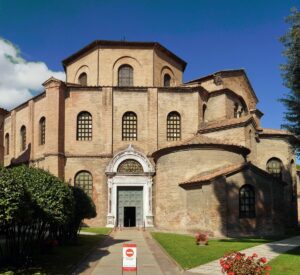
The Archiepiscopal Chapel (or Sant’Andrea) is a Paleochristian gem in the heart of Ravenna. Built in the 6th century by Bishop Peter II, it is the only example of an orthodox bishop’s chapel from the period of Theodoric. Its mosaics, with the warrior Christ and the Chi-Rho monogram, are an anti-Arian manifesto. Included in the cumulative UNESCO ticket. Extraordinary mosaics – Anti-Arian symbolism – Museum with Ivory Throne – Inclusive accessibility.
Introduction
Entering the Archbishop’s Chapel feels like stepping back into the 6th century. It is the only surviving Orthodox oratory from the time of Theodoric, a small jewel of mosaics that seem to shout a political and religious truth. Light filters in and colors shine: you feel enveloped by a mystical atmosphere, almost timeless. It is not just a monument, but an experience that leaves a mark.
Introduction
Entering the Archbishop’s Chapel feels like stepping back into the 6th century. It is the only surviving Orthodox oratory from the time of Theodoric, a small jewel of mosaics that seem to shout a political and religious truth. Light filters in and colors shine: you feel enveloped by a mystical atmosphere, almost timeless. It is not just a monument, but an experience that leaves a mark.
Historical Notes
Built between 494 and 519 by order of Bishop Pietro II, the chapel was the private oratory of Catholic bishops during a period dominated by the Arians. After the Byzantine conquest, it was dedicated to St. Andrew. Since 1996 it is a UNESCO World Heritage site. Here are the key moments:
Historical Notes
Built between 494 and 519 by order of Bishop Pietro II, the chapel was the private oratory of Catholic bishops during a period dominated by the Arians. After the Byzantine conquest, it was dedicated to St. Andrew. Since 1996 it is a UNESCO World Heritage site. Here are the key moments:
Mosaics That Speak
The mosaics are an anti-Arian manifesto. Above the entrance, Christ the Warrior tramples a lion and a serpent, symbols of evil. On the vault, four angels hold the monogram of Christ among pink clouds. The vestibule is a paradisiacal garden with birds (peacocks, doves) and the inscription “Aut lux hic nata est…”. Every detail exalts orthodox light against the Arian heresy.
Mosaics That Speak
The mosaics are an anti-Arian manifesto. Above the entrance, Christ the Warrior tramples a lion and a serpent, symbols of evil. On the vault, four angels hold the monogram of Christ among pink clouds. The vestibule is a paradisiacal garden with birds (peacocks, doves) and the inscription “Aut lux hic nata est…”. Every detail exalts orthodox light against the Arian heresy.
The Museum and the Throne of Maximian
The chapel is on the first floor of the Archbishop’s Museum, which houses treasures such as the Ivory Throne of Maximian: 27 finely carved panels depicting biblical scenes. Don’t miss the ambo, the porphyry statue, and the 6th-century Easter calendar. Each piece tells the story of Byzantine Ravenna.
The Museum and the Throne of Maximian
The chapel is on the first floor of the Archbishop’s Museum, which houses treasures such as the Ivory Throne of Maximian: 27 finely carved panels depicting biblical scenes. Don’t miss the ambo, the porphyry statue, and the 6th-century Easter calendar. Each piece tells the story of Byzantine Ravenna.
Why Visit It
First: it is unique – the only intact early Christian archiepiscopal chapel in the world. Second: the mosaics carry a powerful political message, instantly visible. Third: it is included in the cumulative ticket with the other 4 UNESCO monuments in Ravenna, so no extra cost. Tip: take time to read each scene, they are full of details.
Why Visit It
First: it is unique – the only intact early Christian archiepiscopal chapel in the world. Second: the mosaics carry a powerful political message, instantly visible. Third: it is included in the cumulative ticket with the other 4 UNESCO monuments in Ravenna, so no extra cost. Tip: take time to read each scene, they are full of details.
When to Go
The mosaics come alive with light. Go early in the morning or late in the afternoon, when oblique rays ignite the colors. Avoid midday hours if the museum is crowded. In autumn or winter, the light is softer and the atmosphere more intimate. But even in summer, if you arrive at opening time at 9, you’ll almost have the place to yourself.
When to Go
The mosaics come alive with light. Go early in the morning or late in the afternoon, when oblique rays ignite the colors. Avoid midday hours if the museum is crowded. In autumn or winter, the light is softer and the atmosphere more intimate. But even in summer, if you arrive at opening time at 9, you’ll almost have the place to yourself.
In the Vicinity
The chapel is in the heart of Ravenna. Just a few steps away you’ll find the Neonian Baptistery with its incredible mosaics, and the Mausoleum of Galla Placidia, where the starry sky leaves you breathless. Continue to the Basilica of San Vitale, the pinnacle of Byzantine mosaics. All can be visited on foot in a morning or afternoon.
In the Vicinity
The chapel is in the heart of Ravenna. Just a few steps away you’ll find the Neonian Baptistery with its incredible mosaics, and the Mausoleum of Galla Placidia, where the starry sky leaves you breathless. Continue to the Basilica of San Vitale, the pinnacle of Byzantine mosaics. All can be visited on foot in a morning or afternoon.