Basilica of San Petronio: World’s Longest Sundial and Renaissance Frescoes

The Basilica of San Petronio dominates Piazza Maggiore with its unfinished facade and houses unique masterpieces. Inside, you’ll find the world’s longest sundial, created in 1655, which still marks solar noon with astronomical precision. The basilica is a symbol of Bolognese pride where art, science, and devotion have blended for centuries.

  • Cassini’s 66.8-meter sundial, the longest in the world
  • Renaissance frescoes by Giovanni da Modena in the Bolognini Chapel
  • High altar with polychrome marbles and statue of San Petronio attributed to Michelangelo
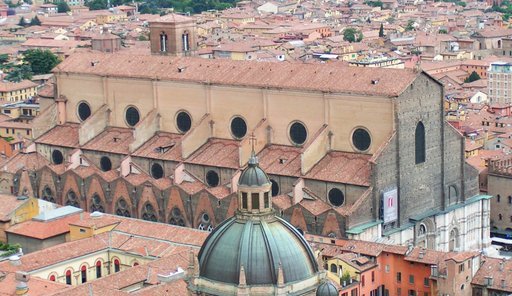
  • Panoramic views of red rooftops and the Two Towers from the terrace


Events nearby


Copertina itinerario Basilica of San Petronio: World's Longest Sundial and Renaissance Frescoes
Basilica of San Petronio in Bologna featuring Cassini’s 66.8-meter sundial, frescoes by Giovanni da Modena, polychrome marble high altar, and panoramic views from the terrace. Free admission.

Good to know


Introduction

As you arrive in Piazza Maggiore, the Basilica of San Petronio immediately captures your attention: its unfinished facade, with pink and white marble abruptly stopping, tells a story of ambition and reality. It’s Bologna’s largest church, designed to surpass St. Peter’s in Rome, but never completed. Stepping inside takes your breath away: the Gothic interior is majestic, with soaring naves and light filtering through the stained-glass windows. At the center of the nave, the world’s longest meridian line, created by Gian Domenico Cassini in 1655, still marks time with precision. It’s a place that unites spirituality, science, and art, a symbol of Bolognese pride. It’s not just a church, but the heart of the city, where history and daily life meet every day.

Historical Overview

The Basilica of San Petronio was founded in 1390 by the Municipality of Bologna, dedicated to the city’s patron saint. Antonio di Vincenzo’s original design envisioned a church larger than St. Peter’s, but construction was interrupted multiple times due to papal opposition and lack of funds. In 1514, Arduino degli Arriguzzi proposed a new Renaissance design that was never realized. Inside, masterpieces stand out such as the Merchants’ Altarpiece by Lorenzo Costa and the frescoes by Giovanni da Modena in the Bolognini Chapel, featuring a vivid depiction of the Last Judgment. The sundial, added in the 17th century, became a fundamental scientific instrument. Today, the basilica is a UNESCO site as part of Bologna’s porticoes, bearing witness to centuries of the city’s history.

  • 1390: Construction begins
  • 1514: Arduino degli Arriguzzi’s expansion project
  • 1655: Installation of Cassini’s sundial
  • 2021: Inclusion in UNESCO porticoes

Cassini’s Meridian Line

As you walk along the central nave, you can’t miss Cassini’s Meridian Line: a 66.8-meter-long brass strip crossing the floor, the longest in the world. Created by astronomer Gian Domenico Cassini in 1655, it was used to study the sun’s movements and define the Gregorian calendar. Even today, at solar noon, a beam of light passing through a hole in the vault hits the line, indicating the exact date. It’s a masterpiece of scientific precision in a religious setting, unique of its kind. Observing it helps you understand how Bologna was a hub of innovation, where faith and reason conversed. Visitors often pause to witness the phenomenon—a magical moment bridging past and present.

Hidden Artistic Masterpieces

Beyond the Gothic majesty, San Petronio houses lesser-known but extraordinary artistic treasures. In the Chapel of San Petronio, admire the high altar with Michelangelo’s statue of the saint, an early work that already reveals his genius. Then, in the Bolognini Chapel, Giovanni da Modena’s frescoes depict Hell with grotesque details, including Muhammad among the damned, a rare and debated iconography. Don’t overlook the monumental organ, one of the oldest in Italy, still functioning for concerts. These elements make the basilica a living art gallery, where every corner tells a story. It’s a place to explore leisurely, to discover those details that escape haste.

Why Visit It

Visit San Petronio for three concrete reasons. First, the world’s longest sundial is a unique experience: watching the light mark solar noon connects you with centuries of science. Second, the Renaissance frescoes, like those by Giovanni da Modena, are little-known masterpieces with great emotional impact. Third, admission is free, unlike many similar attractions, allowing you to enjoy art and history without spending. Plus, its location in Piazza Maggiore makes it easy to include in any Bolognese itinerary. It’s a must for those wanting to understand the city’s soul beyond the usual tourist spots.

When to Go

The best time to visit San Petronio is the early afternoon, when the morning crowds thin out and sunlight streams through the stained-glass windows, casting shadow plays across the soaring Gothic nave. In summer, avoid the hottest hours: the interior remains cool, but visitor numbers can peak. On weekdays, you’ll find more tranquility to admire the artistic details without the rush. If you want to see the meridian line in action, plan your visit around solar noon, but check the opening hours for any religious events. In autumn, the warm-hued light makes the atmosphere even more evocative.

In the Surroundings

After visiting San Petronio, explore the Bologna Porticoes, a UNESCO World Heritage site: they start right from the square and lead you through a labyrinth of historic arches, perfect for a leisurely stroll. Nearby, visit the Two Towers, Asinelli and Garisenda, symbols of the medieval city: climb the Asinelli Tower for a panoramic view over Bologna and the basilica from above. If you love art, the Civic Medieval Museum, just minutes away, completes the story with artifacts related to San Petronio. For a culinary experience, the nearby markets like Quadrilatero offer tastings of typical Emilian products, such as tortellini and mortadella, in an authentic atmosphere.

Itineraries nearby


💡 Did You Know…?

The basilica was meant to surpass St. Peter’s in grandeur, but the Pope halted construction fearing it would overshadow Rome. The meridian, 66.8 meters long, was created in 1655 to verify the Gregorian calendar reform. Observe Jacopo della Quercia’s portal: the Genesis stories are so realistic that Michelangelo studied them for the Sistine Chapel.