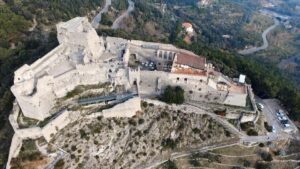
Casertavecchia is a charming medieval village perched on the Tifatini Mountains, 10 km from Caserta. Perfect for a day trip, it offers a dive into history among cobbled streets, breathtaking views, and authentic flavors. St. Michael’s Duomo (12th century) with its 32-meter bell tower offers spectacular views. The ruins of the Norman Castle and its 30-meter tower tell centuries of history. The Gothic Church of the Annunziata preserves original frescoes. And don’t forget to taste buffalo mozzarella, homemade pasta, and local wines in the village’s trattorias.
Introduction
Perched on Monte Virgo at 400 meters high, Casertavecchia is a medieval village that seems straight out of a fairy tale. Stone alleys, tuff houses, and small squares: time has stood still here. A stone’s throw from the magnificent Royal Palace of Caserta, this village offers an authentic atmosphere, with cobbled streets and views stretching to Vesuvius. The silence broken only by the sound of bells and the scent of freshly baked bread welcome anyone who wants to get lost in its medieval labyrinth.
Introduction
Perched on Monte Virgo at 400 meters high, Casertavecchia is a medieval village that seems straight out of a fairy tale. Stone alleys, tuff houses, and small squares: time has stood still here. A stone’s throw from the magnificent Royal Palace of Caserta, this village offers an authentic atmosphere, with cobbled streets and views stretching to Vesuvius. The silence broken only by the sound of bells and the scent of freshly baked bread welcome anyone who wants to get lost in its medieval labyrinth.
Historical Background
Of Lombard origin (8th century), Casertavecchia is mentioned in 816 as
Casa Hirta. It experienced its greatest splendor in the Norman period, when the Cathedral of San Michele (1113-1153) was built. From the 15th century, it lost importance in favor of the new Bourbon Caserta, eventually becoming a hamlet. In 1960 it was declared a National Monument. Here are the key moments:
- 8th century: Lombard foundation
- 1113-1153: construction of the Romanesque Duomo
- 1234: erection of the Gothic bell tower
- 15th century: decline under the Aragonese
- 1960: declared a National Monument
Historical Background
Of Lombard origin (8th century), Casertavecchia is mentioned in 816 as
Casa Hirta. It experienced its greatest splendor in the Norman period, when the Cathedral of San Michele (1113-1153) was built. From the 15th century, it lost importance in favor of the new Bourbon Caserta, eventually becoming a hamlet. In 1960 it was declared a National Monument. Here are the key moments:
- 8th century: Lombard foundation
- 1113-1153: construction of the Romanesque Duomo
- 1234: erection of the Gothic bell tower
- 15th century: decline under the Aragonese
- 1960: declared a National Monument
The Cathedral and the Bell Tower
The heart of the village is Piazza Vescovado, dominated by the Cathedral of San Michele Arcangelo, a Romanesque masterpiece with Arab-Norman influences. The tuff facade features three marble portals with zoomorphic sculptures; inside, three naves on Roman columns and a mosaic floor from 1213. Next to it stands the Gothic bell tower (1234), 32 meters high, with decorated mullioned windows. The main road passes under its arch. The octagonal tiburium with Arabesque mosaics is another gem not to be missed.
The Cathedral and the Bell Tower
The heart of the village is Piazza Vescovado, dominated by the Cathedral of San Michele Arcangelo, a Romanesque masterpiece with Arab-Norman influences. The tuff facade features three marble portals with zoomorphic sculptures; inside, three naves on Roman columns and a mosaic floor from 1213. Next to it stands the Gothic bell tower (1234), 32 meters high, with decorated mullioned windows. The main road passes under its arch. The octagonal tiburium with Arabesque mosaics is another gem not to be missed.
Local Cuisine and Flavors
The cuisine of Casertavecchia is a dive into Campanian tradition. Mozzarella di bufala DOP, pappardelle with wild boar ragù, gnocchi alla sorrentina, and grilled black pig are just some of the dishes you’ll find in the village’s taverns. Don’t miss the typical desserts: babà, sfogliatelle, and pastiera. Local wines such as Falerno del Massico, Aglianico, and Pallagrello accompany every meal. The family atmosphere of the trattorias makes the experience even more authentic.
Local Cuisine and Flavors
The cuisine of Casertavecchia is a dive into Campanian tradition. Mozzarella di bufala DOP, pappardelle with wild boar ragù, gnocchi alla sorrentina, and grilled black pig are just some of the dishes you’ll find in the village’s taverns. Don’t miss the typical desserts: babà, sfogliatelle, and pastiera. Local wines such as Falerno del Massico, Aglianico, and Pallagrello accompany every meal. The family atmosphere of the trattorias makes the experience even more authentic.
Why Visit It
Why Casertavecchia is a medieval jewel just a stone’s throw from the Royal Palace, but completely different: here there is no crowd, only peace and history. You can climb the Torre dei Falchi (30 meters, second highest in Europe) for a breathtaking view of the Campania plain. Moreover, the alleys are decorated with recycled objects and the spiritelli (terracotta goblins) make the walk unique. A perfect place for a day trip that combines culture, food and wine, and relaxation.
Why Visit It
Why Casertavecchia is a medieval jewel just a stone’s throw from the Royal Palace, but completely different: here there is no crowd, only peace and history. You can climb the Torre dei Falchi (30 meters, second highest in Europe) for a breathtaking view of the Campania plain. Moreover, the alleys are decorated with recycled objects and the spiritelli (terracotta goblins) make the walk unique. A perfect place for a day trip that combines culture, food and wine, and relaxation.
When to Go
The best time is spring, from April to June, when the weather is mild and the village is full of flowers. Autumn (September–October) is also ideal: temperatures are pleasant and events like Settembre al Borgo and the Feast of San Michele (September 29) take place, with processions, fireworks, and food stalls. Avoid August instead, when the heat can be intense and the village more crowded.
When to Go
The best time is spring, from April to June, when the weather is mild and the village is full of flowers. Autumn (September–October) is also ideal: temperatures are pleasant and events like Settembre al Borgo and the Feast of San Michele (September 29) take place, with processions, fireworks, and food stalls. Avoid August instead, when the heat can be intense and the village more crowded.
Nearby
Just a few kilometers away lies the Royal Palace of Caserta, a UNESCO World Heritage site with its English-style gardens and royal park. Also not to be missed is San Leucio, the ancient silk village with its museum and gardens. For nature lovers, the trails of the Tifatini Mountains offer panoramic walks. A perfect itinerary for a weekend of history, art, and Campanian flavors.
Nearby
Just a few kilometers away lies the Royal Palace of Caserta, a UNESCO World Heritage site with its English-style gardens and royal park. Also not to be missed is San Leucio, the ancient silk village with its museum and gardens. For nature lovers, the trails of the Tifatini Mountains offer panoramic walks. A perfect itinerary for a weekend of history, art, and Campanian flavors.