Castello D’Alessandro: Medieval Fortress with Cylindrical Towers and Perfect Inner Courtyard

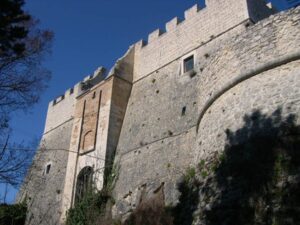
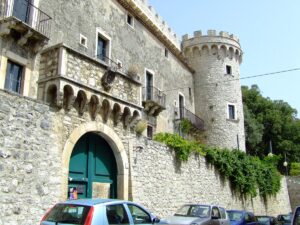
Castello D’Alessandro overlooks Pescolanciano at 800 meters above sea level, offering breathtaking views of the Mainarde mountains and the Volturno valley. Built in the 13th century and renovated in the 16th century, it retains its original structure with cylindrical towers and a paved inner courtyard. The noble halls are still furnished with period furniture, while the patrol walkways provide panoramic views stretching from Abruzzo to Campania.

  • Perfectly preserved medieval cylindrical towers
  • Paved inner courtyard with furnished noble halls
  • Patrol walkways with panoramic views across two regions
  • 13th-century structure renovated in the 16th century

Copertina itinerario Castello D'Alessandro: Medieval Fortress with Cylindrical Towers and Perfect Inner Courtyard
Castello D’Alessandro in Pescolanciano: 13th-century manor with cylindrical towers, paved courtyard, furnished noble halls, and patrol walkways. Panoramic view of the Mainarde mountains and Volturno valley.

Good to know


Introduction

Arriving at the Castello D’Alessandro in Pescolanciano is like stepping back into Molise’s medieval era. This fortress dominates the village from above, with its massive towers silhouetted against the sky. The sight of the perfectly preserved inner courtyard, with its central well and stone arches, immediately strikes you. It’s not just a monument, but a place that breathes history, where every stone tells centuries of life. The atmosphere is authentic, far from mass tourist flows, and gives you the thrill of discovering a still-genuine corner of Italy. If you love castles that seem straight out of a story, this is the right place.

Historical Overview

The Castello D’Alessandro has origins dating back to the 12th century, when it was built as a defensive fortress. The D’Alessandro family, from whom it takes its name, transformed it into a noble residence between the 15th and 16th centuries. In the 18th century, it underwent architectural modifications that enriched its interiors while preserving the medieval structure. During the unification of Italy, the castle was involved in brigandage events, with stories of sieges and resistance. Today, after careful restorations, it is open to visitors and represents one of the historical symbols of Molise.

  • 12th century: construction as a fortress
  • 15th-16th century: transformation into the D’Alessandro residence
  • 18th century: architectural renovations
  • 19th century: episodes related to brigandage
  • Today: restorations and opening to the public

The Towers and Walls

The castle towers are the most iconic feature: the main one, tall and square-shaped, offers a panoramic view over the Trigno Valley. Walking along the ramparts makes you feel like a medieval guardian, with the thick walls that have withstood centuries of weathering. You’ll notice the narrow arrow slits, designed for archers, and the merlons crowning the structure. Inside, the stone staircases lead you through rooms with barrel vaults, where the echo of footsteps seems to reverberate with past stories. It’s a tactile experience: touching these stones means connecting with a distant era.

The Courtyard and Interiors

The inner courtyard is the heart of the castle, a perfect square surrounded by arcades made of local stone. At its center, the ancient well, still functional, adds a touch of daily life from times gone by. Entering the halls, you’ll discover monumental fireplaces, period furniture, and faded frescoes depicting scenes of hunting and courtly life. A particular room is the ‘armory hall’, with a collection of swords and armor that evoke medieval battles. The atmosphere is intimate, almost domestic, thanks to the care with which the spaces have been preserved. It’s not a cold museum, but a home that has retained its soul.

Why Visit It

Visit Castello D’Alessandro for three concrete reasons. First, it’s one of the few Molisan castles still intact in its original structures, without fanciful reconstructions. Second, access is easy and doesn’t require complicated bookings: you can arrive and immerse yourself in history. Third, details like the stone carvings or heraldic coats of arms offer continuous discoveries, ideal for memorable photos. It’s a place that combines authenticity and practicality, perfect for a stress-free outing.

When to Go

The best time to visit the castle is in the early morning hours, when the low-angled light enhances the stone textures and creates evocative shadows in the courtyard. In autumn, the colors of the leaves around the walls add magic, but avoid days with heavy rain because some areas are outdoors. In summer, the coolness of the interior rooms offers a refreshing break. The ideal is to choose a clear day to fully enjoy the views.

In the Surroundings

After visiting the castle, explore the hamlet of Pescolanciano, with its cobblestone alleys and stone houses that seem suspended in time. Not far away, the Sanctuary of Santa Maria di Monteverde, nestled in the greenery, offers a spiritual stop with medieval frescoes. Both locations perfectly complement your visit, enriching it with history and tranquility.

Itineraries nearby


💡 Did You Know…?

Legend has it that the castle is haunted by the ghost of a white lady who appears on full moon nights, while a local tradition tells of a secret passage that would connect the manor to the town’s main church, used by feudal lords to escape sieges. Locals pass down stories of hidden treasures in the cellars, never found, which fuel the mysterious charm of this place.