The Roselle Archaeological Area, just 10 km from Grosseto, is one of the most fascinating sites in the Maremma, where Etruscan, Roman, and medieval layers coexist in a landscape to explore on foot. With an entrance fee of only €4, you can walk among imposing polygonal walls, the travertine-paved forum, the Domus of the Mosaics, and a well-preserved amphitheater.
• Etruscan walls: about 3 km long with heights up to 5 meters, walkable for long stretches.
• Roman forum: heart of the city with basilicas, temples, and seat of the priests of the imperial cult.
• Domus of the Mosaics: noble residence with mosaic floors and polychrome marbles, private baths, and peristyle.
• Elliptical amphitheater: from the 1st century AD, with four entrances and central arena, reused in medieval times.
Introduction
A short walk from Grosseto, the Roselle Archaeological Area is a dive into Etruscan-Roman history. Climb the hill and you’ll find cyclopean walls up to 5 meters high, an intact amphitheater, and the remains of a city that once overlooked the ancient Lake Prile. Walking among the ruins, with the Maremma wind caressing you, is thrilling. It’s not a cold museum: here you can touch the life of two thousand years ago. I recommend arriving early in the morning, when the low light illuminates the mosaics of the Domus and the grass smells of wild herbs.
Introduction
A short walk from Grosseto, the Roselle Archaeological Area is a dive into Etruscan-Roman history. Climb the hill and you’ll find cyclopean walls up to 5 meters high, an intact amphitheater, and the remains of a city that once overlooked the ancient Lake Prile. Walking among the ruins, with the Maremma wind caressing you, is thrilling. It’s not a cold museum: here you can touch the life of two thousand years ago. I recommend arriving early in the morning, when the low light illuminates the mosaics of the Domus and the grass smells of wild herbs.
Historical Background
Roselle was inhabited organically from the 7th century BC by the Etruscans, who built a wall circuit over 3 km in the 6th century. In 294 BC the Roman consul Lucius Postumius Megellus conquered it (as told by Livy). In the imperial age, an amphitheater, forum, and baths were built. From the 5th century it became a bishopric seat, but in 1138 Pope Innocent II transferred the diocese to Grosseto, and the city was abandoned. Modern excavations, begun in the 1950s, have brought everything to light.
Historical Background
Roselle was inhabited organically from the 7th century BC by the Etruscans, who built a wall circuit over 3 km in the 6th century. In 294 BC the Roman consul Lucius Postumius Megellus conquered it (as told by Livy). In the imperial age, an amphitheater, forum, and baths were built. From the 5th century it became a bishopric seat, but in 1138 Pope Innocent II transferred the diocese to Grosseto, and the city was abandoned. Modern excavations, begun in the 1950s, have brought everything to light.
Forum and Domus of the Mosaics
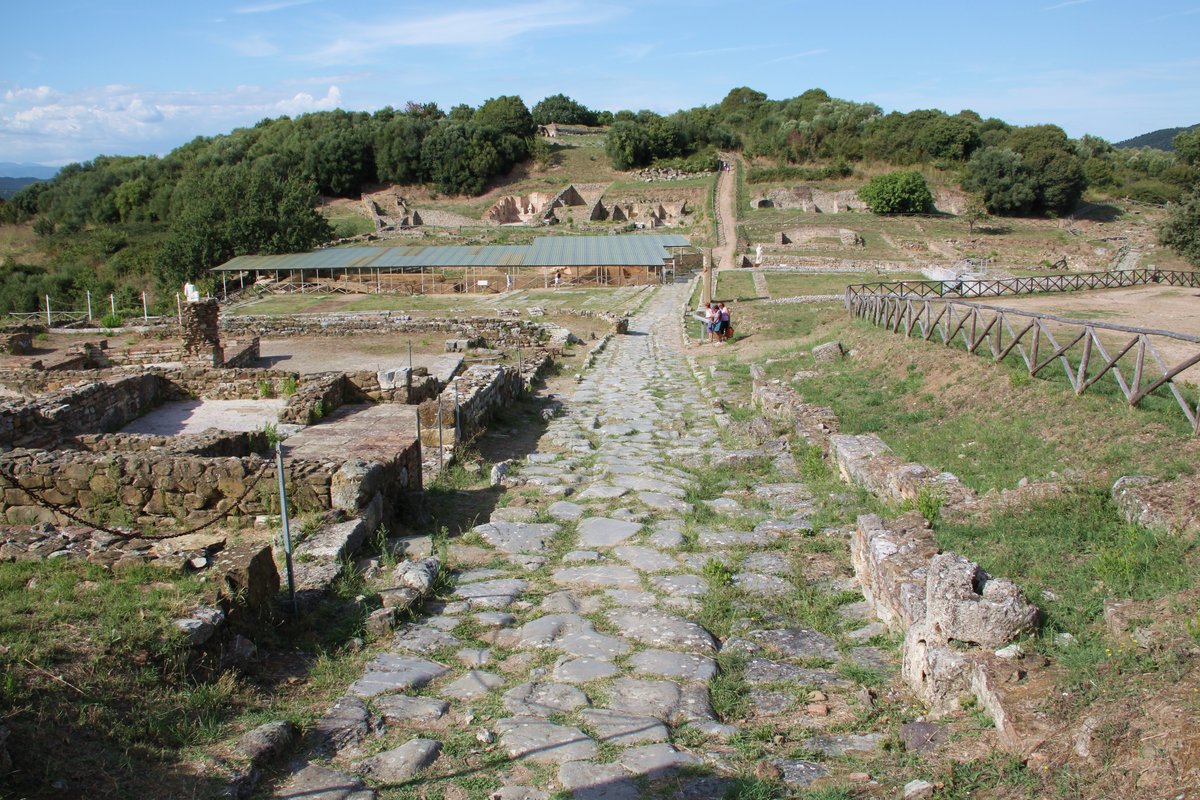
The Forum is the heart of the Roman city, paved in travertine in the 1st century AD. Beneath the paving emerge Etruscan layers: a ‘building with enclosure‘ from the 7th century BC, perhaps a place of worship. On the eastern side runs the Cardo Maximus, with cart ruts still visible. Not far away, the Domus of the Mosaics leaves you speechless: a patrician residence with courtyard, private baths, and polychrome mosaic floors and opus sectile. A true luxury home of antiquity.
Forum and Domus of the Mosaics
The Forum is the heart of the Roman city, paved in travertine in the 1st century AD. Beneath the paving emerge Etruscan layers: a ‘building with enclosure‘ from the 7th century BC, perhaps a place of worship. On the eastern side runs the Cardo Maximus, with cart ruts still visible. Not far away, the Domus of the Mosaics leaves you speechless: a patrician residence with courtyard, private baths, and polychrome mosaic floors and opus sectile. A true luxury home of antiquity.
Amphitheater and Cyclopean Walls
On the northern hill stands the elliptical amphitheater from the 1st century AD, with four entrances and tiered seating that could accommodate spectators. It was later reused as a medieval fortress. But what strikes most are the Etruscan walls: dry-laid polygonal blocks, up to 5 meters high, that stretch for kilometers. Walking along them is like traveling through time. In some spots, the view opens over the Maremma countryside, making it clear why they chose this strategic position.
Amphitheater and Cyclopean Walls
On the northern hill stands the elliptical amphitheater from the 1st century AD, with four entrances and tiered seating that could accommodate spectators. It was later reused as a medieval fortress. But what strikes most are the Etruscan walls: dry-laid polygonal blocks, up to 5 meters high, that stretch for kilometers. Walking along them is like traveling through time. In some spots, the view opens over the Maremma countryside, making it clear why they chose this strategic position.
Why Visit It
Roselle is not just a pile of stones: it’s a living site, never crowded, and with a cheap ticket (€4). First reason: the mosaics of the Domus are among the best preserved in Tuscany. Second: the amphitheater is almost always empty—you can sit and imagine the gladiators. Third: with the same ticket, you get a discount for the Grosseto Archaeological Museum, where the finest artifacts (statues, pottery) are kept. Only downside: the summer sun is intense, but the shade of the walls helps.
Why Visit It
Roselle is not just a pile of stones: it’s a living site, never crowded, and with a cheap ticket (€4). First reason: the mosaics of the Domus are among the best preserved in Tuscany. Second: the amphitheater is almost always empty—you can sit and imagine the gladiators. Third: with the same ticket, you get a discount for the Grosseto Archaeological Museum, where the finest artifacts (statues, pottery) are kept. Only downside: the summer sun is intense, but the shade of the walls helps.
When to Go
The site is outdoors and almost completely unsheltered. The best time? Spring or autumn, when temperatures are mild and the golden light caresses the ruins. If you come in summer, arrive at opening time (8:15) or late afternoon, when the sun goes down and shadows lengthen. Avoid the middle hours: the heat can be intense. Always bring water and a hat. In winter, on the other hand, the site is quieter and the clear sky offers crisp views of the Maremma.
When to Go
The site is outdoors and almost completely unsheltered. The best time? Spring or autumn, when temperatures are mild and the golden light caresses the ruins. If you come in summer, arrive at opening time (8:15) or late afternoon, when the sun goes down and shadows lengthen. Avoid the middle hours: the heat can be intense. Always bring water and a hat. In winter, on the other hand, the site is quieter and the clear sky offers crisp views of the Maremma.
In the Surroundings
After your visit, don’t miss the Museo Archeologico e d’Arte della Maremma in Grosseto: with the same Roselle ticket you get a discount. Here you’ll find the statues of the Flamines Augustales and Etruscan grave goods. If you have time, stop by the historic center of Grosseto with its Medici walls and the Cathedral of San Lorenzo. Alternatively, a few kilometers away is Vetulonia, another Etruscan city with spectacular tumulus tombs.
In the Surroundings
After your visit, don’t miss the Museo Archeologico e d’Arte della Maremma in Grosseto: with the same Roselle ticket you get a discount. Here you’ll find the statues of the Flamines Augustales and Etruscan grave goods. If you have time, stop by the historic center of Grosseto with its Medici walls and the Cathedral of San Lorenzo. Alternatively, a few kilometers away is Vetulonia, another Etruscan city with spectacular tumulus tombs.