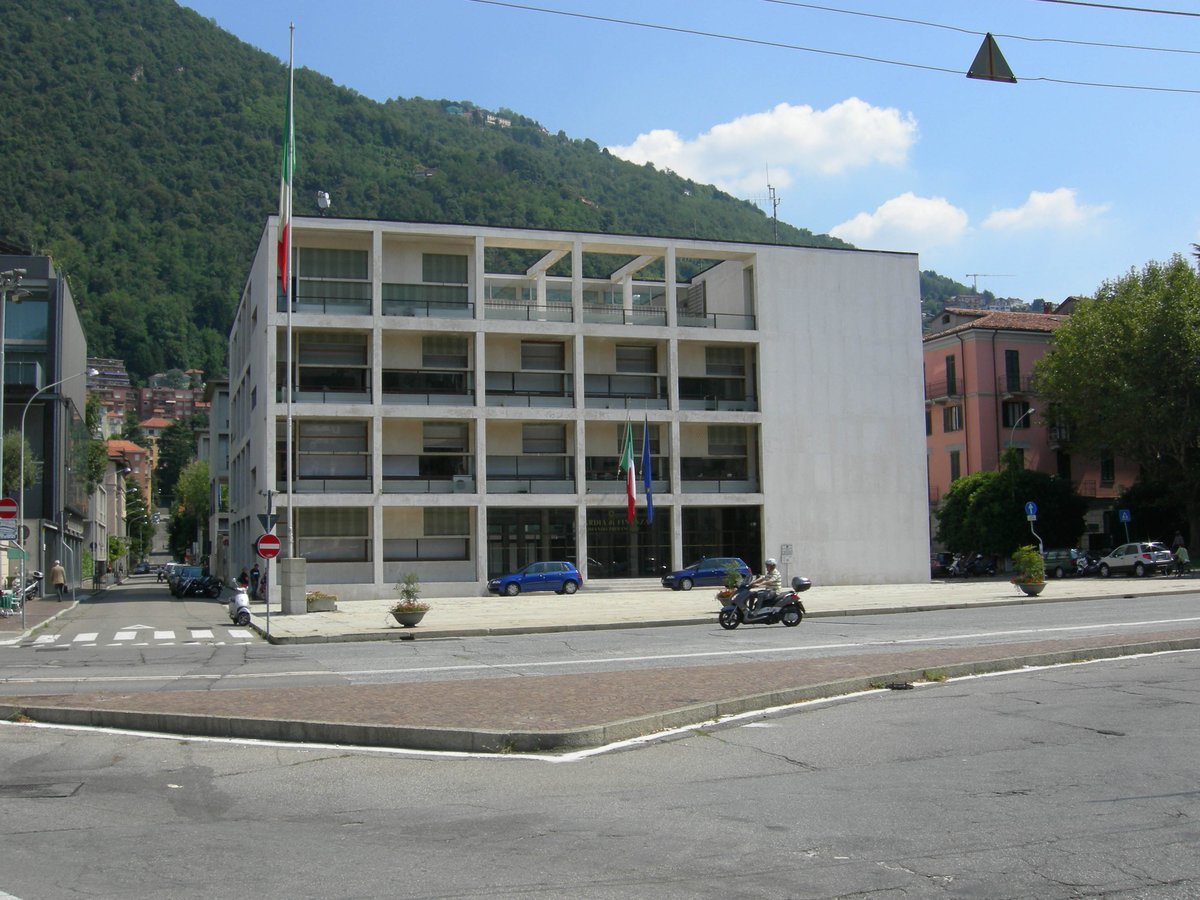
The former Casa del Fascio in Como is an icon of Rationalist architecture, designed by Giuseppe Terragni and completed in 1936. Today, after serving as the headquarters of the Guardia di Finanza, it has been transformed into a museum of Italian Rationalism, telling the story of a building that left its mark on the city. The visit allows you to admire the original atrium, the sacrarium, and the famous facade in Botticino marble, a perfect balance of solids and voids.
Highlights:
– Rationalist architecture: pure geometry and the golden ratio in every detail.
– White marble facade: four different elevations that play with light.
– Museum of Rationalism: opened in 2022, showcasing the evolution of the modern movement.
– View of the square: the building overlooks Piazza del Popolo, the heart of the city.
Introduction: Geometry and Light
You are standing before an almost perfect cube: 33 meters per side, 16.60 meters high, clad in white Botticino marble. The former Casa del Fascio of Como is no ordinary monument: it is one of the finest examples of Italian rationalism, designed by Giuseppe Terragni. Each facade is different, a play of solids and voids that changes with the daylight. You can almost breathe the air of Modernism, among essential geometries and glass blocks. It is a place that speaks of an era, but also of how architecture can be poetry.
Introduction: Geometry and Light
You are standing before an almost perfect cube: 33 meters per side, 16.60 meters high, clad in white Botticino marble. The former Casa del Fascio of Como is no ordinary monument: it is one of the finest examples of Italian rationalism, designed by Giuseppe Terragni. Each facade is different, a play of solids and voids that changes with the daylight. You can almost breathe the air of Modernism, among essential geometries and glass blocks. It is a place that speaks of an era, but also of how architecture can be poetry.
Historical Notes
The building was constructed between 1933 and 1936 as the headquarters of the Fascist Party. After the war, it passed to the CLN and then, from 1957, to the Guardia di Finanza. In 2022 it became the
National Museum of Italian Rationalism, although a large part is still occupied by military offices. The story is one of controversy: attempts at demolition, auctions, restorations. Today it is a symbol of Como.
- 1933-36: construction based on a design by Giuseppe Terragni
- 1945: occupied by the CLN
- 1957: assigned to the Guardia di Finanza
- 1986: listed as a monument
- 2022: inaugurated as a museum of rationalism
Historical Notes
The building was constructed between 1933 and 1936 as the headquarters of the Fascist Party. After the war, it passed to the CLN and then, from 1957, to the Guardia di Finanza. In 2022 it became the
National Museum of Italian Rationalism, although a large part is still occupied by military offices. The story is one of controversy: attempts at demolition, auctions, restorations. Today it is a symbol of Como.
- 1933-36: construction based on a design by Giuseppe Terragni
- 1945: occupied by the CLN
- 1957: assigned to the Guardia di Finanza
- 1986: listed as a monument
- 2022: inaugurated as a museum of rationalism
The Facades: An Architecture in Progress
The four facades are all different, yet united by mathematical rigor. The main one, on Piazza del Popolo, is dominated by a five-bay loggia that hollows out the volume. The others alternate L-shaped windows, vertical glazing, and glass-block walls. The effect is a continuous transparency, as if the building breathes with the square. The materials? White marble for the opaque parts, glass blocks for the transparent ones. A perfect balance between solids and voids, light and shadow.
The Facades: An Architecture in Progress
The four facades are all different, yet united by mathematical rigor. The main one, on Piazza del Popolo, is dominated by a five-bay loggia that hollows out the volume. The others alternate L-shaped windows, vertical glazing, and glass-block walls. The effect is a continuous transparency, as if the building breathes with the square. The materials? White marble for the opaque parts, glass blocks for the transparent ones. A perfect balance between solids and voids, light and shadow.
Interiors: The Atrium and the Assembly Hall
Upon entering, the atrium welcomes you with a black marble ceiling from Belgium. From here you access the shrine, today dedicated to the fallen of the Guardia di Finanza. The true gem is the Assembly Hall: a double-height space lit from above by a glass-cement roof. The walls, once green-blue, housed panels by Mario Radice and the image of the Duce on glass – now disappeared. The main marble staircase is the centerpiece: from it depart the galleries connecting the offices.
Interiors: The Atrium and the Assembly Hall
Upon entering, the atrium welcomes you with a black marble ceiling from Belgium. From here you access the shrine, today dedicated to the fallen of the Guardia di Finanza. The true gem is the Assembly Hall: a double-height space lit from above by a glass-cement roof. The walls, once green-blue, housed panels by Mario Radice and the image of the Duce on glass – now disappeared. The main marble staircase is the centerpiece: from it depart the galleries connecting the offices.
Why visit it
First, it’s a masterpiece of rationalism, one of the most photographed in the world. Second, visiting the atrium is free and gives you the essence of Terragni’s design. Third, it’s right in the city center, a stone’s throw from the Duomo and the lake. No reservation needed, but keep an eye on special events – sometimes the hall opens for temporary exhibitions. A unique opportunity to see a piece of architectural history.
Why visit it
First, it’s a masterpiece of rationalism, one of the most photographed in the world. Second, visiting the atrium is free and gives you the essence of Terragni’s design. Third, it’s right in the city center, a stone’s throw from the Duomo and the lake. No reservation needed, but keep an eye on special events – sometimes the hall opens for temporary exhibitions. A unique opportunity to see a piece of architectural history.
When to Go
The best time? Late afternoon, when the low sun illuminates the main façade and the loggia casts sharp shadows. In spring or autumn, the light is softer. Avoid the midday hours in summer, they are too harsh. If you are lucky, you might catch the evening artistic lighting, which enhances the contrasts between marble and glass. However, even early in the morning, with the piazza still quiet, the effect is remarkable.
When to Go
The best time? Late afternoon, when the low sun illuminates the main façade and the loggia casts sharp shadows. In spring or autumn, the light is softer. Avoid the midday hours in summer, they are too harsh. If you are lucky, you might catch the evening artistic lighting, which enhances the contrasts between marble and glass. However, even early in the morning, with the piazza still quiet, the effect is remarkable.
Nearby
The former Casa del Fascio is in Piazza del Popolo, just steps from the Como Cathedral (another Gothic-Romanesque masterpiece) and the Teatro Sociale, an elegant neoclassical building. If you have time, walk to the lakeside promenade: from there, the view of the mountains is spectacular. For architecture enthusiasts, Terragni’s Asilo Sant’Elia is nearby (unfortunately closed for renovations).
Nearby
The former Casa del Fascio is in Piazza del Popolo, just steps from the Como Cathedral (another Gothic-Romanesque masterpiece) and the Teatro Sociale, an elegant neoclassical building. If you have time, walk to the lakeside promenade: from there, the view of the mountains is spectacular. For architecture enthusiasts, Terragni’s Asilo Sant’Elia is nearby (unfortunately closed for renovations).