In Cabras, on the Sinis Peninsula, the archaeological site of Mont’e Prama is an essential stop for anyone wanting to immerse themselves in the mysterious Nuragic civilization. Here, in 1974, the imposing statues of the Giants were discovered, unique in the Mediterranean for their era and craftsmanship. Today, after careful restoration, you can admire them at the Giovanni Marongiu Civic Museum, while the archaeological area is set to become a large public park.
Chance discovery in 1974 during agricultural work, with over 5,000 fragments recovered from decades of excavations.
Monumental statues up to 2.5 meters tall: boxers, archers, and warriors with stylized details and concentric circle eyes.
Unique necropolis with over 100 lined pit tombs, dated between the 10th and 8th centuries BC.
Museum and visits: the Cabras museum displays 44 statues; the site is visitable by reservation for groups.
Introduction
If you think Sardinia is only about the sea, you’re wrong. In Cabras, on the Sinis Peninsula, there is a place that takes you back nearly three thousand years. The archaeological site of Mont’e Prama is a unique necropolis: not a giants’ tomb, but a long row of pit tombs, aligned like domino tiles. Here, in 1974, a farmer was plowing a field and unearthed the first fragments of the statues now known as the Giants of Mont’e Prama. These are limestone sculptures up to 2.5 meters tall, with concentric circle eyes and boxing gloves. Nothing like this exists in the Mediterranean. Walking among the pits and imagining the statues watching over the dead is a breathtaking experience.
Historical Notes
The necropolis of Mont’e Prama was used between the end of the Bronze Age and the early Iron Age (10th-8th centuries BC). According to scholars, the statues represent warriors, archers, and boxers of a Nuragic elite. After its chance discovery in 1974, excavation campaigns from 1975-1979 (directed by Bedini and Tronchetti) recovered over 5000 fragments. A colossal restoration between 2007 and 2011 allowed many statues to be reconstructed. New excavations in 2014-2016 brought to light another 3000 fragments and nearly intact statues. In 2025-2026, after a process begun in 2019, the Municipality of Cabras acquired the 11-hectare site, with the aim of creating a large archaeological park. Since April 2026, all statues are on display at the Giovanni Marongiu Civic Museum in Cabras.
The Giants: Warriors, Archers, and Boxers
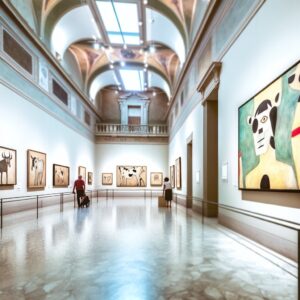
The statues are the only example of Nuragic stone statuary. They depict three types of figures: the boxers (at least 16), with a rectangular shield above their heads and a reinforced fist; the archers (6), with crested helmets and bows; and the warriors with round shields (6). Each statue is about 2 meters tall, with stylized faces: concentric circle eyes, pillar-like noses, and incised mouths. Some have long braids. Alongside the human figures, Nuraghe models and betyls were found. The boxers, with their rigid posture and protective shields, resemble ritual athletes. The ensemble suggests a hierarchical society that celebrated its heroes with a unique monumental language. At the Cabras Museum, you can see them in 360 degrees with 3D reconstructions.
The Necropolis and Archaeological Park
The necropolis of Mont’e Prama is unique in Sardinia: not a giant’s tomb, but over 100 pit graves dug vertically, aligned in parallel rows and covered with sandstone slabs. The deceased, almost all young or adult males, were buried in a crouched position. A paved funerary path runs parallel to the graves, possibly used for processions. The site also includes Nuragic buildings and a long straight wall that defined a monumental enclosure. Today, after public acquisition, work is underway to create an archaeological park with perimeter fencing, visitor spaces, and drainage interventions. The area lies along the road from San Salvatore to Riola Sardo, overlooking the Cabras lagoon. Visits to the site are possible by reservation for groups.
Why Visit
If you love archaeology and ancient stories, Mont’e Prama is a must-see. First: it’s the only place where you can get up close to the Giants, the most impressive Nuragic statues in the Mediterranean. At the Cabras Museum, you can admire them in all their glory, with details like gauntlets and decorated shields. Second: the archaeological site is still evolving—excavations continue and bring new discoveries every year. Third: the location is spectacular, between the Cabras lagoon and the Sinis peninsula, a landscape that helps you understand why the Nuragic people chose this sacred site. You don’t need to be an expert: the visit is suitable for everyone, thanks to guided tours and multimedia stations.
When to Go
The best time? Spring, when temperatures are mild and the morning light illuminates the statues in the museum with a magical aura. Autumn is also excellent, thanks to the calm after the summer season. If you arrive early in the morning, you’ll find fewer visitors and can enjoy the silence of the necropolis. Summer is hot, but the site is outdoors and the museum is air-conditioned. Avoid weekends if you can: groups increase. Personally, I loved the atmosphere of a Tuesday in May, with the sun filtering through the dwarf palms. Always check the updated hours on the official website, as the archaeological site opens only by reservation.
In the Surroundings
Just a few kilometers away, immerse yourself in other eras. Tharros, on the Sinis peninsula, is a fascinating Punic-Roman city with remains of baths, streets, and temples overlooking the sea. A short distance away, visit the Giovanni Marongiu Civic Museum (if you haven’t already) to delve into the area’s history: artifacts from the Neolithic, the Giants, and the cargo of the Roman wreck of Mal di Ventre. For a break, head to the Cabras lagoon: pink flamingos and unforgettable sunsets. If you have time, explore the Nuragic village of Sa Osa, with unique paleobotanical remains. Every site is a short drive away and connects perfectly to a visit to Mont’e Prama.