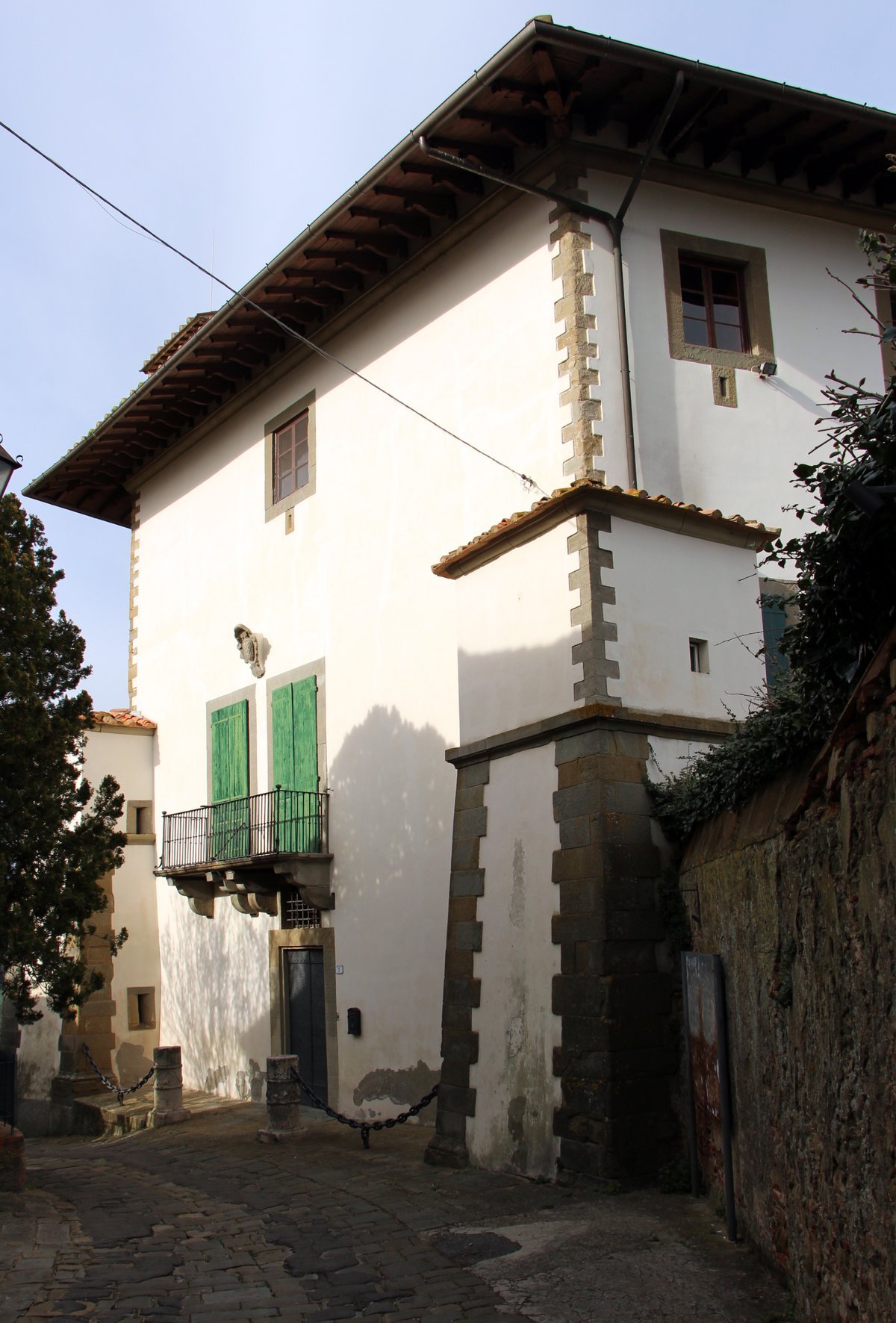
Located on the hill of Montevettolini, the Medici Villa is an imposing fortress built by Ferdinando I de’ Medici at the end of the 16th century. Now owned by the Borghese family, it can be visited by appointment and offers a glimpse into Tuscan history. – Fortress architecture: polygonal plan, watchtowers, loopholes, and white plaster. – Medici history: commissioned by Ferdinando I, designed by Gherardo Mechini. – Agricultural role: administrative center of the Barco Reale estate. – Visits by appointment: the villa opens for events and FAI days.
Evocative Introduction
Perched on the hill of Montevettolini, the Villa Medicea looks more like a fortress than a pleasure residence. White plaster and grey stone, corner turrets and narrow windows: you expect a soldier to pop out at any moment. Instead, this is where Ferdinando I came to hunt in the Barco Reale, the vast grand-ducal reserve. Today it belongs to the Borghese princes, who keep it in perfect condition. It can only be visited by appointment, perhaps during FAI days or special events. As you ascend, you feel like you’re stepping back four centuries. The view stretches over the Valdinievole: olive groves, vineyards, and in the distance the Padule di Fucecchio. A place that exudes power and nature.
Historical Background
The villa was commissioned by Ferdinando I de’ Medici after 1595 as a hunting residence and agricultural administrative center. The project was by Gherardo Mechini, a pupil of Buontalenti. It incorporated the fortress and a tower of the medieval walls, giving it an austere appearance. In 1650, Ferdinando II sold it to the Bartolomei family; in 1871, it passed to the Borghese family, the current owners. Over time, it underwent restorations that preserved its original appearance, such as those ordered by Marcantonio Borghese. Here are the key moments:
- 1595-1600: construction for Ferdinando I
- 1650: sale to the Bartolomei
- 1871: purchase by the Borghese
- Today: private property, visitable by appointment
Fortress Architecture
As soon as you see it, you realize it’s not an ordinary villa. Polygonal layout, compact volume, four corner turrets with loopholes: it looks like a small fortress. But everything is calculated: Ferdinando I wanted a center of power that dominated the landscape. The windows on the piano nobile are regular, with pietra serena frames. Inside, the grand hall occupies almost the entire first floor. On the left, the incorporated tower raises the building by one floor. Beneath the eaves, watchtowers and small windows alternate, as if to avoid being caught off guard. A mix of elegance and defense, typical of the late 1500s.
Administration and Hunting: The Medici Farm
It was not just a leisure villa. Here the grand ducal estates of the Valdinievole were administered, including the lands of the Padule di Fucecchio. The nearby Medici Farm was the productive heart: land reclamation, farmsteads, farmhouses. Today, after a restoration by the Borghese family, the farm is a high-level conference and catering center, but it still bears the Medici coat of arms. The villa and the farm are two sides of the same coin: power, hunting, and agriculture. Visiting them means understanding how a large-scale economic system worked, with the grand duke at its center.
Why Visit
Three reasons: first, the architecture is unique: you don’t see a Medici fortress-villa so well preserved every day. Second, the history: here hunting, administration, and grand ducal power intersect. Third, the setting: the Montevettolini hill is a corner of authentic Tuscany, among olive groves and vineyards, far from mass tourism. Plus, if you are a Medici family enthusiast, it’s a must-see. And if you catch a FAI day or an ADSI event, you can enter and have the guide tell you anecdotes.
When to Visit
The best time? Late spring or early autumn. The weather is mild, the landscape green and golden. If you come in summer, try to avoid the weekend: Montevettolini can get crowded with tourists also visiting the Pieve di San Michele. But the villa is almost always empty, given the limited access. Tip: book early in the morning, so you can enjoy the low light on the hills. In autumn, the surrounding vineyards turn red, and the atmosphere is even more evocative.
In the Area
Two stops: the Pieve di San Michele Arcangelo, right nearby, with its Romanesque lines and bell gable. Then, down in Monsummano Terme, the Grotte Giusti (or other thermal baths) for a dip in the thermal waters. If you feel like walking, the Barco Reale is a protected natural area, ideal for hikes or bike rides through woods and wildlife. A tip: stop for lunch at one of the area’s educational farms, where you can taste local products like Montalbano oil.