
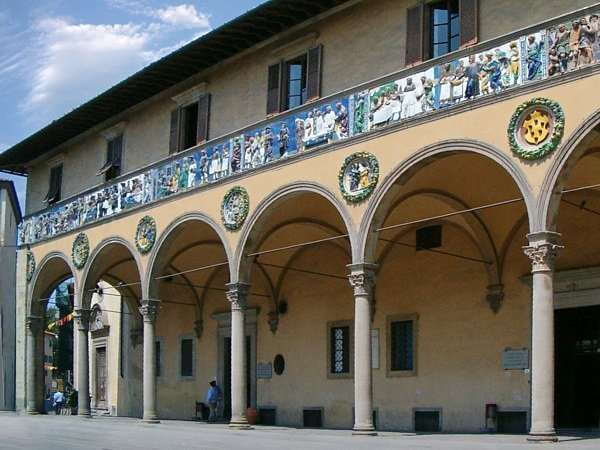
The Ospedale del Ceppo is a jewel in the center of Pistoia, unique for its history of care and medical innovation. Its glazed terracotta frieze, a masterpiece by Giovanni della Robbia and Santi Buglioni, depicts the Seven Works of Mercy in a vivid style. Inside hides the world’s smallest anatomical theater, while the underground reveals the ancient bed of the Brana River.
- Robbia Frieze: a cycle of polychrome ceramics along the loggia that tells the hospital’s mission.
- Anatomical Theater: dating back to 1785, with only 10 seats, used for anatomy lessons.
- Underground Pistoia: a 650-meter hypogeum path under the hospital, with mills and Roman bridges.
- Museum of Surgical Instruments: a collection of ancient medical instruments and the ‘pistorienses gladii’, ancestor of the scalpel.
Events nearby
10/09/2026 - 04/01/2027
03/06/2026 - 10/06/2026
The Ospedale del Ceppo in Pistoia tells seven centuries of care: from Della Robbia’s terracotta frieze to the works of mercy, and from the world’s smallest anatomical theater to medieval underground passages.
- Vicolo del Frantoio, Pistoia (PT)
- Open in Google Maps
- View on Google Images Ospedale del Ceppo a Pistoia
Good to know
Introduction
Walking through Pistoia, you come across a portico that seems like something out of a dream: the Ospedale del Ceppo. The glazed terracotta frieze, almost 40 meters long, immediately captures you with its vibrant colors. Here, art and medicine merge into a story that has lasted seven centuries. This is no ordinary museum: it’s a journey into healing, among Renaissance masterpieces and hidden underground secrets. The frieze of the Seven Works of Mercy is the first embrace that welcomes you, and it’s enough to make you fall in love with the place.
Historical Notes
Founded in 1277, according to legend, after the Madonna appeared to the couple Antimo and Bendinella, pointing to a flowering stump in winter. The hospital grew enormously after the plague of 1348, thanks to bequests from patients. In the 15th century it came under Florence, and the hospital director Leonardo Buonafede commissioned the loggia and the Robbia frieze. In the 16th century it became a School of Medicine; in 1785 the small anatomical theater was built. It functioned as a hospital until 2013, then turned into a museum. The scalpel was invented here, known as ‘pistorienses gladii’.
The Robbia Frieze
The real star of the Ospedale del Ceppo is the frieze running under the loggia. Created between 1525 and 1529 by Giovanni Della Robbia and Santi Buglioni, it is a masterpiece of polychrome glazed terracotta. Seven panels illustrate the Works of Mercy: clothing the naked, sheltering pilgrims, visiting prisoners, caring for the sick – in one scene a patient lies in bed while a doctor feels his pulse. Among the scenes, the Virtues (Faith, Hope, Charity…) and the Medici coat of arms appear. In each panel, the patron Buonafede is shown kneeling. The glazing technique keeps the colors brilliant to this day.
Underground and Anatomical Amphitheater
Beneath the hospital runs a 650-meter path along the ancient bed of the Brana stream: this is Pistoia Sotterranea, the longest underground route in Tuscany. You walk among medieval wash houses, a Roman bridge, and ancient mills. But the gem is the Anatomical Amphitheater, the smallest in the world: ten wooden seats, a lectern for the teacher, and a table for dissections. Built in 1785, it testifies to Pistoia’s medical avant-garde. In the Medical Academy Hall, 19th-century surgical instruments are preserved, including the famous local scalpel.
Why Visit It
Three practical reasons. First: the Robbian frieze is unique in Italy for its size and state of preservation – nowhere else will you find such a complete cycle of the Works of Mercy. Second: the opportunity to visit the medieval underground lets you understand how people lived and were treated in the past, with authentic remains. Third: the anatomical theater is a rare, almost intimate gem. It’s a museum that tells seven centuries of medicine without boring you, perfect for those who love history, art, and science. And if you’re curious, ask about the Pistoian scalpel!
When to Go
The best time? Late afternoon on a weekday. The low light illuminates the frieze magically, making the colors of the Della Robbia shine. During the week there are fewer people and you can enjoy the undergrounds almost in solitude. If possible, avoid Monday when it’s closed. In autumn and spring, the climate is ideal for a walk in the city center after the visit. But even in winter, with the glancing light, the loggia has a special charm.
Around the Area
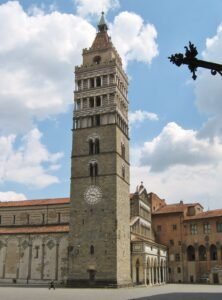
The Ospedale del Ceppo is in the heart of Pistoia, so everything is at your fingertips. Just a few steps away, the Cathedral of San Zeno with its bell tower and the Romanesque Baptistery. A little further, the medieval city walls. If you have time, visit the Museum of Palazzo Fabroni (contemporary art) or stroll through the artisan shops in the center. Pistoia is compact and easy to explore on foot. And after all that history, treat yourself to a warm crostino at one of the trattorias in the square.
Itineraries nearby

💡 Did You Know…?
According to legend, the Virgin Mary herself indicated the site to found the hospital by showing a flowering stump in the middle of winter. The hospital took its name from that stump, and still today the frieze tells the story of caring for the sick. But not only that: in Pistoia the scalpel was created, called ‘pistorienses gladii’, a tool that revolutionized surgery.