The Segesta Archaeological Park, in Calatafimi Segesta, is a journey through history spanning Greek, Roman, and medieval cultures. Its symbol is the unfinished 5th-century BC Doric temple that dominates the valley. The Greek theater offers a spectacular panorama of the surrounding landscape.
– Doric temple: 36 columns, never finished, dedicated to Aphrodite Urania
– Greek theater: 4,000 seats, panoramic view, used for summer performances
– Medieval remains: castle, mosque, and Norman church
– Sanctuary of Contrada Mango and sacred cave
Evocative Introduction
As soon as you arrive in Segesta, silence envelops you. Then you see it: the Doric temple, perfect and solitary, on a green hill. It seems like something out of a dream, with its 36 columns supporting the pediment for over 2,500 years. And up there, on Monte Barbaro, the Greek theater awaits you with a breathtaking view: gentle hills sliding down to the sea. It’s not just archaeology, it’s pure emotion.
Evocative Introduction
As soon as you arrive in Segesta, silence envelops you. Then you see it: the Doric temple, perfect and solitary, on a green hill. It seems like something out of a dream, with its 36 columns supporting the pediment for over 2,500 years. And up there, on Monte Barbaro, the Greek theater awaits you with a breathtaking view: gentle hills sliding down to the sea. It’s not just archaeology, it’s pure emotion.
Historical Background
Founded by the Elymians (possibly Trojan refugees), Segesta was an ally of Athens and later Carthage against Selinunte. In 409 BC it fell into Carthaginian hands, and the temple remained unfinished. Destroyed by Agathocles in 307 BC, it was rebuilt and flourished under Roman rule, receiving privileges due to its supposed Trojan descent. In medieval times, Arabs and Normans left their mark: a castle, mosque, and churches. Here are the key moments:
- 5th century BC – Construction of the Doric temple and early fortifications.
- 409 BC – Carthaginian conquest, temple work halted.
- 260 BC – Passed to the Romans, tax exemption granted.
- 2nd century BC – Theater construction.
- 13th century – Norman castle and mosque.
Historical Background
Founded by the Elymians (possibly Trojan refugees), Segesta was an ally of Athens and later Carthage against Selinunte. In 409 BC it fell into Carthaginian hands, and the temple remained unfinished. Destroyed by Agathocles in 307 BC, it was rebuilt and flourished under Roman rule, receiving privileges due to its supposed Trojan descent. In medieval times, Arabs and Normans left their mark: a castle, mosque, and churches. Here are the key moments:
- 5th century BC – Construction of the Doric temple and early fortifications.
- 409 BC – Carthaginian conquest, temple work halted.
- 260 BC – Passed to the Romans, tax exemption granted.
- 2nd century BC – Theater construction.
- 13th century – Norman castle and mosque.
The Doric Temple: A Stone Enigma
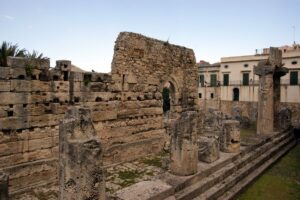
The temple is the symbol of Segesta. Perfect in proportion, with 14 columns on the long sides and 6 on the short, it is in classic Doric style. But look closely: the columns are fluteless, and the cella and roof are missing. Why? Perhaps work stopped due to the war with Selinunte, or perhaps it was a sacred enclosure for an open-air cult. Certainly, its dedication to Aphrodite Urania (discovered in 2020) adds mystery. Walking among these stones, with the wind whistling, is like stepping back in time.
The Doric Temple: A Stone Enigma
The temple is the symbol of Segesta. Perfect in proportion, with 14 columns on the long sides and 6 on the short, it is in classic Doric style. But look closely: the columns are fluteless, and the cella and roof are missing. Why? Perhaps work stopped due to the war with Selinunte, or perhaps it was a sacred enclosure for an open-air cult. Certainly, its dedication to Aphrodite Urania (discovered in 2020) adds mystery. Walking among these stones, with the wind whistling, is like stepping back in time.
The Greek Theatre: Spectacle and Panorama
Climbing up to the Northern Acropolis, the theatre appears carved into the rock of Mount Barbaro. Dating back to the 2nd century BC, it could seat up to 4,000 spectators. But the real magic is the view: from the top of the cavea, the gaze spans over the valleys all the way to the Gulf of Castellammare. In summer, during the Dionysian festivals, the theatre comes alive with classical performances. Sitting there at sunset, with the sun painting the temple below red, is an unforgettable experience.
The Greek Theatre: Spectacle and Panorama
Climbing up to the Northern Acropolis, the theatre appears carved into the rock of Mount Barbaro. Dating back to the 2nd century BC, it could seat up to 4,000 spectators. But the real magic is the view: from the top of the cavea, the gaze spans over the valleys all the way to the Gulf of Castellammare. In summer, during the Dionysian festivals, the theatre comes alive with classical performances. Sitting there at sunset, with the sun painting the temple below red, is an unforgettable experience.
Why Visit
1) A unique temple in the world: never collapsed, never completed, shrouded in mystery. 2) The view from the theater: worth the trip on its own. 3) Not crowded: unlike other sites, here you find peace and can enjoy the monuments almost in solitude, especially in spring or autumn. Plus, tickets cost only €6 and the park is open all year round.
Why Visit
1) A unique temple in the world: never collapsed, never completed, shrouded in mystery. 2) The view from the theater: worth the trip on its own. 3) Not crowded: unlike other sites, here you find peace and can enjoy the monuments almost in solitude, especially in spring or autumn. Plus, tickets cost only €6 and the park is open all year round.
When to Go
If you want to avoid the heat and crowds, choose May, June, September or October. The afternoon light, around 5-6 PM, makes the Doric temple even more evocative, and from the theater the sea seems within reach. If you go in summer, bring a hat and water: the sun is strong. But the sunset, when the park closes, is the perfect moment to take the photo of a lifetime.
When to Go
If you want to avoid the heat and crowds, choose May, June, September or October. The afternoon light, around 5-6 PM, makes the Doric temple even more evocative, and from the theater the sea seems within reach. If you go in summer, bring a hat and water: the sun is strong. But the sunset, when the park closes, is the perfect moment to take the photo of a lifetime.
In the Vicinity
A few kilometers away, a visit to the Pianto Romano (combo ticket €8) is well worth it—an archaeological area with remains of Roman buildings and an olive press. Alternatively, head down to Calatafimi Segesta, a medieval village, to sample traditional Trapani dishes. If you have time, explore the Grotte di Scurati, a prehistoric site on the coast, or enjoy the sea at Castellammare del Golfo, just a 15-minute drive away.
In the Vicinity
A few kilometers away, a visit to the Pianto Romano (combo ticket €8) is well worth it—an archaeological area with remains of Roman buildings and an olive press. Alternatively, head down to Calatafimi Segesta, a medieval village, to sample traditional Trapani dishes. If you have time, explore the Grotte di Scurati, a prehistoric site on the coast, or enjoy the sea at Castellammare del Golfo, just a 15-minute drive away.