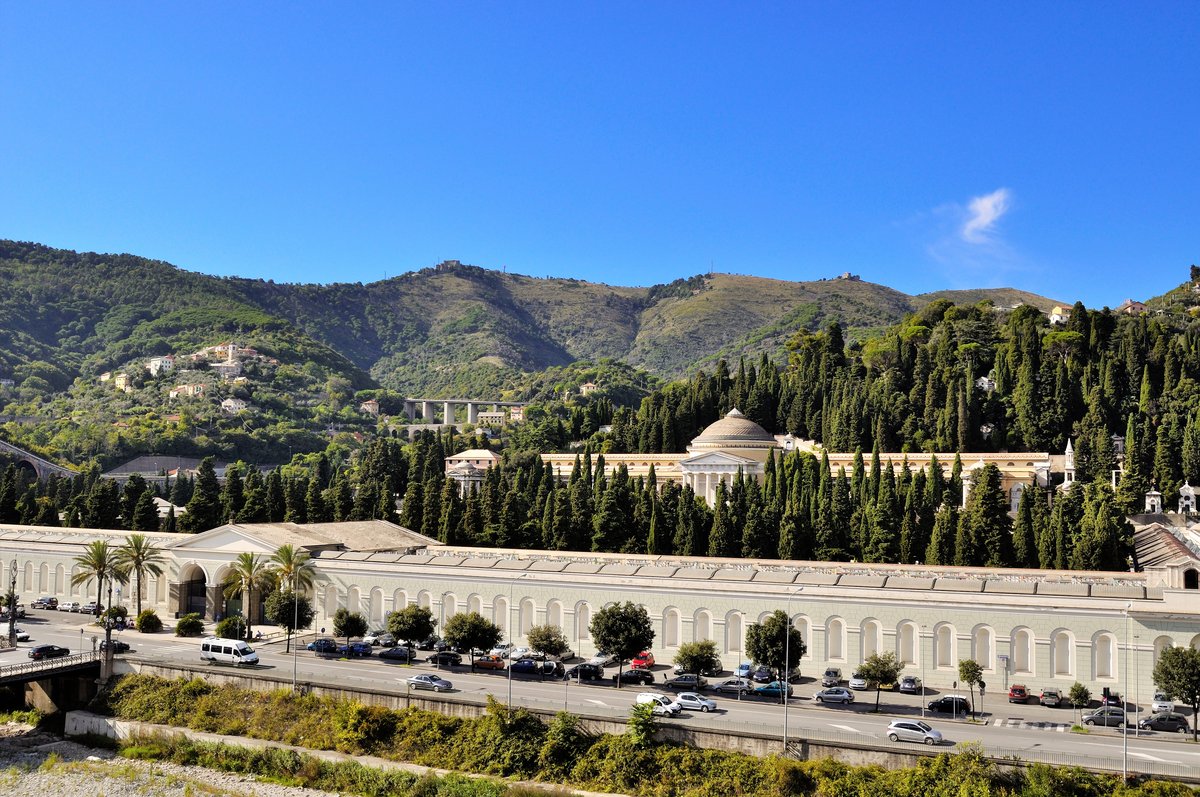
Welcome to Staglieno Monumental Cemetery, a true open-air treasure chest in the heart of Genoa. With over 1,800 works and 10,000 tombs, it’s one of the largest monumental cemeteries in Europe. Here rest figures like Giuseppe Mazzini and Fabrizio De André. Here’s what not to miss:
– Scultures by Santo Varni and Giulio Monteverde: masterpieces of realism and symbolism.
– The tomb of Caterina Campodonico: the peanut vendor immortalized in marble.
– The Pantheon and the statue of Faith: focal points of neoclassical architecture.
– Practical hours: daily 7:30 AM–5:00 PM, free admission.
Introduction: An Open-Air Museum
330,000 sq m of statues, chapels, and tree-lined avenues: the Staglieno Monumental Cemetery is a vast open-air museum. With 1,800 works of art and 10,000 tombs, it is considered one of the three most important monumental cemeteries in the world, alongside Paris’s Père Lachaise and Buenos Aires’s Recoleta. Strolling here means immersing yourself in a bygone era, among marble and bronze sculptures that tell stories of Genoese bourgeoisie, art, and memory. The atmosphere is romantic, far from any macabre notion: death becomes a celebration of life.
Introduction: An Open-Air Museum
330,000 sq m of statues, chapels, and tree-lined avenues: the Staglieno Monumental Cemetery is a vast open-air museum. With 1,800 works of art and 10,000 tombs, it is considered one of the three most important monumental cemeteries in the world, alongside Paris’s Père Lachaise and Buenos Aires’s Recoleta. Strolling here means immersing yourself in a bygone era, among marble and bronze sculptures that tell stories of Genoese bourgeoisie, art, and memory. The atmosphere is romantic, far from any macabre notion: death becomes a celebration of life.
Historical Notes
Designed by Carlo Barabino in
1835 and completed by Giovanni Battista Resasco, the cemetery opened on
January 2, 1851. Born from the Napoleonic edict banning burials in cities, today it extends over 330,000 sqm. In
1902 the crematorium temple was added. The sections expanded to include cemeteries for the Protestant, Jewish, and Greek Orthodox communities. Among its illustrious visitors: Nietzsche, Maupassant, and Mark Twain.
- 1835: Barabino’s design
- 1844: start of works
- 1851: opening
- 1902: crematorium temple
Historical Notes
Designed by Carlo Barabino in
1835 and completed by Giovanni Battista Resasco, the cemetery opened on
January 2, 1851. Born from the Napoleonic edict banning burials in cities, today it extends over 330,000 sqm. In
1902 the crematorium temple was added. The sections expanded to include cemeteries for the Protestant, Jewish, and Greek Orthodox communities. Among its illustrious visitors: Nietzsche, Maupassant, and Mark Twain.
- 1835: Barabino’s design
- 1844: start of works
- 1851: opening
- 1902: crematorium temple
Sculptures That Enchant
At the center stands Santo Varni’s Statue of Faith, 9 meters tall. Among the masterpieces, the Angel of Monteverde on the Oneto tomb, a symbol of grace and melancholy. The tomb of Caterina Campodonico (the ‘peanut vendor’) portrays the common woman in natural size, as she herself wished. Styles range from neoclassicism to Art Nouveau, passing through Egyptian and Mesopotamian influences. Each sculpture is a unique piece, crafted by masters like Lorenzo Orengo and Augusto Rivalta. Death here is depicted without horror, as a natural passage.
Sculptures That Enchant
At the center stands Santo Varni’s Statue of Faith, 9 meters tall. Among the masterpieces, the Angel of Monteverde on the Oneto tomb, a symbol of grace and melancholy. The tomb of Caterina Campodonico (the ‘peanut vendor’) portrays the common woman in natural size, as she herself wished. Styles range from neoclassicism to Art Nouveau, passing through Egyptian and Mesopotamian influences. Each sculpture is a unique piece, crafted by masters like Lorenzo Orengo and Augusto Rivalta. Death here is depicted without horror, as a natural passage.
Famous Figures and Celebrated Tombs
In Staglieno rest giants of history and culture: Giuseppe Mazzini in his mausoleum, Fabrizio De André (cenotaph), Ferruccio Parri, Nino Bixio, Gilberto Govi and Edoardo Sanguineti. Also present is Constance Lloyd, wife of Oscar Wilde. Popular figures like Caterina Campodonico are not missing. Their tombs are true works of art, often pilgrimage destinations. Among the most curious are the Egyptian and Art Nouveau style chapels, and the Irregular Grove with 2,501 chapels. A moving museum of memory.
Famous Figures and Celebrated Tombs
In Staglieno rest giants of history and culture: Giuseppe Mazzini in his mausoleum, Fabrizio De André (cenotaph), Ferruccio Parri, Nino Bixio, Gilberto Govi and Edoardo Sanguineti. Also present is Constance Lloyd, wife of Oscar Wilde. Popular figures like Caterina Campodonico are not missing. Their tombs are true works of art, often pilgrimage destinations. Among the most curious are the Egyptian and Art Nouveau style chapels, and the Irregular Grove with 2,501 chapels. A moving museum of memory.
Why Visit
Three good reasons: free entry (takes about an hour to visit), masterpieces of the 19th and 20th centuries at your fingertips, and a unique atmosphere between art and nature. Nietzsche and Mark Twain walked here; the statues immortalize Genoese bourgeoisie with realism and symbolism. Perfect for a cultural break different from the usual. And then, the Joy Division album covers? Yes, they were shot here, among the Appiani and Ribaudo tombs. A place that inspires.
Why Visit
Three good reasons: free entry (takes about an hour to visit), masterpieces of the 19th and 20th centuries at your fingertips, and a unique atmosphere between art and nature. Nietzsche and Mark Twain walked here; the statues immortalize Genoese bourgeoisie with realism and symbolism. Perfect for a cultural break different from the usual. And then, the Joy Division album covers? Yes, they were shot here, among the Appiani and Ribaudo tombs. A place that inspires.
When to Go
The best time? Early morning, when the low light caresses the sculptures and the silence is broken only by the rustle of trees. In autumn, the warm colors of the leaves contrast with the white marble. Avoid the midday hours in summer, but the cemetery is open all year from 7:30 AM. Wear comfortable shoes and bring a camera: every corner is worth a shot.
When to Go
The best time? Early morning, when the low light caresses the sculptures and the silence is broken only by the rustle of trees. In autumn, the warm colors of the leaves contrast with the white marble. Avoid the midday hours in summer, but the cemetery is open all year from 7:30 AM. Wear comfortable shoes and bring a camera: every corner is worth a shot.
Nearby
The cemetery is located in the Staglieno neighborhood, nestled in the Val Bisagno. After your visit, take a walk through the streets of the neighborhood, where the Genoese atmosphere is palpable in the small shops and alleyways. If you have time, the historic center of Genoa is just a few kilometers away, with its Rolli palaces and aquarium. But even staying in the neighborhood offers authentic glimpses of local life.
Nearby
The cemetery is located in the Staglieno neighborhood, nestled in the Val Bisagno. After your visit, take a walk through the streets of the neighborhood, where the Genoese atmosphere is palpable in the small shops and alleyways. If you have time, the historic center of Genoa is just a few kilometers away, with its Rolli palaces and aquarium. But even staying in the neighborhood offers authentic glimpses of local life.