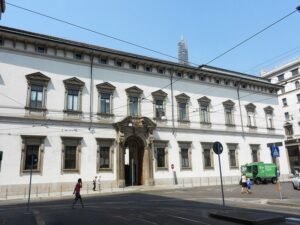
Villa Visconti in Cassinetta di Lugagnano is an eighteenth-century residence overlooking the Naviglio Grande, perfect for a cultural outing just steps from Milan. The villa hosts temporary exhibitions and cultural events, featuring Italian-style gardens and a unique relationship with the canal’s water. The tranquil village of Cassinetta di Lugagnano offers walks along the towpath and local eateries to complete the experience.
- Eighteenth-century facade with a columned portico reflected in the Naviglio Grande
- Italian-style garden with geometric flowerbeds, boxwood hedges, and eighteenth-century statues
- Temporary exhibitions and cultural events enlivening the villa’s rooms
- Walks along the Naviglio Grande and opportunities to visit other historic villas in the area
A Jewel on the Naviglio
Just outside the chaos of Milan, Villa Visconti in Cassinetta di Lugagnano welcomes you with a discreet elegance that leaves you breathless. It’s not just a historic residence: it’s an immersive experience where 18th-century architecture converses with the gentle flow of the Naviglio Grande. The view from the main facade, with its classic portico mirrored in the canal waters, offers an unforgettable sight. Here, time seems to have stood still, providing a peaceful refuge just steps away from the metropolis. The atmosphere is that of a drawing room from another era, perfect for those seeking a cultural excursion without traveling kilometers. The villa, with its Italian-style garden, immediately becomes the star of breathtaking photographs, especially at sunset, when the warm light enhances the stone details and water features.
The Story of a Noble Residence
The villa was built in the
18th century as a countryside residence for the powerful Visconti family, who spent their summer months here away from the city. During the 19th century, it passed to the Counts Lurani, who oversaw its expansion and the beautification of its gardens. Throughout the 20th century, the property experienced various phases, including a period of abandonment, before being restored and opened to the public as a cultural heritage site. Today, it stands as a well-preserved example of 18th-century Lombard architecture, with later Neoclassical influences. Its strategic location along the Naviglio Grande made it a focal point for trade and social life in the area for centuries.
- Mid-18th century: construction commissioned by the Visconti family
- 19th century: transfer to the Counts Lurani and expansions
- 20th century: periods of abandonment and restoration
- Today: open as a visitable site and venue for events
Architecture and Interiors
The villa’s structure spans two floors, with a main façade featuring an imposing columned portico that opens directly onto the Naviglio. Inside, the highlight are the reception rooms, such as the honor salon with frescoed ceilings and marble fireplaces. The rooms, although not always accessible in every detail during visits, showcase period furnishings that recreate the atmosphere of a bygone era. Particularly interesting is the private chapel, a small Baroque jewel with stuccoes and religious decorations. The layout of the rooms follows a symmetrical logic typical of Lombard pleasure villas, with large windows that flood the spaces with light. The Lombard terracotta floors and coffered ceilings also contribute to the authentic charm of the place.
The Gardens and Their Relationship with Water
The true heart of Villa Visconti is its Italian-style garden, an oasis of orderly greenery extending toward the rear of the property. Here, geometric flowerbeds, boxwood hedges, and eighteenth-century statues create an evocative pathway. But the most fascinating element is the relationship with water: beyond the Naviglio Grande canal that grazes the facade, the park features fountains and small reflecting pools that mirror the sky and vegetation. In spring, the blooming of linden trees and magnolias offers intense fragrances, while in autumn, the colorful leaves transform the garden into a living painting. It’s the perfect place for a leisurely stroll, perhaps sitting on a bench to watch the comings and goings of boats on the canal.
Why Visit
First, because it offers a journey back in time just a short distance from Milan, without the need for long travel. Second, for the opportunity to combine the visit with a stroll along the banks of the Naviglio Grande, a well-maintained cycling and walking path that offers picturesque views. Third, because the villa often hosts temporary exhibitions and cultural events, such as concerts or readings, which enrich the experience. Additionally, its tranquil and intimate atmosphere makes it perfect for a family outing or for those seeking a moment of relaxation away from the noise. Finally, its proximity to other historic villas in the area allows for creating a themed itinerary on Lombard noble residences.
The Perfect Time to Visit
The best time is undoubtedly late spring or early autumn, when temperatures are mild and the gardens are at their peak. During these seasons, the afternoon light enhances the colors of the facade and creates reflections on the Naviglio’s water. Avoid the hottest summer months, as it might get warm inside the villa. As for the timing, aim for early afternoon, so you have time to explore both the interiors and the gardens at a leisurely pace, and perhaps stay until sunset, when the atmosphere becomes even more magical. Weekends can be crowded, so if you prefer tranquility, opt for a weekday.
What to see in the surrounding area
Just outside Cassinetta di Lugagnano, don’t miss a stroll along the Naviglio Grande to nearby Robecco sul Naviglio, where you’ll find other historic villas like Villa Gaia. For a culinary experience, stop at one of the typical osterias along the canal to sample traditional Lombard dishes, such as saffron risotto or cassoeula. If you love art, a few kilometers away is the Abbazia di Morimondo, a 12th-century Cistercian monastic complex with a charming cloister and a museum. Alternatively, you can explore the Ticino Park, a protected natural area perfect for short hikes or bike rides, immersed in the Lombard countryside.