
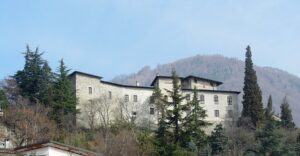
Villanova Castle in Cassolnovo is a perfectly preserved 15th-century manor with crenellated towers, a moat, and a Gothic porticoed courtyard. Guided tours are conducted by the owners, offering an authentic experience in the tranquility of the Pavia countryside.
- 15th-century corner towers with accessible internal staircases
- Still recognizable moat and walls with drawbridge holes
- Porticoed courtyard with pointed arches and rooms with frescoes
- Private property visitable by reservation, away from tourist crowds
Events nearby



15th-century castle with corner towers, visible moat, and Gothic porticoed courtyard. Guided tours led by the owners in the secluded Pavia countryside.
- Via Castello, Pavia (PV)
- Open in Google Maps
- View on Google Images Castello di Villanova a Pavia
Good to know
Introduction
As soon as you arrive in Cassolnovo, the Castle of Villanova immediately strikes you: a fifteenth-century manor that emerges from the Pavese countryside like an island of history. Its massive towers and still-visible moat create an atmosphere suspended in time. It’s not just a monument, but an experience that makes you feel part of an ancient tale. The contrast between the imposing structure and the surrounding agricultural landscape makes this place unique in its kind, perfect for those seeking authenticity without tourist frills.
Historical Overview
Villanova Castle was built in the 15th century by the Beccaria family, powerful local lords connected to the Visconti of Milan. Originally conceived as a fortified residence, it served to control the trade routes between Pavia and Novara. In the 17th century, it passed to the Cusani family, who partially modified its structure to adapt it into a noble residence. Today, despite the centuries, it retains intact the architectural characteristics of the era, with its exposed brick walls and arrow slits that speak of a past of defense and power.
- 15th century: construction by the Beccaria family
- 17th century: transfer to the Cusani family and transformations
- 20th century: conservation restorations
- Today: private property visitable by appointment
The Towers and the Moat
The two corner towers are the castle’s most distinctive feature: the taller, more slender northeast tower served as a lookout point, while the southwest tower had a residential function. Climbing the internal staircases (still accessible during guided tours) allows visitors to appreciate the period’s construction details, such as the cross vaults and splayed windows. The moat, now partially filled in but still recognizable, once completely surrounded the building and was fed by local springs. When carefully observing the walls, one can still see the holes where the drawbridges were fixed.
The Interior: Courtyard and Halls
Beyond the main entrance, you enter a porticoed courtyard that retains its original atmosphere. The porticoes with pointed arches are a rare example of Lombard Gothic architecture in the area. The interior halls, although altered over time, preserve traces of 15th-century frescoes, particularly in the representative hall where geometric patterns and family coats of arms can be distinguished. Particularly interesting is the private chapel, with a small stone altar still intact. The original terracotta floors and monumental fireplaces complete the historical setting.
Why Visit It
Three practical reasons not to miss Villanova Castle: first, it’s one of the few Pavia castles still inhabited and maintained in excellent condition without invasive interventions. Second, the guided tours (by reservation) are conducted by the owners themselves, who share family anecdotes and stories, making the experience personal and authentic. Third, its isolated location in the countryside allows you to enjoy the tranquility and take photos without crowds of tourists, which is rare for a monument of this importance.
When to Go
The best time to visit the castle is in the early morning hours, when the low-angled sunlight accentuates the towers’ volumes and creates captivating shadow plays across the moat. In autumn, when the typical fogs of the Po Valley partially envelop the building, a particularly romantic and photogenic atmosphere emerges. Avoid days with heavy rain as access to the moat may be challenging.
In the Surroundings
Just a short drive away, you’ll find the Morimondo Abbey, one of the most important Cistercian monastic complexes in Northern Italy, with its brick church and perfectly preserved cloister. For an authentic food and wine experience, stop at one of the local farmhouses to sample Carnaroli rice from Lomellina, a typical product that reaches excellence here.
Itineraries nearby

💡 Did You Know…?
Local legend tells that the castle was connected by secret underground passages to other manors in the area, used during wars between Pavese noble families. A little-known historical detail: the moat was originally fed by waters from the nearby Terdoppio stream, creating a defensive system still recognizable today despite the centuries that have passed.