
🧭 What to Expect
- Ideal for Renaissance art enthusiasts and medieval history lovers.
- Highlights: intact historic center, works by Perugino and Pinturicchio, Etruscan walls.
- Includes an interactive map with 15 marked locations for easy navigation.
- Experience: vibrant university atmosphere blended with tradition in cobblestone alleys.
The City of Perugia, the capital of Umbria, is a medieval jewel perched on a hill with breathtaking views over the valley. It's not just the city of chocolate during Eurochocolate: its historic center, enclosed by Etruscan and medieval walls, is a labyrinth of cobblestone alleys, staircases, and squares that tell centuries of history. Here you'll find artworks by Perugino and Pinturicchio in places like the Collegio del Cambio, while the Galleria Nazionale dell'Umbria houses one of the most important regional collections. The Rocca Paolina, a Renaissance fortress commissioned by Pope Paul III, conceals an entire medieval quarter accessible via escalators connecting it to the center. Perugia is also a lively university city: the youthful atmosphere blends with tradition in the venues around Corso Vannucci, the main pedestrian street. To orient yourself, start from the Fontana Maggiore in Piazza IV Novembre, the symbolic heart of the city, and lose time among artisan workshops and historic cafés. Travel sites recommend not missing a walk along the walls to admire the views over the Umbrian hills, especially at sunset.
Overview
- Palazzo dei Priori
- Fontana Maggiore: The Medieval Heart of Perugia
- National Gallery of Umbria
- Collegio del Cambio: A Renaissance Masterpiece in the Heart of Perugia
- Rocca Paolina
- National Archaeological Museum of Umbria
- San Severo Chapel
- Etruscan Arch
- The Etruscan Well
- Volumni Hypogeum and Palazzone Necropolis
- Porta San Pietro
- Porta di Sant'Angelo
- University of Perugia Botanical Garden
- Giardini del Frontone
- Città della Domenica: The Dream Park for Families
Palazzo dei Priori
- Go to the page: Palazzo dei Priori in Perugia: National Gallery of Umbria and Gothic Frescoes
- Corso Pietro Vannucci 19, Perugia (PG)
- https://turismo.comune.perugia.it/poi/palazzo-dei-priori
- Open in Google Maps
- View on Google Images
 If you're looking for the symbol of civil power in Perugia, the Palazzo dei Priori is the right place. This imposing Gothic building dominates Piazza IV Novembre with its asymmetrical facade and battlements that seem to tell centuries of history. Built between the 13th and 15th centuries, it still houses the town hall today, but the real surprise is inside. Climbing the grand staircase, you'll access the National Gallery of Umbria, where masterpieces by Perugino, Pinturicchio, and Beato Angelico await. Personally, I was struck by the Sala dei Notari, with its medieval frescoes depicting Aesop's fables and biblical scenes—an unexpected mix that makes everything feel more human. Pay attention to the opening hours: the gallery has variable hours, while the palace is only partially visitable during office hours. If you pass by here, don't miss the Collegio del Cambio, attached to the palace, with Perugino's frescoes that are a true dive into the Renaissance. Sometimes I wonder how they managed to decide the fate of the city in these majestic rooms, between art and politics. A tip? Take the time to observe the details of the facade: the triforas, the statues, and that Perugian lion that seems to watch over the square.
Fontana Maggiore: The Medieval Heart of Perugia
- Piazza IV Novembre, Perugia (PG)
- Open in Google Maps
- View on Google Images
 At the center of Piazza IV Novembre, the Fontana Maggiore is not just a fountain: it is the symbol of Perugia, a monument that for over seven centuries has told the city's story through its meticulously carved details. Created between 1275 and 1278 by Nicola and Giovanni Pisano, this two-tiered structure represents one of the finest examples of Italian medieval sculpture. What immediately strikes you is the richness of the bas-reliefs: the 50 panels of the lower basin illustrate the months of the year with their corresponding agricultural labors, zodiac signs, liberal arts, and biblical scenes. Each panel is a small narrative of daily life in the thirteenth century, with surprisingly vivid details—from the tailor's scissors to the winemaker's barrels. The upper basin, on the other hand, hosts statues of mythological and biblical figures, among which Mary Magdalene and Solomon stand out. Looking closely, you can also see the damages of time and some restorations, but this only adds to its charm. Personally, I enjoy searching for the panel of May with the two young people exchanging flowers—a romantic detail amidst many work-related depictions. The fountain is always surrounded by tourists and university students, but in the early morning hours, you can enjoy a certain tranquility. A tip: view it from different angles, because the light completely changes the perception of the reliefs. And don't forget to look up at the three bronze nymphs on the top—added in the fourteenth century, they seem almost to dance above the entire composition.
National Gallery of Umbria
- Go to the page: National Gallery of Umbria: Masterpieces by Perugino and Piero della Francesca
- Corso Pietro Vannucci 19, Perugia (PG)
- http://musei.beniculturali.it/musei?mid=287&nome=galleria-nazionale-dellumbria
- Open in Google Maps
- View on Google Images
- gan-umb@beniculturali.it
- +39 075 58668415
 If you think Perugia is just chocolate and staircases, prepare to change your mind. The National Gallery of Umbria, housed on the third floor of the Palazzo dei Priori, is one of those surprises that makes you slow your pace and lose track of time. It's not a huge museum, but every room has a story to tell. You enter and immediately notice that Umbrian art breathes here, with those warm tones and attention to detail that seem to speak of a region both devout and earthy. The chronological path guides you from the 13th to the 18th century, but it's the Renaissance paintings that steal the show. Works by Perugino, Pinturicchio, and Fra Angelico gaze at you from the walls, with that soft light that seems to emanate from the canvas. Personally, I was struck by Perugino's Pala di Sant'Antonio: there's a sweetness in the faces that I've rarely seen elsewhere, almost an invitation to contemplation. Then there are the disassembled polyptychs, reconstructed like historical puzzles, showing how art was also a matter of patronage and popular devotion. Don't expect only big names: there are minor works that tell local stories, like the processional banners that still seem to smell of incense. The layout is essential, without too many frills, and this leaves space for the artworks. Pay attention to the windows: every now and then, a glance at Piazza IV Novembre reminds you that you're in the heart of Perugia, between art and daily life. I recommend taking your time, perhaps avoiding peak hours, because some rooms are small and a noisy group can spoil the magic. And don't skip the applied arts section: ceramics, textiles, and goldsmithing that show a craftsmanslike and refined Umbria. In short, if you want to truly understand the soul of this region, you'll find many answers here.
Collegio del Cambio: A Renaissance Masterpiece in the Heart of Perugia
- Corso Pietro Vannucci 25, Perugia (PG)
- https://www.collegiodelcambio.it/
- Open in Google Maps
- View on Google Images
 Entering the Collegio del Cambio is like stepping back in time, straight into the Umbrian Renaissance. This place is not just a museum, but the ancient seat of Perugian money changers, active since the 15th century. What immediately strikes you is the Audience Hall, entirely frescoed by Pietro Vannucci, better known as Perugino. The frescoes are an extraordinary pictorial cycle that blends classical and Christian themes with a mastery that leaves you in awe. Personally, I lost myself observing the details of the allegorical figures of the Virtues—Prudence, Justice, Fortitude, and Temperance—which almost seem to speak from the walls. The light filtering through the original windows illuminates the colors in a unique way, especially in the morning hours. It's not just art: it's a unique historical document that tells of Perugia's economic power in the 15th century. The money changer's desk, still present, makes you imagine the negotiations that took place here. Some visitors linger only briefly, but in my opinion, it's worth taking time for every detail, like the coffered ceiling decorations or the monumental fireplace. The atmosphere is intimate, almost cozy, different from crowded major museums. A tip: look closely at the expressions of the characters in the frescoes; there's a sweetness typical of Perugino that you won't find elsewhere. For me, it was one of those places that make you understand why Perugia is considered a capital of Umbrian art.
Rocca Paolina
- Quadrivio, Perugia (PG)
- Open in Google Maps
- View on Google Images
 Visiting Rocca Paolina is an experience that literally takes you beneath the streets of Perugia. This fortress, commissioned by Pope Paul III Farnese in 1540, is not just a historical monument: it's a true hidden layer of the city that tells centuries of power and conflict. Built to subdue the Perugians after the Salt War, the fortress incorporated entire medieval neighborhoods, houses, and towers, creating an underground labyrinth that you can explore on foot today. Walking through its galleries, with red bricks that seem to still breathe history, is almost dizzying. You can feel the weight of the past, but also the resilience of a city that has managed to reclaim these spaces. Today, the underground areas host temporary exhibitions and cultural events, while the upper part, with the Carducci Gardens, offers a breathtaking view of the Umbrian valley. Personally, I find it fascinating how a symbol of oppression has transformed into a place of culture and gathering. Note: access is free and the lighting creates suggestive plays of light, but some areas can be damp – a light jacket is advisable. Don't miss the escalator connecting Piazza Italia to the historic center: it's a modern passageway that cuts right through the ancient walls, a contrast that perfectly encapsulates the soul of Perugia.
National Archaeological Museum of Umbria
- Piazza Giordano Bruno 10, Perugia (PG)
- http://musei.beniculturali.it/musei?mid=5351&nome=museo-archeologico-nazionale-dellumbria
- Open in Google Maps
- View on Google Images
- pm-umb@beniculturali.it
- +39 075 5727141
 If you think Perugia is just about chocolate and views, prepare for a surprise. The National Archaeological Museum of Umbria, housed in the former convent of San Domenico, is one of those places that makes you realize how layered this city's history truly is. You enter and are immediately struck by the atmosphere: the building itself is an artifact, with quiet cloisters contrasting with the bustle of the nearby square. The collection is clearly organized, almost chronological, but what fascinated me are the concrete details. For example, the Etruscan section isn't just a list of vases: there's the famous Cippo di Perugia, a stele with inscriptions that still seem to tell stories, and then funerary urns decorated with scenes of daily life that make you imagine how people really lived. Moving to the Roman section, don't expect just imposing statues. There are small but significant objects, like lamps, coins, and surgical instruments that reveal lesser-known aspects of Roman rule. Personally, I found the room dedicated to pre-Roman Perugia particularly interesting, with artifacts showing how the city was already an important center before the Romans arrived. Some might think it's a museum 'for experts,' but in my opinion, it's accessible to everyone: the labels are concise, and the modern layout avoids that dusty effect that sometimes puts visitors off. A tip? Don't skip the basement, where you'll find the remains of a Roman cistern: it's an unexpected sight that combines architecture and archaeology. It might not be the most glamorous spot in Perugia, but if you want to understand where this city comes from, it's an almost obligatory stop.
San Severo Chapel
- Go to the page: San Severo Chapel: Raphael's Only Fresco in Perugia with Completion by Perugino
- Via Raffaello, Perugia (PG)
- Open in Google Maps
- View on Google Images
 Finding the San Severo Chapel is a bit like discovering a well-kept secret in the heart of Perugia. It's not one of those monuments that stands before you in all its majesty: it hides in a side alley of Piazza Raffaello, almost as if wanting to protect itself from the tourist bustle. Yet, when you finally spot it, you immediately understand why it's worth seeking out. The chapel itself is small, simple, almost unassuming on the outside. But what it holds inside is breathtaking. Because here, on one wall, two giants of the Renaissance coexist: Raphael and his master Pietro Perugino. The fresco of the Trinity and Saints is divided into two registers: the upper one is the work of Raphael, created in 1505, while the lower one was completed years later by Perugino. Seeing them side by side is a strange and fascinating experience. You notice the difference in style, of course: the sweetness and balance of Raphael against the more traditional solemnity of the master. I like to think that this small space tells a story of passing the torch, of a pupil who surpassed the master while remaining connected to him. The atmosphere is intimate, silent. There are no crowds, only the slow breath of history. The light filtering through the windows illuminates the colors of the frescoes differently depending on the time of day, offering ever-new shades. A detail few notice: next to the chapel are the remains of an ancient Benedictine monastery, almost a reminder of how layered this city's history is. I recommend visiting it calmly, letting its quiet envelop you. It's one of those places that forces you to slow down, to observe the details. And perhaps, if you're lucky, you'll have the sensation of capturing a moment of that artistic dialogue that forever changed Italian art.
Etruscan Arch
- Via Bartolo, Perugia (PG)
- Open in Google Maps
- View on Google Images
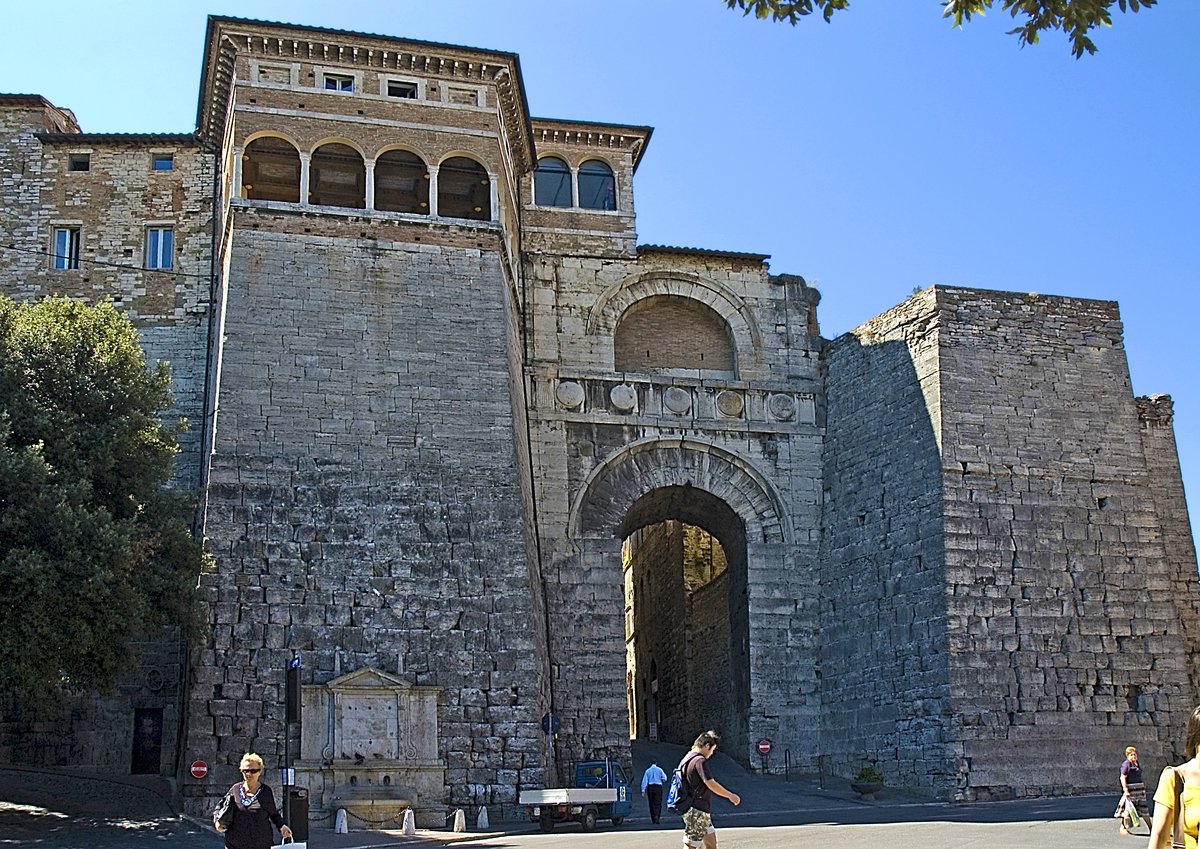 Walking along Corso Garibaldi, you almost find yourself under the Etruscan Arch without even noticing. It's not just a monument; it's a gateway that still functions today. Built in the 3rd century BC, it's one of the few intact Etruscan remains in Perugia, and perhaps the most impressive. What always strikes me is its dual nature: on one side, the external facade facing the countryside, with those cyclopean blocks of travertine that seem placed there yesterday, so perfect. On the other, the internal facade facing the city, which the Romans reworked by adding the rounded arch we see today. Passing beneath it has something magical: you think of all those who passed through before you, for centuries. Merchants, soldiers, pilgrims. Today, university students and tourists with maps in hand walk through. The arch is tall, majestic, and the inscription 'Augusta Perusia' above the Roman arch reminds you that history has layered here. Sometimes I stop to look at the details: the stone blocks aren't all the same; some have strange grooves. They say they were used for lifting. Not far away, to the right as you go up, there's a medieval tower leaning against it, almost embracing the ancient structure. No ticket is needed; it's there, in the middle of the street, part of the urban fabric. In the evening, illuminated, it's even more evocative. A piece of advice? Look up when you pass. And don't rush. This isn't a monument to photograph and move on; it's a place to absorb. I like to think that while I observe those stones, someone two thousand years ago did the same, perhaps checking that the blocks were perfectly aligned.
The Etruscan Well
- Piazza Piccinino, Perugia (PG)
- https://www.pozzoetrusco.it/
- Open in Google Maps
- View on Google Images
- pozzoetrusco@fondazioneranieri.org
- +39 075 573 3669
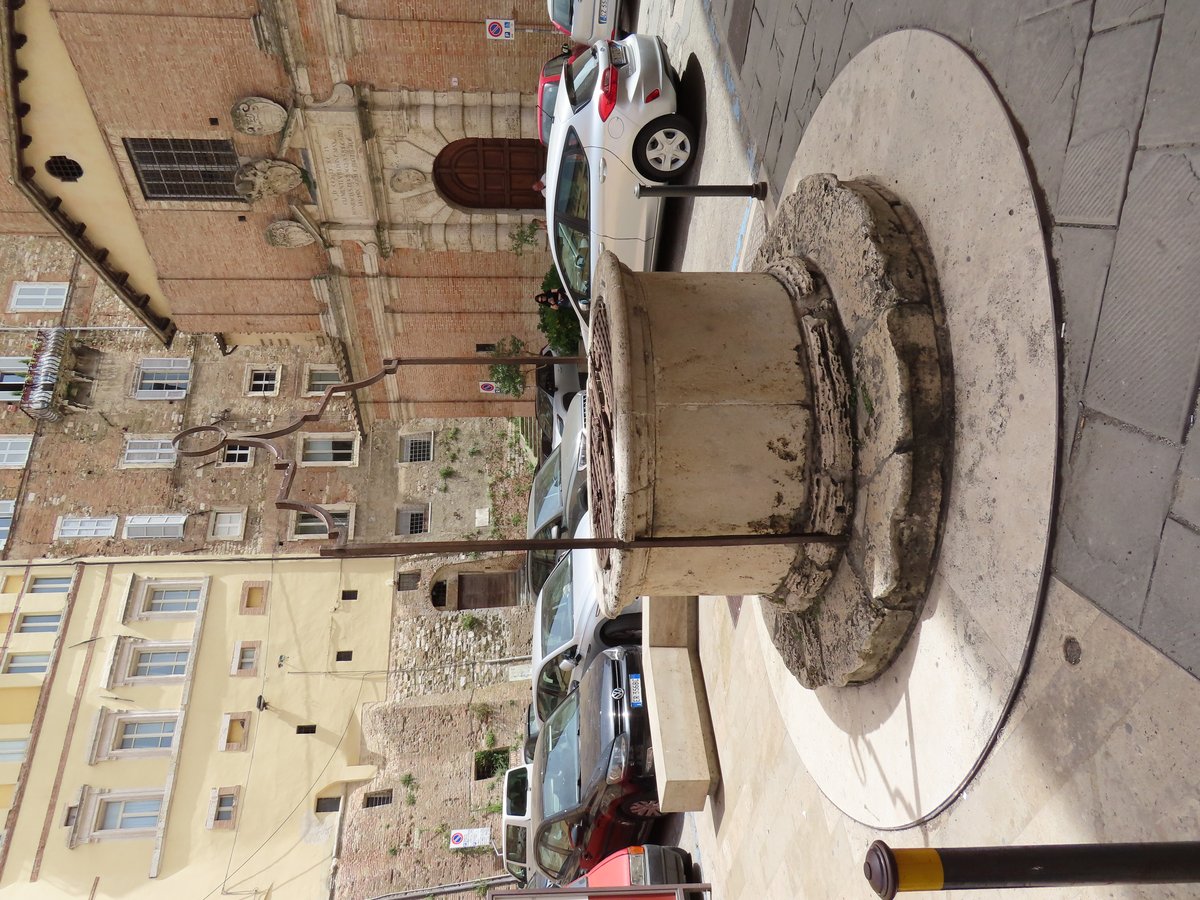 A journey back in time awaits you, quite literally. The Etruscan Well, also known as Sorbello, is one of those surprises that Perugia keeps hidden beneath its surface. It's not just a deep hole: it's an extraordinary feat of hydraulic engineering, carved into the tufa rock by the Etruscans around the 3rd century BC. Imagine, it served to ensure the city's water supply during sieges. What struck me the most? Its depth: about 37 meters, with a diameter of over 5. Descending the modern staircase that runs alongside it (be careful, the steps can be damp and a bit slippery), you immediately feel the cool humidity and hear, in the distance, the dripping of water. The atmosphere is evocative, almost mystical. The faint light illuminates the stone walls, smoothed by time. At the bottom, you can still glimpse the water's surface, fed by a perennial spring. It's not a grand place like a cathedral, but it has an intimate and powerful charm. It tells of an advanced civilization that built a fortified city here, on this hill. Sometimes I wonder how many buckets were lowered into this well over the centuries. The visit is quick, but intense. I recommend checking the opening hours before going, as it's not always accessible. It's located in Piazza Danti, just steps from the Cathedral, almost hidden among the buildings. Easy to miss if you don't know what to look for: look for the modest entrance with the descending staircase. A curious detail: the name 'Sorbello' comes from the nearby Palazzo Sorbello, which owned it for centuries. It's absolutely worth the small detour.
Volumni Hypogeum and Palazzone Necropolis
- Via Assisana 8, Perugia (PG)
- http://musei.beniculturali.it/musei?mid=5032&nome=ipogeo-dei-volumni-e-necropoli-del-palazzone
- Open in Google Maps
- View on Google Images
- pm-umb@beniculturali.it
- +39 075 5759636
 If you think Perugia is just the medieval city with its towers and walls, get ready for a surprise. A few kilometers from the center, to the southeast, there's a place that takes you back over two thousand years: the Volumni Hypogeum and the Palazzone Necropolis. This isn't your typical crowded tourist attraction, but an archaeological site that lets you breathe in the atmosphere of ancient Etruscan Perugia. The hypogeum is an underground tomb carved into tuff, discovered by chance in the 19th century during agricultural work. Entering here is an almost surreal experience: you descend a staircase and find yourself in a silent world where time seems to have stood still. The structure is incredibly well-preserved, with six burial chambers arranged around a central atrium, and decorations that give you an idea of the life and beliefs of the Etruscans. What struck me most were the travertine cinerary urns, especially that of Arnth Velimna (the Latin Volumnius), from whom the site takes its name. The carved details tell stories of banquets, deities, and journeys to the afterlife, helping you understand how sophisticated these ancient inhabitants of Umbria were. The Palazzone Necropolis, which extends around it, is another fascinating piece: here there are dozens of chamber tombs, some visitable, showing how this area was an important burial ground. Personally, I find it to be a perfect place for those who want to go beyond the usual tourist destinations and immerse themselves in a more ancient and mysterious history. Be careful, though: the site isn't always open, so check the hours before going. And bring a sweatshirt, because it's cool underground even in summer.
Porta San Pietro
- Corso Cavour, Perugia (PG)
- Open in Google Maps
- View on Google Images
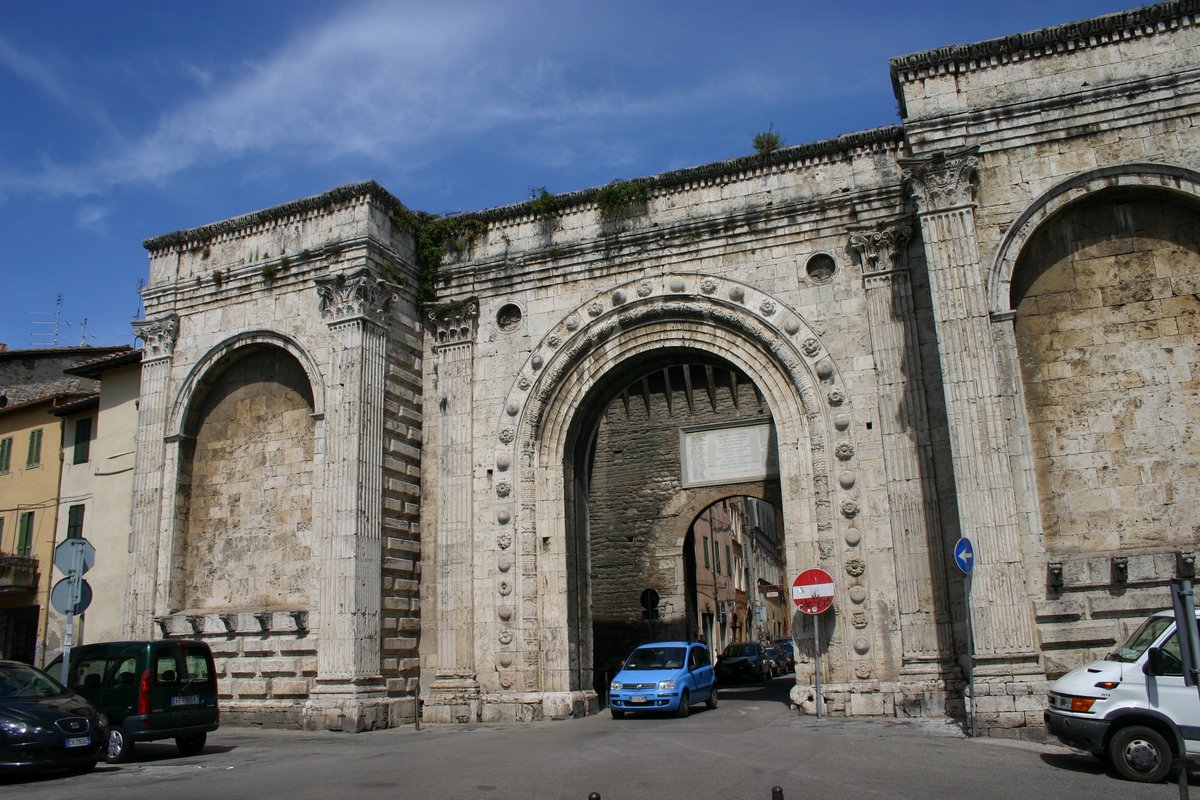 If you arrive in Perugia from the south, you'll almost certainly come across Porta San Pietro, one of the city's best-preserved historic gates. It's not just an entrance, but a true monument that immediately makes you realize you're in a special place. Built in the 14th century, this gate was part of the medieval walls and takes its name from the nearby Church of San Pietro, located right next to it. What strikes you first is its massive structure made of white and pink Subasio stone, with that large pointed arch that almost seems to embrace you as you pass underneath. I like to pause for a moment to look at the details: there are still traces of the ancient hinges and arrow slits, reminders of when entry and exit were controlled here. The view from the gate is spectacular: on one side you glimpse the bell tower of the Church of San Pietro, on the other opens the descent toward the valley, with those typical green hues of Umbria that look like they've been painted. You often find tourists taking photos here, but also locals passing by in a hurry, as if after centuries this gate has become a natural part of their daily life. A curious detail? If you look up, above the arch there's a coat of arms recalling the papal power of the time, a detail that tells how important Perugia was. In my opinion, passing through Porta San Pietro is a bit like traveling back in time: it prepares you for the intimate atmosphere of the historic center, with its narrow alleys and ancient buildings. It's not just a monument to see, but an experience to live, especially if you pass through at sunset, when the warm light enhances its colors even more.
Porta di Sant'Angelo
- Via Monteripido, Perugia (PG)
- Open in Google Maps
- View on Google Images
 If you're looking for a corner of Perugia that feels like it's stepped out of a history book, Porta di Sant'Angelo is the perfect spot. It's not just one of the best-preserved gates in the medieval city walls, but a genuine journey back in time. Built in the 14th century, it's located in the northern part of the city, near the Porta Sant'Angelo district, and welcomes you with its massive structure of white and pink Subasio stone. What immediately catches the eye is the pointed arch, typical of Gothic architecture, which leads into an inner courtyard with an almost suspended atmosphere. Look closely above the arch: traces of the original coats of arms and decorations are still visible, though time has taken its toll. I find it interesting to note how this gate was a strategic point for controlling access to the city, connected to the defensive system that included towers and bastions. Today, crossing it means moving from a more modern area to one of Perugia's most authentic historic cores, with cobblestone streets inviting exploration. Personally, I love stopping here at sunset, when the warm light enhances the stone's colors and creates evocative shadow play. It's not as crowded as other attractions, so you can enjoy it at your leisure, perhaps imagining the pilgrims and merchants who once passed through. If you're passionate about photography, the architectural details offer incredible inspiration, from the carvings on the walls to the glimpse of the Umbrian countryside visible on the other side. Plus, it's free and always accessible, making it a perfect stop for travelers on a budget. Some say it's less spectacular than Porta San Pietro, but in my opinion, it has a more intimate and cozy charm, ideal for those wanting to discover a less touristy side of the city. Just remember to wear comfortable shoes, as the surrounding area is on a slope and the stones can be slippery when it rains.
University of Perugia Botanical Garden
- Strada della Pallotta, Perugia (PG)
- Open in Google Maps
- View on Google Images
 If you think Perugia is only about art and history, the University Botanical Garden will make you think again. This green space of over 3 hectares, founded in 1962, is a true green lung just steps from the historic center, yet it feels like a world apart. I arrived there almost by chance, following a small street descending from the center, and found myself immersed in unexpected tranquility. The collection includes around 3,000 different species, organized into thematic sections that tell botanical stories from around the world. What struck me most was the tropical greenhouse, a warm, humid environment where exotic plants like orchids and giant ferns grow – it feels like being in a rainforest, not in Umbria. Then there are the medicinal plants, with labels explaining their traditional uses, and the area dedicated to Umbrian flora, which helps you understand the biodiversity of this region. Walking along the paths, I noticed many university students studying in the shade of the trees, and families with children exploring curiously. The atmosphere is relaxed and informal, far from the tourist crowds. This isn't just an ornamental garden: here, scientific research is conducted, rare species are conserved, and respect for nature is taught. Personally, I really appreciated the pond with water lilies and aquatic plants, a peaceful corner where you can stop to observe dragonflies and small fish. It might not be the first attraction that comes to mind in Perugia, but in my opinion, it's worth a visit, especially if you want to take a break from museums and enjoy some greenery. A tip: check the opening hours, as it sometimes closes before sunset.
Giardini del Frontone
 When you think of Perugia, medieval alleyways or art museums might come to mind, but there's a green corner that often escapes the more beaten paths: the Giardini del Frontone. Located right beneath the Rocca Paolina, in a position that offers a spectacular view of the city and the Umbrian hills, this is not just a simple park: this space has a history dating back to the 18th century, when it was designed as an area for public spectacles and festivities. Today, strolling along its tree-lined avenues and well-kept flowerbeds makes you feel far from the hustle and bustle, even though you're just a stone's throw from the city center. I particularly like the panoramic terrace, where you can sit on a bench and watch the city's comings and goings from above, perhaps with an ice cream in hand. It's the perfect spot for a refreshing break, especially if you've just visited the nearby monuments and are looking for a moment of respite. The gardens aren't huge, but they have an intimate and well-maintained atmosphere, with centuries-old trees providing shade on hot days. Sometimes you might stumble upon impromptu events or small concerts, but usually it's a tranquil place, frequented by university students and local families. Personally, I find it a pleasant addition to a cultural itinerary, as it effortlessly combines nature and history. Remember that admission is free and open year-round, though in spring and summer it's at its most splendid, with blooms adding color to the panorama.
Città della Domenica: The Dream Park for Families
- Strada delle Pulite, Perugia (PG)
- https://www.cittadelladomenica.it/
- Open in Google Maps
- View on Google Images
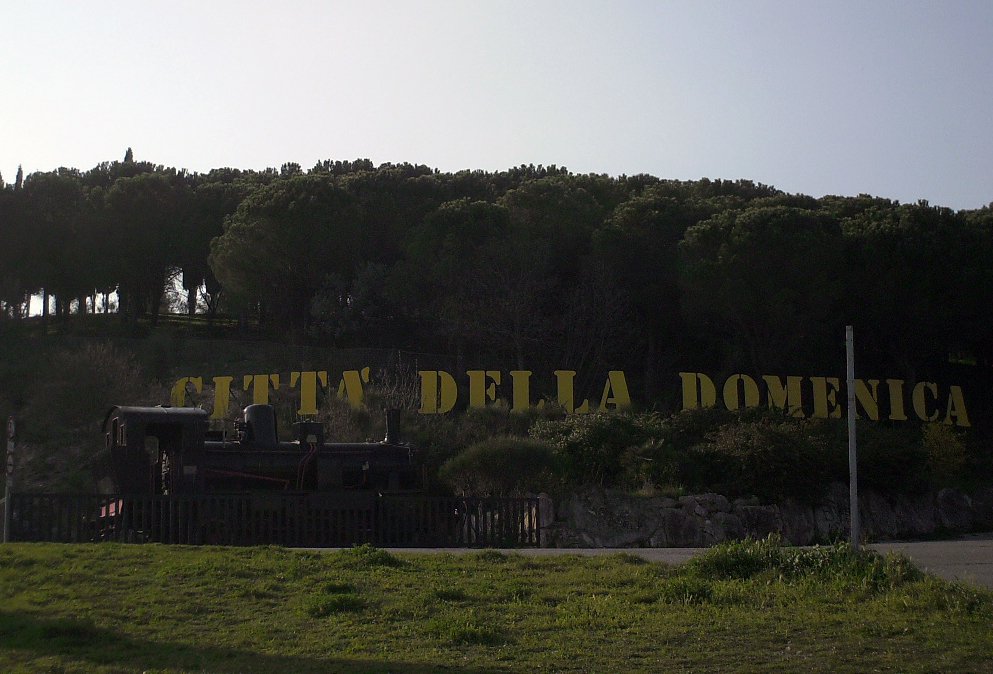 If you think Perugia is only about Renaissance art and medieval alleys, get ready for a surprise. Città della Domenica is a theme park that has existed since 1963, and it has something special you won't find elsewhere. It's not just a zoo or an amusement park: it's a place where imagination takes shape among the Umbrian hills. There are areas dedicated to classic fairy tales, like Little Red Riding Hood's house or Pinocchio's village, recreated with that vintage charm that appeals to both parents and children. Then there are the animals: not only common species, but also deer, donkeys, and peacocks that roam freely in some areas, creating spontaneous encounters that make the visit unpredictable. I remember a peacock deciding to fan its tail just as we were passing by – a free spectacle you won't forget. The park is immersed in greenery, with shaded paths and panoramic viewpoints over Perugia, perfect for a break. Be aware: don't expect adrenaline-pumping rides or cutting-edge technology. Here, you come to slow down, breathe fresh air, and smile at details like dwarf statues or the little train that circles the park. It's a simple, somewhat retro, but authentic experience. I recommend checking the opening hours before going, as they vary by season, and bringing a snack – even though there's a bar, having a picnic on the grass is always better.