
🧭 What to Expect
- Ideal for a cultural weekend blending Roman history, medieval charm, and Shakespearean romance.
- Compact and lively historic center, a UNESCO site, best explored on foot.
- Iconic attractions: a perfectly functioning Arena for opera performances and Juliet's House with its balcony.
- Historic squares, bridges over the Adige River like the Scaliger Bridge, and Romanesque churches such as San Zeno.
- Offers excellent Veneto cuisine and an elegant atmosphere, with practical tips for your visit.
Events nearby

Verona is not just the city of Romeo and Juliet, but a true open-air museum that captivates with its unique atmosphere. The Verona Arena, a Roman amphitheater from the 1st century AD, is still used today for spectacular opera performances and concerts, an experience that makes you feel part of history. Strolling through the UNESCO-listed historic center, you'll come across Piazza delle Erbe, the ancient Roman forum transformed into a lively market, and Piazza dei Signori, the medieval political heart with the Scaliger Tombs. You can't miss Juliet's House, with the famous balcony that inspired Shakespeare, though crowds are often large. For some tranquility, head to Castelvecchio, a Scaliger fortress housing a museum rich in artworks, and the Scaliger Bridge, perfect for taking photos over the Adige River. The Basilica of San Zeno Maggiore, a Romanesque masterpiece, houses a polyptych by Mantegna and a suggestive crypt. If you have time, climb the Lamberti Tower for a panoramic view of the city or relax in the Giusti Garden, a Renaissance oasis. Verona is best explored on foot: focus on the main attractions over a weekend, avoiding peak hours for Juliet's House and booking in advance for the Arena if you want to attend a performance. The typical restaurants around Piazza delle Erbe are great for tasting bigoli with donkey ragù or pastissada, but if you're looking for something more authentic, wander a few alleys away.
Overview
Itineraries nearby


Arena of Verona
 When you think of Verona, the Arena is likely the first image that comes to mind. This imposing Roman amphitheater, built in the 1st century AD, is one of the best-preserved ancient monuments in the world and dominates Piazza Bra, the vibrant heart of the city. With its three tiers of arches made from local limestone, the Arena could accommodate up to 30,000 spectators in Roman times for gladiatorial games and naval battles. Today, after restoration that preserved its integrity, it has become a unique stage for cultural events, especially during the summer season. Its exceptional acoustics make it perfect for concerts and, above all, for the famous Arena opera season, which attracts enthusiasts from around the world. Climbing the steps, even just for a daytime visit, offers a breathtaking view of the square and the city, allowing you to imagine life in ancient Verona. Inside, you can explore the underground corridors and galleries, discovering architectural details like the still-visible Latin inscriptions. The Arena is not just a monument to admire, but a living place: if you visit Verona in summer, check the event calendar, because attending an opera like 'Aida' or a concert under the stars is an unforgettable experience. For your visit, I recommend purchasing tickets online in advance, especially during peak season, to avoid queues. Remember that access is facilitated, with routes for people with reduced mobility, and outside you'll find several benches to rest after discovering this Roman gem.
Juliet's House
- Go to the page: Juliet's House in Verona: Historic Balcony, Statue of Fortune, and Love Letters
- Via Cappello, Verona (VR)
- https://www.lettodigiulietta.it/
- Open in Google Maps
- View on Google Images
 It's impossible to visit Verona without stopping at Juliet's House, the place that inspired Shakespeare's tragedy and now attracts millions of visitors. Located on Via Cappello in the heart of the historic center, this medieval residence dates back to the 13th century and belonged to the Dal Cappello family, whose coat of arms is still visible above the entrance arch. The house is most famous for its stone balcony, from which, according to legend, Juliet leaned to speak with Romeo. Inside, you can visit the courtyard, always crowded with tourists taking photos under the balcony or touching Juliet's statue for good luck in love. Upstairs on the first floor, you can access rooms furnished with period furniture and paintings that recreate the Renaissance atmosphere, along with a collection of ceramics and costumes related to the tragedy's history. An interesting detail: the courtyard walls are covered with love notes and padlocks left by visitors, a modern tradition that has added to the charm of the place. To enter, it's advisable to purchase tickets online to avoid long lines, especially on weekends and during peak season. The house is open year-round, with extended hours in summer, and admission includes access to the internal museum. Whether you love literature or simply want to breathe in a romantic atmosphere, this is a place not to be missed, even though its historical authenticity is debated: Shakespeare never visited Verona, but the myth has made this corner one of the city's most iconic symbols.
Piazza delle Erbe
 Piazza delle Erbe has been the historic and commercial center of Verona since Roman times, when the forum stood here. Today it's a vibrant and colorful place, dominated by the Column of San Marco with its winged lion, symbol of the Serenissima Republic, and the Madonna Verona Fountain, a Roman statue from the 1st century that gives the square its name. Surrounded by historic buildings like the Baroque-style Palazzo Maffei and the Palazzo della Ragione with its medieval tower, the square hosts a daily market of fruits, vegetables, and souvenirs, maintaining a centuries-old tradition. Don't miss the characteristic market umbrellas of the vendors, which create a unique atmosphere, and the surrounding spots to stop for an aperitivo. In the evening, the square lights up and becomes even more enchanting, perfect for a post-dinner stroll. It's a place where history blends with daily life, making it one of the most authentic spots in the city.
Roman Theatre
- Go to the page: Roman Theatre of Verona: Panoramic View of the Adige River and Archaeological Museum
- Via Redentore, Verona (VR)
- Open in Google Maps
- View on Google Images
 If you think Verona is just the Arena and Juliet's House, prepare for a pleasant surprise: the Roman Theatre is an archaeological gem that takes you back over two thousand years. Built in the 1st century BC, this theatre is one of the oldest and best-preserved in Northern Italy, though less famous than other city monuments. Its location is spectacular: perched on the slopes of San Pietro Hill, it overlooks the Adige River directly, offering a breathtaking view of the historic centre and surrounding hills. The cavea, or seating area for spectators, is carved into the rock and could accommodate up to 5,000 people, an impressive number for the time. Today, during summer, the theatre comes alive with performances and concerts as part of the Estate Teatrale Veronese festival, a unique experience that lets you watch a show in the same place where ancient Romans enjoyed entertainment. Next to the theatre, don't miss the Archaeological Museum, housed in the former San Girolamo monastery, which holds artefacts found in the area, including mosaics, statues, and everyday objects. The climb to the theatre is a bit challenging, but it's absolutely worth it: once at the top, you can admire the remains of the stage and orchestra, as well as enjoy an unforgettable panorama of Verona. It's a perfect spot for a break away from the crowds, ideal for those seeking a bit of tranquillity and a dive into the city's most authentic history.
Basilica of San Zeno Maggiore
- Go to the page: Basilica of San Zeno Maggiore: Bronze Portal and Mantegna's Altarpiece in Verona
- Piazza San Zeno, Verona (VR)
- Open in Google Maps
- View on Google Images
 If you think Verona is only about the Arena and Juliet's balcony, prepare for a pleasant surprise: the Basilica of San Zeno Maggiore is an often-underestimated gem that absolutely deserves a visit. Located in the namesake square, just steps from the historic center but in a quiet area, this church is considered one of the most perfect examples of Romanesque architecture in Italy. Its façade of tuff and Verona pink marble immediately catches the eye, with the majestic wheel of fortune rose window and the imposing bronze panels of the portal that tell biblical stories and the life of San Zeno. Upon entering, you are struck by the solemn atmosphere and the soft light filtering through the windows, creating an intimate and evocative environment. Inside, don't miss the high altar with the famous San Zeno Altarpiece by Andrea Mantegna, a Renaissance masterpiece that seems to almost defy the laws of perspective. Beneath the church, the crypt preserves the urn with the relics of Verona's patron saint, while the adjacent cloister offers a peaceful corner with its marble colonnades. The basilica also houses Verona's oldest organ, still functioning during celebrations. A curious detail: look for the statue of San Zeno laughing, an unusual and friendly icon that characterizes this place. Admission is free, but a small ticket is required to access the crypt and cloister. I recommend checking the opening hours, which may vary based on religious functions, and dedicating at least an hour to appreciate every detail. If you're lucky, you might attend an organ concert or a mass with Gregorian chants, experiences that make the visit even more memorable. Perfect for those who love art, history, or simply seek a moment of tranquility away from the crowds, the Basilica of San Zeno is an unmissable stop that enriches any Veronese itinerary.
Castelvecchio
- Go to the page: Castelvecchio Verona: Scaliger Fortress with Art Museum and Bridge over the Adige River
- Via Roma, Verona (VR)
- Open in Google Maps
- View on Google Images
 If you think Verona is only about the Arena and Juliet's balcony, prepare for a pleasant surprise: Castelvecchio is an often-underestimated gem that is absolutely worth a visit. Built in the 14th century by Cangrande II della Scala as a defensive fortress, this imposing complex overlooks the Adige River directly, offering picturesque views especially from the Scaliger Bridge, rebuilt after the bombings of World War II. Today it houses the Castelvecchio Civic Museum, one of the richest art collections in Veneto, with works ranging from the Middle Ages to the 18th century. Don't miss masterpieces by artists like Pisanello, Mantegna, and Bellini, along with sculptures, ancient weapons, and archaeological finds. The structure itself is fascinating: walk among the battlements, explore the frescoed halls, and climb the towers for a panoramic view of the city. It's a perfect place for those who love history without sacrificing art, and the atmosphere is more tranquil compared to the more crowded sites. I recommend dedicating at least a couple of hours to appreciate everything, perhaps combining the visit with a stroll along the banks of the Adige.
Castelvecchio Museum
- Go to the page: Castelvecchio Museum: Scaliger Art and Carlo Scarpa's Architecture in Verona
- Corso Castelvecchio 2, Verona (VR)
- https://museodicastelvecchio.comune.verona.it/
- Open in Google Maps
- View on Google Images
- +39 045 8062611
 If you think Verona is just about the Arena and Juliet's balcony, get ready for a pleasant surprise: the Castelvecchio Museum is one of those places that truly lets you understand the soul of the city. Located in the namesake castle, built in the 14th century by Cangrande II della Scala as a defensive fortress, it now houses one of the most important art collections in the Veneto region. It's not just a museum, but an experience that blends medieval architecture with artistic masterpieces. The visit begins by crossing the Scaliger Bridge, rebuilt after World War II, which alone is worth the ticket for its views over the Adige River. Once inside, you'll find a chronological journey spanning from the Middle Ages to the 18th century, with works by masters like Pisanello, Mantegna, and Bellini. The Gothic sculpture hall with the equestrian statues of the Scaligeri is breathtaking, while the Renaissance rooms captivate you with religious-themed paintings and portraits. Don't miss the section dedicated to ancient weapons and archaeological finds, which tell the military history of Verona. The layout, designed by architect Carlo Scarpa in the 1950s, is a masterpiece of museum design: the lighting, pathways, and display cases seem to converse with the artworks, making the visit even more engaging. I recommend dedicating at least a couple of hours to explore all the rooms calmly and enjoy the details, perhaps ending with a walk along the castle walls to admire Verona from above. It's a museum suitable for everyone, from art enthusiasts to those seeking a quiet corner away from the crowds. The entrance ticket also includes access to the nearby Archaeological Museum, so you can optimize your cultural day. If you visit Verona, skipping Castelvecchio would be a shame: it's here that history comes alive between ancient walls and timeless masterpieces.
Piazza dei Signori
- Piazza dei Signori, Verona (VR)
- Open in Google Maps
- View on Google Images
 As you pass through the arch connecting it to Piazza delle Erbe, Piazza dei Signori welcomes you with an atmosphere of solemn elegance, a true Renaissance salon in the heart of Verona. Also known as Piazza Dante due to the statue of the poet at its center, this rectangular square has been the political power center of the city for centuries, dominated by the powerful Scaliger family. Here, every building tells a story: the Palazzo del Comune, with its imposing facade and access to the Lamberti Tower, offers breathtaking views of the city if you decide to climb its 368 steps. Opposite, the Palazzo del Governo, seat of the Venetian rulers, displays Venetian Gothic style, while the Palazzo della Ragione, one of Italy's oldest public palaces, hosts frescoes and temporary exhibitions. Don't miss the Scaliger Tombs, the monumental sepulchers of Verona's lords, protected by a wrought iron fence that is a masterpiece of medieval craftsmanship. The square is a perfect place for a break, perhaps sitting at the feet of Dante's statue or observing architectural details like the Loggia of Fra Giocondo. In the evening, the lighting emphasizes the shadows and textures of the stones, creating an almost theatrical atmosphere. It's an ideal starting point for exploring the historic center, just steps from Juliet's House and the Arena, yet here time seems to have stopped in Verona's golden age.
Cathedral of Santa Maria Matricolare
- Go to the page: Verona Cathedral: Titian's Altarpiece, Renaissance Frescoes, and Early Christian Crypt
- Piazza Duomo, Verona (VR)
- http://www.cattedralediverona.it/
- Open in Google Maps
- View on Google Images
 If you think Verona is only about the Arena and Juliet's balcony, prepare for a pleasant surprise: the Cathedral of Santa Maria Matricolare is an often-underestimated gem that absolutely deserves a visit. Located in the heart of the historic center, just steps from Ponte Pietra and the Adige River, this cathedral is the main Catholic place of worship in the city and a true history book in stone. Its typically Romanesque facade, made of white and pink marble, welcomes you with a portal decorated with prophets and biblical scenes that seem to tell ancient stories. Upon entering, you'll be struck by the harmony of the spaces: the central nave is wide and bright, with columns supporting round arches, while the side chapels house priceless works of art. Don't miss Titian's Assumption of the Virgin, a painting that shines with intense colors in the Mazzanti Chapel, and the baptismal font where, according to tradition, Verona's patron saint, San Zeno, was baptized. The cathedral stands on an ancient worship site: here there was already a Paleo-Christian basilica and, even earlier, a Roman temple. Descending into the crypt, you can see the remains of these earlier structures—a journey through time that lets you touch the historical layers of the city. Admission is free, but if you want to delve deeper, consider the audio guide available at the entrance. Remember to dress appropriately (covered shoulders and pants or skirts below the knee) and maintain silence during services. For a memorable photo, position yourself in Piazza Duomo to capture the entire facade with the bell tower in the background. The Cathedral of Santa Maria Matricolare is not just a religious stop but an experience that immerses you in the most authentic soul of Verona, away from the crowds of more touristy spots.
Lamberti Tower
- Cortile del Mercato Vecchio, Verona (VR)
- https://www.torredeilamberti.it/
- Open in Google Maps
- View on Google Images
 If you're looking for a privileged viewpoint over Verona, the Lamberti Tower is your destination. Standing at 84 meters tall, it's the city's highest tower and majestically overlooks Piazza delle Erbe, offering a 360-degree view that stretches from the red roof tiles to the surrounding hills. Its construction began in 1172 at the behest of the Lamberti family but was only completed centuries later, in 1464, with the addition of the octagonal bell chamber in white and red Veronese marble. Today, you can comfortably reach the top via the modern elevator or, if you're feeling adventurous, by tackling the 368 steps of the original spiral staircase. Once at the top, your gaze will embrace iconic landmarks: the Verona Arena, the Scaliger Bridge, the Basilica of San Zeno, and even the gentle curves of the Adige River. Don't miss the historic bells: the Rengo, which called the City Council to assembly, and the Marangona, which marked the start and end of the workday. The tower is open year-round, with slightly varying hours between summer and winter, and the entrance ticket also includes access to the nearby Achille Forti Modern Art Gallery in the Palazzo della Ragione. Practical tip: avoid peak hours to enjoy the climb more leisurely and, if possible, choose a clear day for unforgettable photos.
Scaliger Bridge
- Go to the page: Scaliger Bridge of Verona: Medieval bridge from 1354 with three red brick arches
- Ponte Castelvecchio, Verona (VR)
- Open in Google Maps
- View on Google Images
 If you think Verona only has the Arena and Juliet's balcony, prepare for a pleasant surprise: the Scaliger Bridge, also known as Castelvecchio Bridge, is an architectural gem that will leave you in awe. Built in the 14th century at the behest of Cangrande II della Scala, this red-brick bridge originally served as an escape route from Castelvecchio, the fortified residence of the Scaliger family. Its massive structure, with three asymmetrical arches, is a masterpiece of medieval engineering, designed to withstand the floods of the Adige River. During World War II, the bridge was blown up by retreating German troops but was faithfully reconstructed between 1949 and 1951 using original materials retrieved from the river. Today, walking across the Scaliger Bridge is an immersive experience: on one side, you admire the crenellated walls of Castelvecchio, which houses an important civic museum; on the other, you lose yourself in the panoramic view of the river and the city's rooftops. The bridge is pedestrian-only and always accessible, making it perfect for a romantic sunset stroll or for capturing unforgettable photos. Don't forget to observe the details, such as the defensive arrow slits and side towers, which tell centuries of Veronese history. If you visit the Castelvecchio Museum, admission also includes access to the bridge—an excellent opportunity to delve deeper into the history of the Scaligeri. In short, the Scaliger Bridge is not just a link between two banks but a symbol of resilience and beauty that embodies the spirit of Verona.
Giusti Garden
- Via Giardino Giusti, Verona (VR)
- https://giardinogiusti.com/
- Open in Google Maps
- View on Google Images
- info@giardinogiusti.com
 If you're looking for a peaceful corner away from the crowds at the Arena and Juliet's House, Giusti Garden is the perfect answer. This Renaissance gem, created in the late 1500s for the noble Giusti family, is one of the best-preserved Italian-style gardens in Northern Italy. As soon as you pass through the entrance, you're greeted by an avenue of centuries-old cypress trees, some over 40 meters tall, leading you to the heart of the park. The real surprise is the boxwood hedge maze, one of the oldest in Europe still walkable: getting lost in its paths is a fun and evocative experience, especially for families. Climbing up the slope, you reach the panoramic terrace, offering views over Verona's rooftops, the Adige River, and the surrounding hills—a picture-perfect panorama that's absolutely worth a photo. In the garden, you'll also find mythological statues, artificial grottoes, and a rich botanical collection with citrus trees, roses, and rare plants. It's an ideal spot for a refreshing break, where you can soak in history and nature all at once. I recommend visiting early in the morning or late in the afternoon to enjoy the best light and a more tranquil atmosphere.
Church of Sant'Anastasia
- Go to the page: Church of Sant'Anastasia: Veronese Gothic with frescoes by Pisanello and the Hunchback
- Via Don Bassi, Verona (VR)
- https://www.chieseverona.it/it/
- Open in Google Maps
- View on Google Images
 If you think Verona is just about the Arena and Juliet, get ready for a pleasant surprise: the Church of Sant'Anastasia is one of those places that makes you understand why this city is a UNESCO World Heritage site. Located in the square of the same name, just steps from the Adige River, this Gothic basilica dominates the skyline with its red brick facade, unfinished yet full of character. Upon entering, you'll be struck by the high vaulted ceiling and the light filtering through the stained-glass windows, creating an almost mystical atmosphere. But it's when you look down that you'll discover a curiosity: the 'hunchbacks' of Sant'Anastasia, two statues of kneeling figures holding the holy water fonts at the entrance. They have become a symbol of the church, and according to tradition, touching them brings good luck. Don't miss the frescoes by Pisanello in the Pellegrini Chapel, although unfortunately only one has survived in good condition. The main altar, with its gilded wooden polyptych from the 15th century, is another work to admire at leisure. The church is open year-round, with slightly varying hours between summer and winter, and admission is by free donation. A tip? Go in the morning, when the light is best for appreciating the architectural details and there are fewer crowds than in the afternoon. It's a plunge into Veronese art and history, away from the beaten path but absolutely unmissable.
Church of San Fermo Maggiore
- Go to the page: Church of San Fermo Maggiore: Ship's Keel Ceiling and Medieval Frescoes in Verona
- Stradone San Fermo, Verona (VR)
- Open in Google Maps
- View on Google Images
 If you think you've seen everything in Verona, get ready for a surprise: the Church of San Fermo Maggiore is a place that often escapes the most beaten tourist paths, but it's absolutely worth a visit. Located along the Adige River, near Ponte Navi, this church has a unique feature: it consists of two superimposed buildings, a lower Romanesque one and an upper Gothic one. Upon entering, you'll be struck by the ship's keel ceiling, a 14th-century wooden masterpiece resembling an overturned boat hull, decorated with golden stars and figures of saints. The 14th-century frescoes, such as those in the Brenzoni Chapel, tell stories of martyrs and saints with vibrant colors that have withstood time. Don't miss the tomb of Guglielmo di Castelbarco, a Gothic-style funerary monument that testifies to the importance of the Scaliger families in Veronese history. The lower church, older and more evocative, preserves an intimate atmosphere with remains of frescoes and a crypt, perfect for a moment of tranquility away from the crowd. Admission is paid, but the ticket often includes access to other religious sites in the city, making it an excellent option for those wanting to delve deeper into Veronese art. I recommend checking the opening hours, which may vary seasonally, and dedicating at least half an hour to explore both levels. It's an ideal spot for lovers of architecture and history, but also for those seeking a peaceful corner in the heart of Verona.
Piazza Bra
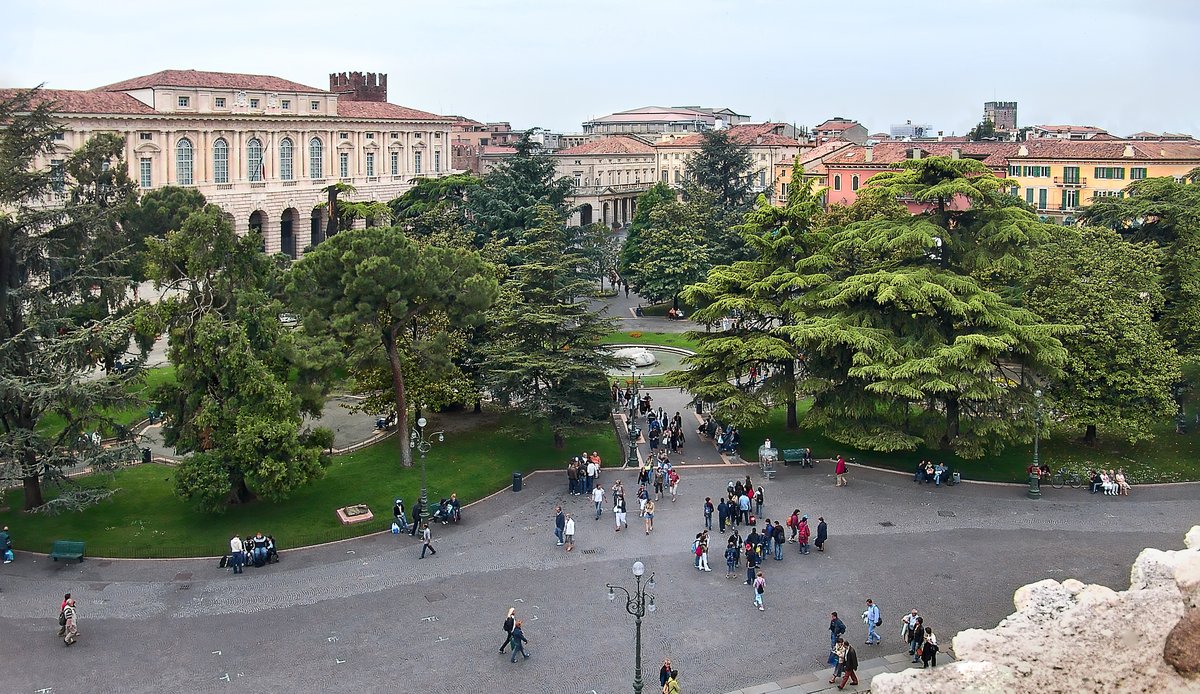 If you're looking for the ideal starting point to explore Verona, Piazza Bra is the answer. This square, the largest in the city, isn't just an open space, but the true nerve center of Veronese life. As soon as you set foot here, you immediately understand why: on one side, the imposing Arena di Verona dominates the scene with its Roman majesty, while on the other, the Portoni della Bra, the ancient medieval entrance, remind you that eras blend here. The square is a lively place where tourists and locals meet for a stroll under the centuries-old plane trees or for a coffee in one of the many venues with a view. At its center, the Liston, the red Veronese marble sidewalk, is the traditional meeting point for the evening passeggiata. Don't miss the Fontana delle Alpi, a gift from the Trentino region, and Palazzo Barbieri, the town hall, whose neoclassical façade adds a touch of elegance. Piazza Bra is also the starting point to reach Juliet's House with a short walk, but here, amidst the buzz of conversations and the shade of the trees, you can already breathe in the unique atmosphere of Verona, made of history, art, and everyday life.