In the historic center of Mazara del Vallo, the former church of Sant’Egidio (15th century) houses the Museum of the Dancing Satyr, an archaeological museum centered on the eponymous Greek bronze statue. Found in two phases by the fishing boat ‘Capitan Ciccio’ in 1997-98, the statue is 2 meters tall and weighs 96 kg, depicted in a dancing pose with preserved eyes made of alabaster limestone. Besides the satyr, the museum displays underwater artifacts such as amphorae and a fragment of a Punic-Hellenistic elephant foot.
The highlight: the statue of the Dancing Satyr, a Hellenistic masterpiece attributed to the school of Praxiteles.
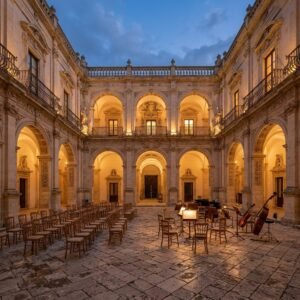
The setting: the deconsecrated church of Sant’Egidio, of high architectural interest.
Accessibility: easy wheelchair access and special lighting for the visually impaired.
Tickets: full €7, reduced €3.50, free under 18.
An Evocative Introduction
Entering the Museum of the Dancing Satyr is like diving into the past. Imagine: you’re in a deconsecrated 16th-century church in Mazara del Vallo, and suddenly you come face to face with a two-meter-tall Greek bronze statue, captured in mid-leap. The Dancing Satyr looks at you with eyes of alabaster limestone, still vivid after centuries. It’s an emotion hard to describe – you almost expect it to move. The museum is small and intimate, but what it holds is unique: a masterpiece pulled from the sea.
Historical Notes
The church of Sant’Egidio, which houses the museum, was built at the beginning of the 16th century. But the real story begins in 1997, when the fishing trawler ‘Capitan Ciccio’ recovered a bronze leg from the Sicilian Channel. On the night of March 4, 1998, from the same seabed at a depth of 500 meters, the rest of the statue emerged. After restoration in Rome, the Satyr has been on display here since 2005. In 2018, a new intelligent lighting system enhanced its details, also designed for visually impaired visitors.
The Dancing Satyr: A Bronze Masterpiece
The statue is attributed to the school of Praxiteles (4th century BC) and weighs 96 kg. It depicts a satyr in ecstasy, with his head tilted back, hair tousled by dance, and torso in torsion. Originally he held a thyrsus in his right hand and a panther skin with a cup in his left. The eyes, made of alabaster limestone with glass paste, are perfectly preserved. It is an extremely rare example of Greek bronze statuary, and seeing it up close makes you understand why it is considered a treasure.
More Artifacts from the Strait of Sicily
In addition to the Satyr, the museum displays artifacts recovered from the same seabed. Not to be missed: a bronze fragment of an elephant’s foot from the Punic-Hellenistic period, a medieval bronze cauldron, and a rich selection of amphorae spanning from the Archaic period to the Middle Ages. There are also two iron cannons and some Corinthian and Ionic capitals. Each piece tells of a shipwreck, an interrupted journey. The variety is surprising: from the sacred to the everyday, everything was transported by sea.
Why Visit It
Three concrete reasons. First: admire an original Greek bronze statue, a rarity since most ancient works are marble or Roman copies. Second: the intimate atmosphere of the former church, with carefully designed lighting that changes during the visit, almost theatrical. Third: it’s a dive into the history of Sicily and the Mediterranean, among fishermen, shipwrecks, and ancient trade. And let’s face it, seeing the ecstatic expression of the Satyr up close is something that stays with you.
When to Go
The museum is open year-round, but the best time is late afternoon, when the sunlight fades and filters through the church windows, creating an even more evocative atmosphere. If you visit on weekdays, you’ll avoid the weekend crowds. In summer, Mazara is lively, but the museum remains a cool oasis. In winter, with fewer tourists, you can enjoy the Satyr almost in solitude.
In the Surroundings
Just a stone’s throw from the museum, get lost among the alleys of the historic center. Don’t miss: the Saracinesche street art trail, with murals coloring the old shop shutters, and the Cortile della Giudecca, a remnant of the ancient Jewish quarter. If you are a fan of sacred art, the Diocesan Museum is a few minutes away. And for a sweet break, stop at one of the pastry shops on the main street to taste Sicilian cassata.