If you love history at your fingertips, historic Rimini is your ideal destination. This one-day walking itinerary takes you to discover the city’s Roman and medieval gems. Starting from the Tiberius Bridge, a symbol of ancient engineering, you’ll walk to the Arch of Augustus, the oldest surviving Roman arch. Then, in the heart of the center, you’ll visit the Surgeon’s Domus, an archaeological site preserving medical instruments from two thousand years ago. The route continues toward Castel Sismondo, an imposing Malatesta fortress. A perfect mix of monuments, museums, and charming alleyways, all in a relaxing walk. It’s an experience combining culture and discovery, ideal for those wanting to savor the essence of Rimini away from the summer nightlife. Follow the footsteps of the Romans and Renaissance lords, on a path that will make you fall in love with this Adriatic city.
🗺️ Your trip at a glance
A compact yet history-rich itinerary, perfect for a day discovering ancient Rimini. Among Roman bridges, archaeological domus, and medieval castles, this walking route offers a dive into the past just steps from the sea.
- Ideal for: history and archaeology enthusiasts who want an immersive cultural experience in a few hours.
- Key highlights: exceptionally well-preserved Roman monuments, a unique archaeological museum, and an imposing medieval fortress.
- What to do: a walk of about 3 km among Rimini’s iconic sites, with entry included to the Surgeon’s Domus and breathtaking views of the Tiberius Bridge.
Itinerary stops
Stop no. 1
Tiberius Bridge: The Roman Bridge That Defies Time
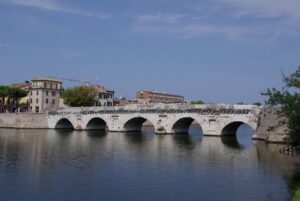
 The first stop on our itinerary could only be the ultimate symbol of Rimini: the Tiberius Bridge. Built between 14 and 21 AD, it is one of the best-preserved Roman bridges in the world. Its five arches of Istrian stone have withstood earthquakes, floods of the Marecchia River, and even wartime destruction attempts. Today it’s pedestrian-only, welcoming you with its original basoli trachyte paving. Notice the blind niches and reliefs: an oak crown, a shield, an amphora. Legend calls it the ‘Devil’s Bridge’ for the mysterious goat-like hoofprints on the balustrade. From here the Via Emilia begins, and right under the bridge, the new Piazza sull’Acqua offers a unique perspective. Continue towards the San Giuliano district, but first pause to admire the majesty of this work that has spanned two millennia.
- Go to the page: Tiberius Bridge: A 1st-Century Roman Bridge Still Walkable in Rimini
- Viale Tiberio, Rimini (RN)
- Open in Google Maps
- View on Google Images

You should go if…
Stop no. 2
Arch of Augustus
 Second stop, the Arch of Augustus: a sight that takes your breath away. Built in 27 BC, it is the oldest surviving Roman arch in northern Italy. Made of Istrian stone, with a single span so wide that it never had doors – a sign of the Pax Augusta that guaranteed safety. Looking up, you notice the clipei with deities: Jupiter and Apollo face Rome, Neptune and the goddess Roma face the city. At the top, the medieval crenellation replaced the original attic, possibly collapsed due to an earthquake. On the sides, remains of the ancient walls. Until the 1930s it was embedded among houses and towers, then it was isolated to enhance its grandeur. Today it stands in a green area with benches to sit and admire it. On the pavement, a nail marks the intersection of Via Flaminia and Via Emilia. A tip: come here at sunset, when the warm light enhances its forms.
- Go to the page: Arch of Augustus: The Oldest Roman Arch in Italy
- Corso d’Augusto, Rimini (RN)
- Open in Google Maps
- View on Google Images
You should go if…
Stop no. 3
Domus of the Surgeon: Secrets of Roman Medicine
 Beneath Piazza Ferrari lies an archaeological gem: the Domus of the Surgeon, discovered in 1989 during urban refurbishment works. This 2nd-century AD residence belonged to a military doctor, Eutyches, as evidenced by the graffito ‘Eutyches homo bonus’. Walking along the suspended walkways, you admire the original mosaics: the one with Orpheus among the animals stands out, a symbol of the physician who soothes pain. But the real treasure is the surgical kit: over 150 bronze and iron instruments, now displayed at the City Museum. The domus was destroyed by a fire around 257 AD, possibly during the Alemanni invasion, and remained buried for centuries. A modern installation with glass and steel protects it, making the visit thrilling. Don’t miss the reconstruction of the taberna medica at the museum: it will feel like stepping into a doctor’s office from two thousand years ago.
- Go to the page: Domus del Chirurgo in Rimini: 150 Original Roman Surgical Instruments from the 3rd Century
- Piazza Luigi Ferrari, Rimini (RN)
- https://www.domusrimini.com/
- Open in Google Maps
- View on Google Images
You should go if…
Stop no. 4
Palazzo dell’Arengo: Power and Medievality in Piazza Cavour
 Leave behind the mosaics of the Domus del Chirurgo and reach Piazza Cavour, one of Rimini’s oldest living rooms. Dominating the square is the Palazzo dell’Arengo, built in 1204 at the behest of Podestà Modio de’ Carbonesi. It is the city’s oldest town hall, with its Ghibelline battlements and a portico with pointed arches among the first in Romagna. Beneath those vaults, justice was once administered: there was the lapis magnum, a stone on which insolvent debtors would bare their bottoms! Climbing to the first floor, the Hall of the Arengo welcomes you with wooden trusses and mullioned windows; here the People’s Council gathered and, from 1681 to 1857, it served as a theater. It is said that the young Carlo Goldoni attended performances there that inspired his comedies. Today, the palace, together with the adjacent Palazzo del Podestà, houses the Palazzi dell’Arte Rimini (PART), a contemporary art hub currently closed for renovation. A dive into the Middle Ages just steps from the center.
- Go to the page: Palazzo dell’Arengo in Rimini: Fourteenth-Century Frescoes and Medieval Heart in Piazza Cavour
- Vicolo San Martino, Rimini (RN)
- Open in Google Maps
- View on Google Images
You should go if…
Stop no. 5
Fountain of the Pinecone: Rimini’s Watery Living Room
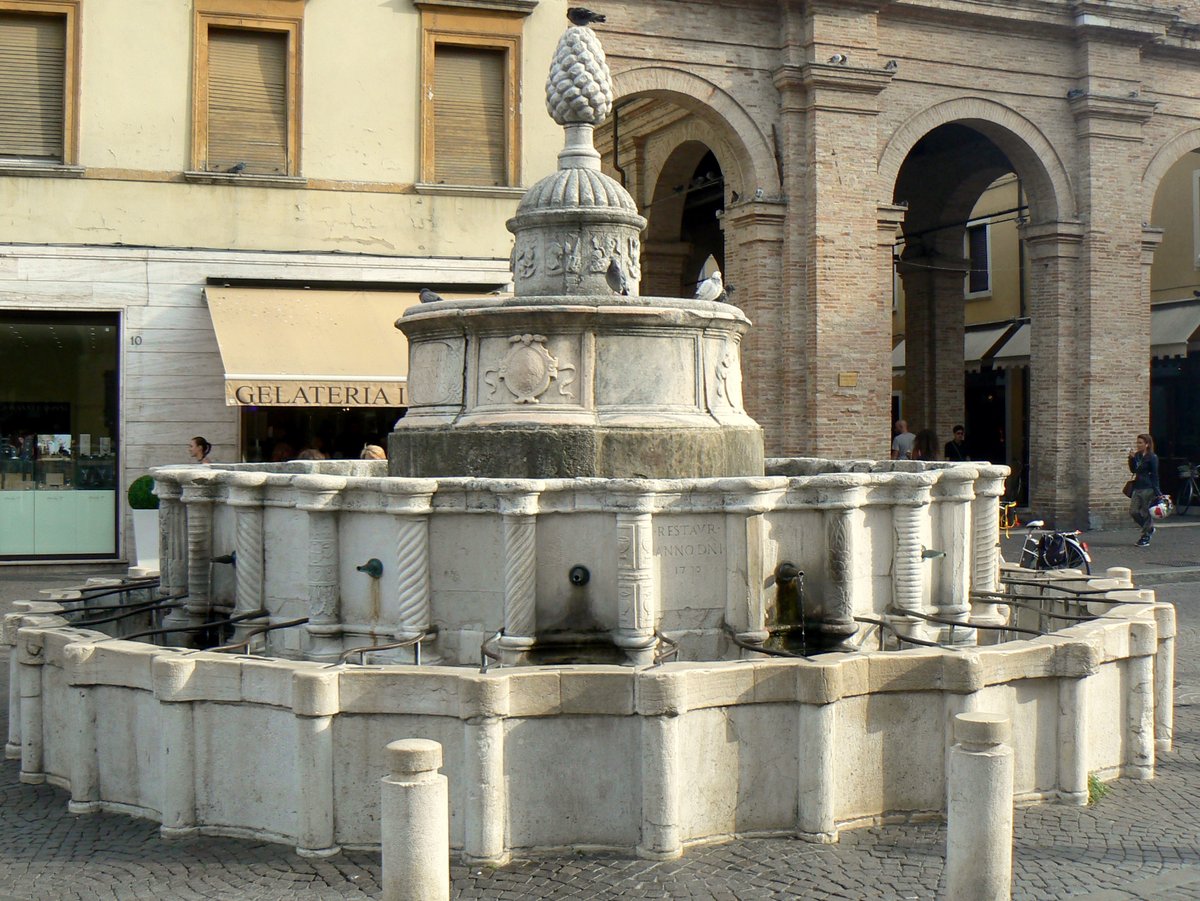 Continuing under the arcades of Piazza Cavour, you come across one of Rimini’s oldest symbols: the Fountain of the Pinecone. Rebuilt in 1543 by Giovanni da Carrara, it retains a Roman soul: the central drum supporting the pinecone is original, with ancient bas-reliefs, while the marble basins date from the 1400s. Until 1912 it was the city’s only source of drinking water – a legacy that still quenches the thirst of passersby today. During the Napoleonic period, the statue of Saint Paul on top was replaced by the pinecone (the original statue is now at the City Museum). On the fountain you’ll find a plaque with the words of Leonardo da Vinci, who wrote in 1502: “An harmony is made with the diverse falls of water.” I couldn’t resist: I took a sip of cool water, just as the people of Rimini once did. A corner of history that smells of the Renaissance.
- Go to the page: Pigna Fountain in Rimini: Renaissance basin from 1543 in Verona marble
- Piazza Cavour, Rimini (RN)
- Open in Google Maps
- View on Google Images
You should go if…
Stop no. 6
Castel Sismondo: The Malatestian Fortress Embracing Fellini
 From Piazza Cavour, the route leads you to the imposing mass of Castel Sismondo, the fortress commissioned by Sigismondo Pandolfo Malatesta starting in 1437. Built with the probable advice of Filippo Brunelleschi, it was intended to serve both as a lordly residence and a defensive bulwark. Today, after a restoration lasting decades, the castle houses a wing of the Fellini Museum: walking through its Renaissance halls, you come across installations recreating iconic scenes such as the Trevi Fountain from La Dolce Vita or the fog of Amarcord. The structure is complex, organized into four interconnected parts – Palazzo Isotta, central body, large courtyard, and Maschio – covering over 3,300 square meters. Outside, the square towers and sloping walls were once surrounded by a dry moat. Above the entrance stands the coat of arms with an elephant, rose, and chessboard, symbols of the Malatesta family. Until 1967 it was a prison, but today it is a vibrant cultural center. The entrance ticket (€12) includes access to the Fellini museum.
- Go to the page: Castel Sismondo: Malatesta Fortress and Fellini Museum
- Piazza Malatesta, Rimini (RN)
- Open in Google Maps
- View on Google Images
You should go if…