Temple of Hera II at Paestum: The Best Preserved in Magna Graecia

If you think you’ve seen Greek temples, the Temple of Hera II at Paestum will make you think again. It’s the best-preserved Doric giant in the world, and walking among its columns is a direct plunge into 450 BC. This article explains why it’s worth visiting, what makes this site unique, and how to best plan your trip.

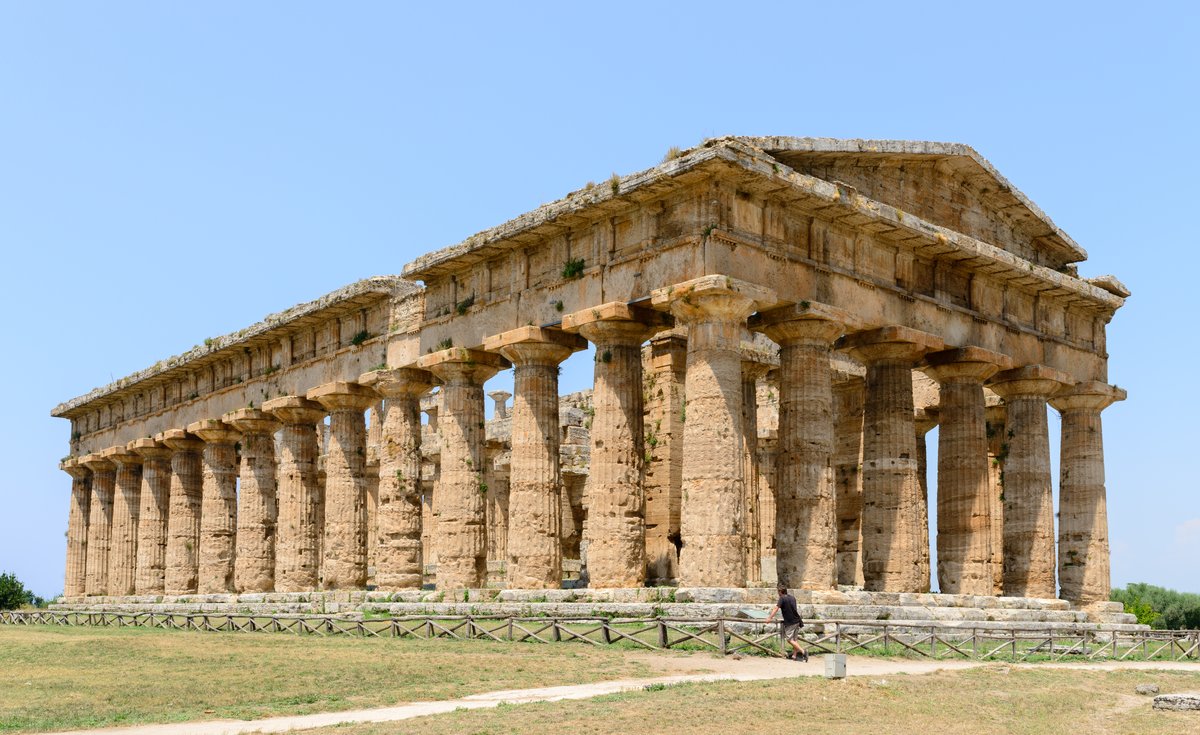
Perfect Columns: 36 Doric columns standing 9 meters tall, all original and intact, giving you a real sense of how the temple once was.
Unique Perspective: Its location in the Archaeological Park allows you to admire it from various angles, especially at sunset when the stone turns golden.
Full Accessibility: You can approach and walk around the temple, virtually touching history—a rare opportunity for such ancient sites.
Combined Ticket: Admission also includes the Archaeological Museum and the other two temples, optimizing both time and cost.

Copertina itinerario Temple of Hera II at Paestum: The Best Preserved in Magna Graecia
The Temple of Hera II, also known as the Temple of Neptune, is the largest and best-preserved temple in Paestum. Visit this Doric masterpiece from the 5th century BC, a UNESCO World Heritage site, with its 36 intact columns and the grandeur that has inspired centuries of architecture.

Good to know


Introduction

I assure you, seeing the Temple of Hera II in person is a completely different experience compared to photos. As soon as you enter the archaeological area of Paestum, its silhouette immediately strikes you: it seems almost too perfect to be real, with those 36 Doric columns standing out against the sky of the Sele Plain. It’s not just a well-preserved monument; it’s an experience that makes you feel small in the face of two thousand five hundred years of history. The strongest emotion? Walking around it and discovering that every angle offers a different perspective, as if the temple was designed to be admired in motion. Personally, I stopped for a long time to observe the contrast between the golden limestone and the green grass surrounding it—an image you won’t easily forget.

Historical Overview

This stone giant was built around 460-450 BC, when Paestum (then Poseidonia) was one of the wealthiest cities of Magna Graecia. Interestingly, the name “Temple of Neptune” is a misnomer from 18th-century archaeologists—it was actually dedicated to Hera, goddess of marriage and family. For centuries, it remained buried and forgotten, miraculously spared from the material reuse that affected other ancient monuments. Its rediscovery in the 18th century astonished scholars and became a model for Neoclassical architecture across Europe.

  • 460-450 BC: Temple construction
  • 273 BC: Paestum becomes a Roman colony
  • 9th century: Abandonment and gradual burial
  • Around 1750: Restoration and initial excavations
  • 1998: Inclusion in the UNESCO World Heritage list

The Game of Proportions

What strikes you most when looking at it up close is how Greek architects played with optical illusions. The columns are not perfectly straight: they taper toward the top and have a slight curvature (entasis) that makes them appear even more slender. If you stand in front of the eastern facade, try looking at the corner columns: they are slightly thicker than the others, a trick to compensate for the more intense light that hit them. And that’s not all: the temple floor is convex, as if it were built with how it would appear from a distance in mind. These details made me realize that for the Greeks, architecture was a living art form, not just a matter of measurements and calculations.

The Light of Paestum

The best time to visit? Early morning or late afternoon, when the low sun creates shadow plays among the columns that almost seem to draw patterns on the ground. In winter, with the mist rising from the plain, the temple takes on a mysterious, timeless aura. In summer, during the midday hours, the stone becomes so warm to the touch it almost feels alive. A personal tip: if you go in spring, try to coincide with the blooming of red poppies among the ruins—the spectacle is twofold. Definitely avoid heavy rainy days, not so much because of the bad weather, but because the mud in the archaeological area can be quite treacherous.

Why Visit It

First: it’s the only Greek temple in the world with its inner cella still intact on two floors, so you can truly imagine how it was used. Second: the preservation is so good that you can still see the holes from the lead clamps that held the stone blocks together—details usually found only in archaeology books. Third: the landscape setting is unique, with views stretching from the Alburni Mountains to the sea, creating a natural frame that further emphasizes the building’s grandeur. And there’s a fourth reason, more personal: here you truly understand what ‘world heritage’ means, not as a label but as a concrete experience.

In the Surroundings

After visiting the temple, don’t miss the Archaeological Museum of Paestum, which houses the metopes from the nearby Heraion at the mouth of the Sele River and the famous Tomb of the Diver. If you’re looking for a complete thematic experience, a few kilometers away you’ll find the Antica Pasticceria Pantaleone, where you can taste the renowned buffalo mozzarella paired with a good local wine – after so much history, a bit of contemporary flavor is just what you need. For those wanting to delve deeper into Doric architecture, a short detour leads to the Temple of Athena, smaller but equally fascinating in its simplicity.

Itineraries nearby


💡 Did You Know…?

A detail few notice: look at the columns. They aren’t perfectly straight but have a slight inward curve (entasis). This engineering trick by the Greeks created an optical illusion of perfection when viewed from below. Additionally, the name ‘Temple of Neptune’ is a historical error: excavations have confirmed it was dedicated to Hera, wife of Zeus. The confusion arose in the 18th century, but both names are now commonly used. The local stone, travertine, has endured for 2,500 years without needing major restoration, unlike many similar sites.