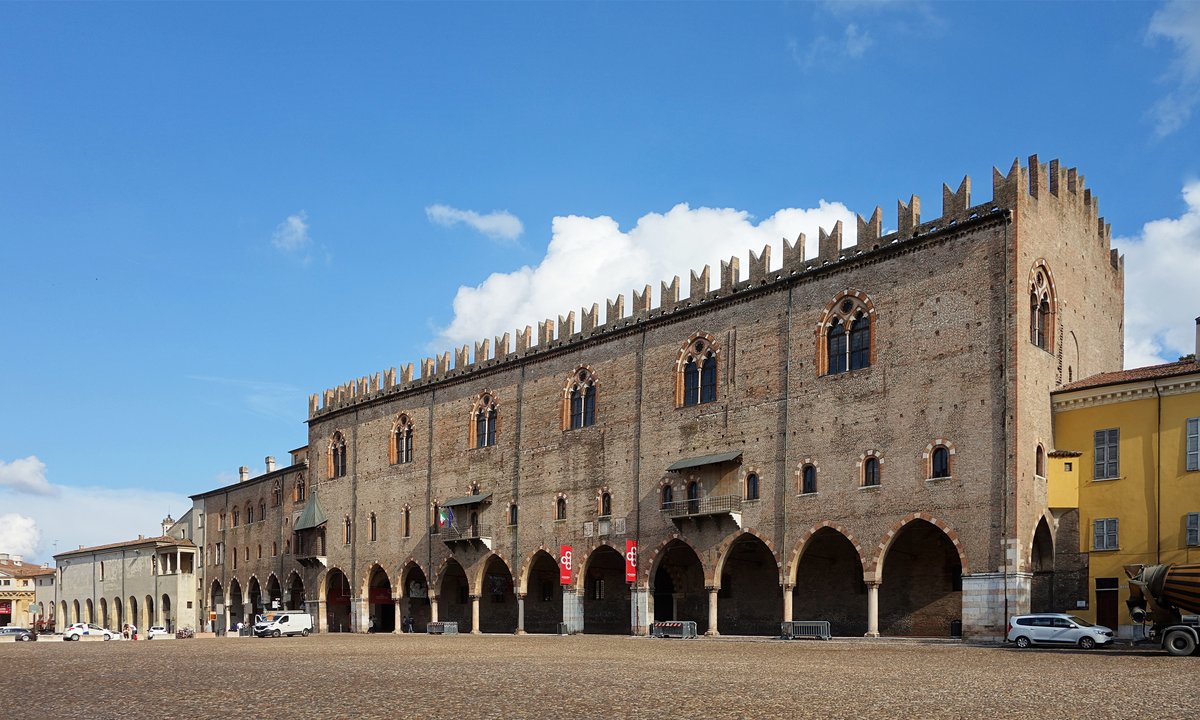
The Palazzo Ducale of Mantua is one of the largest palace complexes in Europe, spanning 35,000 square meters, with 500 rooms, 7 gardens, and 8 courtyards. It was the residence of the Gonzaga family from 1328 to 1707, enriched with masterpieces by Mantegna, Pisanello, Giulio Romano, and Raphael. Today it is a state museum open to the public.
– Camera degli Sposi: Mantegna’s masterpiece with an illusionistic oculus.
– Raphael’s Tapestries: nine Flemish weavings depicting the Acts of the Apostles.
– Hanging Gardens and Courtyards: suspended green spaces and Renaissance architecture.
– Practical Information: open Tue-Sun 8:15am-7:15pm, full ticket €18, reservation recommended.
Introduction
If you find yourself in Mantua, the Palazzo Ducale is a must-see, and not just because it’s the heart of the city. Stepping inside means getting lost in a maze of 500 rooms, 7 gardens, and 8 courtyards that seem never-ending. It was the palace of the Gonzaga family, who for centuries turned this complex into one of the most lavish courts in Europe. The first time I walked in, I was taken aback: it’s not just any museum, but a city within a city, with hidden corners and breathtaking views. Strolling through the halls is like flipping through an art history book, but without the boredom of a textbook. Each room has its own personality, from the Camera degli Sposi to the Raphael tapestries, passing through hanging gardens that seem suspended in time.
Introduction
If you find yourself in Mantua, the Palazzo Ducale is a must-see, and not just because it’s the heart of the city. Stepping inside means getting lost in a maze of 500 rooms, 7 gardens, and 8 courtyards that seem never-ending. It was the palace of the Gonzaga family, who for centuries turned this complex into one of the most lavish courts in Europe. The first time I walked in, I was taken aback: it’s not just any museum, but a city within a city, with hidden corners and breathtaking views. Strolling through the halls is like flipping through an art history book, but without the boredom of a textbook. Each room has its own personality, from the Camera degli Sposi to the Raphael tapestries, passing through hanging gardens that seem suspended in time.
Historical Background
The Ducal Palace is a work in progress that spanned centuries. The first constructions date back to the
13th century under the Bonacolsi family, but it was in
1328, with the rise of the Gonzaga, that the true expansion began. In
1459, the Diet of Mantua was held in the Hall of the Armory, and a few years later, between
1465 and 1474, Andrea Mantegna frescoed the
Camera degli Sposi (Bridal Chamber), a Renaissance masterpiece. In
1556 Duke Guglielmo commissioned Giovan Battista Bertani to unify the buildings, and in
1887 the complex opened to the public as a museum. Since
2008, it has been a UNESCO site together with Sabbioneta. A long history, made of power, art, and a bit of decline: during Austrian rule it was adapted as barracks and prison (where the Belfiore martyrs were imprisoned).
- 13th century: construction of the Palazzo del Capitano and Magna Domus
- 1328: rise of the Gonzaga
- 1465–1474: Mantegna paints the Camera degli Sposi
- 1556: Bertani unifies the complex
- 1887: opening to the public
- 2008: UNESCO
Historical Background
The Ducal Palace is a work in progress that spanned centuries. The first constructions date back to the
13th century under the Bonacolsi family, but it was in
1328, with the rise of the Gonzaga, that the true expansion began. In
1459, the Diet of Mantua was held in the Hall of the Armory, and a few years later, between
1465 and 1474, Andrea Mantegna frescoed the
Camera degli Sposi (Bridal Chamber), a Renaissance masterpiece. In
1556 Duke Guglielmo commissioned Giovan Battista Bertani to unify the buildings, and in
1887 the complex opened to the public as a museum. Since
2008, it has been a UNESCO site together with Sabbioneta. A long history, made of power, art, and a bit of decline: during Austrian rule it was adapted as barracks and prison (where the Belfiore martyrs were imprisoned).
- 13th century: construction of the Palazzo del Capitano and Magna Domus
- 1328: rise of the Gonzaga
- 1465–1474: Mantegna paints the Camera degli Sposi
- 1556: Bertani unifies the complex
- 1887: opening to the public
- 2008: UNESCO
The Bridal Chamber: The Castle’s Jewel
The Bridal Chamber (or Camera Picta) is the main reason many visitors come here. It is located in the Castle of San Giorgio, a medieval fortress that is part of the complex. Mantegna worked on it for nearly ten years, and the result is a masterpiece of perspective illusion. The walls tell the story of the Gonzaga family: Ludovico III receiving a letter, the court gathered, and above all the famous oculus on the ceiling, where angels and putti look out over a painted sky. It is one of the first examples of aerial perspective in art. When you enter, it almost seems as if the room opens upward. The emotion is strong, also because the room is small and the frescoes envelop you from every side. It is advisable to book, as access is limited (30 people every 10 minutes).
The Bridal Chamber: The Castle’s Jewel
The Bridal Chamber (or Camera Picta) is the main reason many visitors come here. It is located in the Castle of San Giorgio, a medieval fortress that is part of the complex. Mantegna worked on it for nearly ten years, and the result is a masterpiece of perspective illusion. The walls tell the story of the Gonzaga family: Ludovico III receiving a letter, the court gathered, and above all the famous oculus on the ceiling, where angels and putti look out over a painted sky. It is one of the first examples of aerial perspective in art. When you enter, it almost seems as if the room opens upward. The emotion is strong, also because the room is small and the frescoes envelop you from every side. It is advisable to book, as access is limited (30 people every 10 minutes).
Beyond the Chamber: Courtyards, Gardens, and Hidden Masterpieces
The Palazzo Ducale is more than just the Camera degli Sposi. Moving through its wings is an adventure: from the Cortile della Cavallerizza to the Giardino Pensile, a terrace 12 meters high with an eighteenth-century coffeehouse. The Giardino dei Semplici is a fragrant corner of medicinal herbs, while the Galleria della Mostra is a 64-meter-long corridor where the most precious pieces of the Gonzaga collection were once displayed. Don’t miss the Raphael Tapestries (in the Stanza degli Arazzi), woven in Flanders from his cartoons, and the Sala dello Zodiaco with its ceiling frescoed by Lorenzo Costa the Younger. And then there’s the Appartamento di Isabella d’Este, with her studiolo and grotto, an intimate corner of the most famous marchioness of the Renaissance. Each room has something unique: don’t rush.
Beyond the Chamber: Courtyards, Gardens, and Hidden Masterpieces
The Palazzo Ducale is more than just the Camera degli Sposi. Moving through its wings is an adventure: from the Cortile della Cavallerizza to the Giardino Pensile, a terrace 12 meters high with an eighteenth-century coffeehouse. The Giardino dei Semplici is a fragrant corner of medicinal herbs, while the Galleria della Mostra is a 64-meter-long corridor where the most precious pieces of the Gonzaga collection were once displayed. Don’t miss the Raphael Tapestries (in the Stanza degli Arazzi), woven in Flanders from his cartoons, and the Sala dello Zodiaco with its ceiling frescoed by Lorenzo Costa the Younger. And then there’s the Appartamento di Isabella d’Este, with her studiolo and grotto, an intimate corner of the most famous marchioness of the Renaissance. Each room has something unique: don’t rush.
Why Visit It
Three reasons not to miss it:
1. The Camera degli Sposi: one of the greatest masterpieces of the Renaissance. Mantegna revolutionized perspective, and seeing it in person is a unique experience.
2. The size: with over 35,000 square meters, it is one of the largest palaces in Italy. Each room, each courtyard tells a different story, from medieval splendor to traces of Austrian rule.
3. The atmosphere: despite the influx of visitors, the palace retains an air of ancient grandeur. Walking through the empty rooms, imagining court life, is a leap into the past.
Why Visit It
Three reasons not to miss it:
1. The Camera degli Sposi: one of the greatest masterpieces of the Renaissance. Mantegna revolutionized perspective, and seeing it in person is a unique experience.
2. The size: with over 35,000 square meters, it is one of the largest palaces in Italy. Each room, each courtyard tells a different story, from medieval splendor to traces of Austrian rule.
3. The atmosphere: despite the influx of visitors, the palace retains an air of ancient grandeur. Walking through the empty rooms, imagining court life, is a leap into the past.
When to Go
The best time? Before opening, around 8:15, or in the late afternoon, when the low light magically illuminates the frescoes. It’s closed on Mondays, so plan your visit from Tuesday to Sunday. Avoid weekends if possible, because the crowds can be annoying. In spring or autumn the weather is also ideal for enjoying the gardens. In summer, the coolness of the rooms is a relief, but the courtyards can be sunny. If you have a couple of hours, focus on the castle and the Camera; if you have half a day, also explore the Corte Nuova and the Galleria.
When to Go
The best time? Before opening, around 8:15, or in the late afternoon, when the low light magically illuminates the frescoes. It’s closed on Mondays, so plan your visit from Tuesday to Sunday. Avoid weekends if possible, because the crowds can be annoying. In spring or autumn the weather is also ideal for enjoying the gardens. In summer, the coolness of the rooms is a relief, but the courtyards can be sunny. If you have a couple of hours, focus on the castle and the Camera; if you have half a day, also explore the Corte Nuova and the Galleria.
Nearby
Just steps from the Ducal Palace, don’t miss Palazzo Te, the other Gonzaga palace designed by Giulio Romano. It’s about 1 km away, a pleasant walk. There you’ll find the famous Hall of the Giants, a fresco that makes you feel crushed by illusory architecture. Another stop is the Basilica of Sant’Andrea, with Mantegna’s tomb and works by Correggio. If you have time, the Museo di Palazzo San Sebastiano houses Mantegna’s Triumphs of Caesar.
Nearby
Just steps from the Ducal Palace, don’t miss Palazzo Te, the other Gonzaga palace designed by Giulio Romano. It’s about 1 km away, a pleasant walk. There you’ll find the famous Hall of the Giants, a fresco that makes you feel crushed by illusory architecture. Another stop is the Basilica of Sant’Andrea, with Mantegna’s tomb and works by Correggio. If you have time, the Museo di Palazzo San Sebastiano houses Mantegna’s Triumphs of Caesar.