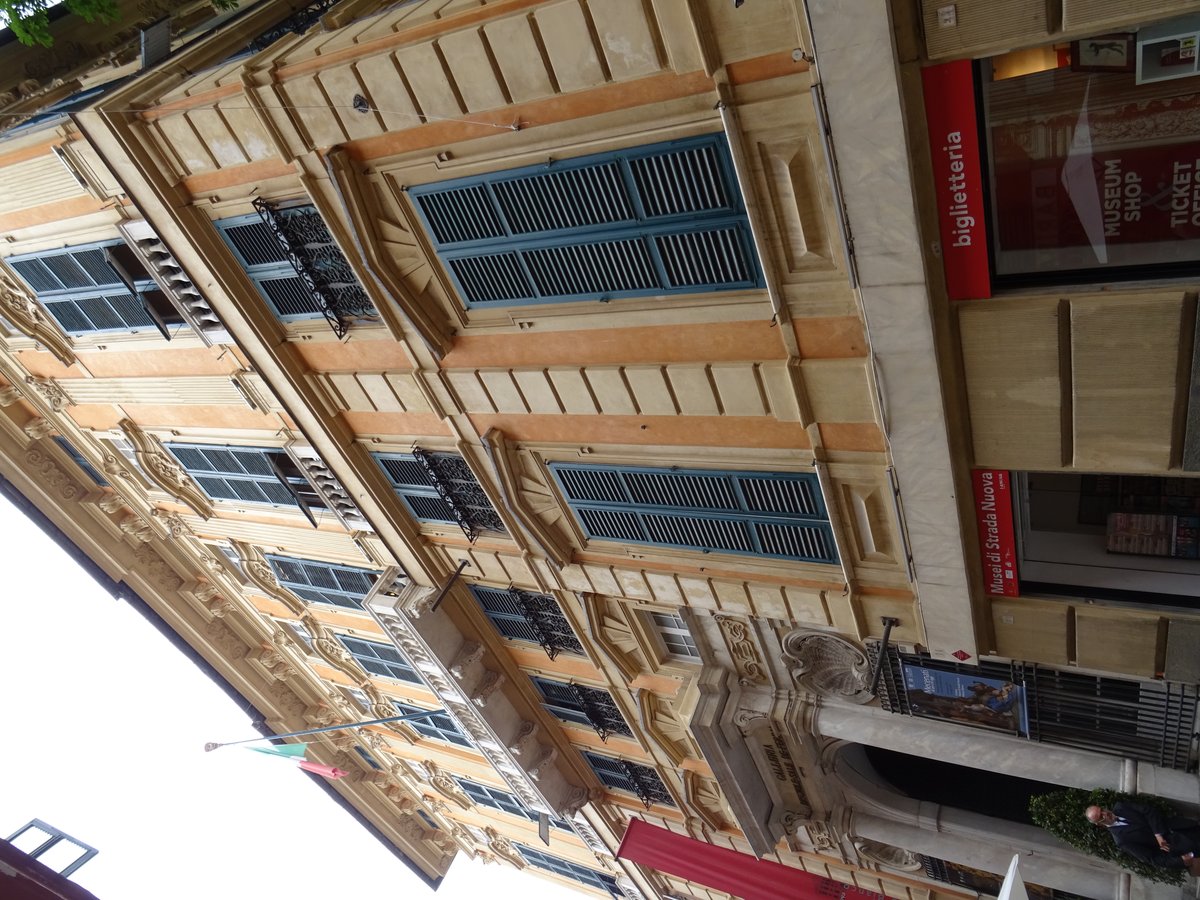
Palazzo Bianco is the most important art gallery in Liguria, with 47 rooms displaying works from the 16th to the 18th century. Among the masterpieces, Caravaggio’s Ecce Homo and Rubens’ Venus and Mars stand out, along with a rich section of Genoese painting. The modern layout by Franco Albini from 1950 enhances the spaces, while the 18th-century garden offers a peaceful break.
– Caravaggio, Rubens, Van Dyck, and Veronese on display
– Collection of Genoese painting from Cambiaso to Magnasco
– Rationalist layout by Franco Albini
– Garden with parterre and view of Palazzo Rosso
Introduction
Entering Palazzo Bianco is like opening a book of European art history. Overlooking the famous Via Garibaldi, this 18th-century palace – part of the UNESCO Rolli Palaces – houses one of Italy’s richest art galleries. Here, among elegant halls and hidden gardens, you encounter Caravaggio, Rubens, Van Dyck and Canova. The atmosphere is intimate and secluded, far from the city center chaos. Each work seems to tell a story: from Flemish altarpieces to Genoese portraits, from Spanish Baroque to Classicism. A visit that feels like a discovery, even for those who think they know art.
Introduction
Entering Palazzo Bianco is like opening a book of European art history. Overlooking the famous Via Garibaldi, this 18th-century palace – part of the UNESCO Rolli Palaces – houses one of Italy’s richest art galleries. Here, among elegant halls and hidden gardens, you encounter Caravaggio, Rubens, Van Dyck and Canova. The atmosphere is intimate and secluded, far from the city center chaos. Each work seems to tell a story: from Flemish altarpieces to Genoese portraits, from Spanish Baroque to Classicism. A visit that feels like a discovery, even for those who think they know art.
Historical Background
Built between 1530 and 1540 for Luca Grimaldi, the palace was transformed in the 18th century at the behest of Maria Durazzo Brignole-Sale. Architect Giacomo Viano renovated it, moving the entrance to Strada Nuova and covering the facade in a brilliant white that still distinguishes it today. In 1884, the Duchess of Galliera donated it to the city, which opened it to the public in 1892. The bombings of 1942 damaged the building, but the 1950 renovation by Franco Albini made it a model of rationalist museum design. Since 2006, it has been a UNESCO World Heritage site.
Historical Background
Built between 1530 and 1540 for Luca Grimaldi, the palace was transformed in the 18th century at the behest of Maria Durazzo Brignole-Sale. Architect Giacomo Viano renovated it, moving the entrance to Strada Nuova and covering the facade in a brilliant white that still distinguishes it today. In 1884, the Duchess of Galliera donated it to the city, which opened it to the public in 1892. The bombings of 1942 damaged the building, but the 1950 renovation by Franco Albini made it a model of rationalist museum design. Since 2006, it has been a UNESCO World Heritage site.
Must-See Masterpieces
The collection spans from the 16th to the 18th century, with an extraordinary Flemish core: Hans Memling (Christ Blessing), Gerard David (Polyptych of the Cervara), and Rubens (Venus and Mars). Among the Italians, the unmissable Ecce Homo by Caravaggio, painted in 1605. But it is the Genoese section that surprises: Luca Cambiaso, Bernardo Strozzi, Valerio Castello, and Alessandro Magnasco tell the story of local Baroque vitality. On the piano nobile, Canova’s Penitent Magdalene (exhibited at Palazzo Tursi) concludes the journey with its Neoclassical purity.
Must-See Masterpieces
The collection spans from the 16th to the 18th century, with an extraordinary Flemish core: Hans Memling (Christ Blessing), Gerard David (Polyptych of the Cervara), and Rubens (Venus and Mars). Among the Italians, the unmissable Ecce Homo by Caravaggio, painted in 1605. But it is the Genoese section that surprises: Luca Cambiaso, Bernardo Strozzi, Valerio Castello, and Alessandro Magnasco tell the story of local Baroque vitality. On the piano nobile, Canova’s Penitent Magdalene (exhibited at Palazzo Tursi) concludes the journey with its Neoclassical purity.
A Dive into Genoese Baroque
Palazzo Bianco is the perfect place to fall in love with the Genoese school of the 17th and 18th centuries. Artists such as Grechetto, Domenico Piola, and Gregorio De Ferrari bring walls to life with mythological and religious scenes, in a riot of color and movement. Don’t miss the room dedicated to Antoon van Dyck (Vertumnus and Pomona) and the masterpieces by Simon Vouet and Zurbarán. The itinerary is well-organized, with clear panels and lighting that enhances every detail. For the curious, the visitable storage on the fourth floor – set up by Albini – offers over 200 works not usually on display, including canvases from vanished churches.
A Dive into Genoese Baroque
Palazzo Bianco is the perfect place to fall in love with the Genoese school of the 17th and 18th centuries. Artists such as Grechetto, Domenico Piola, and Gregorio De Ferrari bring walls to life with mythological and religious scenes, in a riot of color and movement. Don’t miss the room dedicated to Antoon van Dyck (Vertumnus and Pomona) and the masterpieces by Simon Vouet and Zurbarán. The itinerary is well-organized, with clear panels and lighting that enhances every detail. For the curious, the visitable storage on the fourth floor – set up by Albini – offers over 200 works not usually on display, including canvases from vanished churches.
Why Visit It
Three good reasons not to skip it: the variety of the collection – in one palace you find Flemish, Spanish, Italian, and Genoese works; Franco Albini’s layout, a masterpiece of museum design from the 1950s that dialogues with the historic rooms; the combined ticket (€9) also includes Palazzo Rosso and Palazzo Tursi, allowing you to see Canova’s Magdalene and other wonders. It’s a total immersion in European art without excessive queues, even on weekends.
Why Visit It
Three good reasons not to skip it: the variety of the collection – in one palace you find Flemish, Spanish, Italian, and Genoese works; Franco Albini’s layout, a masterpiece of museum design from the 1950s that dialogues with the historic rooms; the combined ticket (€9) also includes Palazzo Rosso and Palazzo Tursi, allowing you to see Canova’s Magdalene and other wonders. It’s a total immersion in European art without excessive queues, even on weekends.
When to Go
To enjoy the light on the paintings, early morning (the museum opens at 9 am) is the best time: almost empty halls and soft reflections on the canvases. If you can, choose a weekday (Tuesday-Friday) to avoid weekend crowds. In autumn and spring, the golden light filters through the windows and creates an intimate atmosphere, almost like a private studio. Avoid Monday, when it’s closed.
When to Go
To enjoy the light on the paintings, early morning (the museum opens at 9 am) is the best time: almost empty halls and soft reflections on the canvases. If you can, choose a weekday (Tuesday-Friday) to avoid weekend crowds. In autumn and spring, the golden light filters through the windows and creates an intimate atmosphere, almost like a private studio. Avoid Monday, when it’s closed.
Nearby
Just a few steps away, Palazzo Rosso (via Garibaldi, 18) completes the journey into Genoese art with its collections of paintings and furnishings. After your visit, take a stroll to the Porto Antico (10 minutes on foot) for an informal lunch among the caruggi, perhaps tasting Genoese focaccia. If you have more time, the nearby Museo di Sant’Agostino offers an overview of medieval Ligurian sculpture.
Nearby
Just a few steps away, Palazzo Rosso (via Garibaldi, 18) completes the journey into Genoese art with its collections of paintings and furnishings. After your visit, take a stroll to the Porto Antico (10 minutes on foot) for an informal lunch among the caruggi, perhaps tasting Genoese focaccia. If you have more time, the nearby Museo di Sant’Agostino offers an overview of medieval Ligurian sculpture.