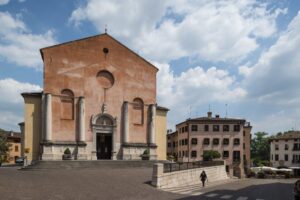
The Roman Theatre of Trieste, dating back to the Augustan age and restored at the beginning of the 2nd century by Quintus Petronius Modestus, is one of the city’s most fascinating monuments. It could seat up to 6,000 spectators and used the natural slope of San Giusto Hill for its cavea. Today, closed for renovations, it is visible from the outside and offers a unique atmosphere.
– Capacity up to 6,000 spectators and masonry structure with Aurisina stone.
– Rediscovered in 1938 after centuries hidden under medieval houses.
– Statues of deities such as Apollo and Minerva, now at the Winckelmann Museum.
– Free admission and central location, reachable by buses 5, 9, 10, 11, 17, 18, 24, 25, 30.
Roman Theatre of Trieste: The Augustan Jewel
Strolling through the center of Trieste, almost by chance, you find yourself in front of a Roman theatre nestled among the buildings. It is the Roman Theatre, at the foot of San Giusto Hill. Built in the Augustan age, it could hold up to 6,000 spectators. Today, although partially reconstructed, it retains the intact charm of ancient Tergeste. The cavea takes advantage of the natural slope, as was typical of Greek theatres. From the street you catch a glimpse of it, but just stop for a moment to imagine the performances of two thousand years ago. A dive into history, a stone’s throw from the sea.
Roman Theatre of Trieste: The Augustan Jewel
Strolling through the center of Trieste, almost by chance, you find yourself in front of a Roman theatre nestled among the buildings. It is the Roman Theatre, at the foot of San Giusto Hill. Built in the Augustan age, it could hold up to 6,000 spectators. Today, although partially reconstructed, it retains the intact charm of ancient Tergeste. The cavea takes advantage of the natural slope, as was typical of Greek theatres. From the street you catch a glimpse of it, but just stop for a moment to imagine the performances of two thousand years ago. A dive into history, a stone’s throw from the sea.
Historical Background
The theatre was built between the end of the 1st century BC and the beginning of the 2nd century AD. The first phase dates to the Augustan age, and a major restoration was later funded by
Quintus Petronius Modestus, procurator of Trajan, as attested by the inscriptions on Aurisina stone. During the Middle Ages, the theatre disappeared beneath houses, but the toponym ‘Rena vecia’ preserved its memory. In 1814, architect Pietro Nobile identified it, but it was only in 1938, after demolishing the neighborhood, that it was brought to light. Today it is a symbol of Roman Trieste.
- End of 1st century BC: construction in the Augustan age
- Beginning of 2nd century AD: restoration by Quintus Petronius Modestus
- 1814: identification by Pietro Nobile
- 1938: excavation and restoration
Historical Background
The theatre was built between the end of the 1st century BC and the beginning of the 2nd century AD. The first phase dates to the Augustan age, and a major restoration was later funded by
Quintus Petronius Modestus, procurator of Trajan, as attested by the inscriptions on Aurisina stone. During the Middle Ages, the theatre disappeared beneath houses, but the toponym ‘Rena vecia’ preserved its memory. In 1814, architect Pietro Nobile identified it, but it was only in 1938, after demolishing the neighborhood, that it was brought to light. Today it is a symbol of Roman Trieste.
- End of 1st century BC: construction in the Augustan age
- Beginning of 2nd century AD: restoration by Quintus Petronius Modestus
- 1814: identification by Pietro Nobile
- 1938: excavation and restoration
Architecture and Materials
The structure is built in masonry, with the cavea (seating area) leaning against the hill. There were 14 lower rows, of which 12 remain, and possibly 7 upper rows made of wood. The orchestra is semicircular, and the scena was a monumental façade with niches for statues. What about the materials? Aurisina stone, a light gray limestone, was used for columns and decorations. The stage was clad in slabs of red marble with plant motifs. A semicircular wall with holes supported a wooden covering. Walking among the ruins, you notice the attention to detail: every stone tells of the skill of Roman architects.
Architecture and Materials
The structure is built in masonry, with the cavea (seating area) leaning against the hill. There were 14 lower rows, of which 12 remain, and possibly 7 upper rows made of wood. The orchestra is semicircular, and the scena was a monumental façade with niches for statues. What about the materials? Aurisina stone, a light gray limestone, was used for columns and decorations. The stage was clad in slabs of red marble with plant motifs. A semicircular wall with holes supported a wooden covering. Walking among the ruins, you notice the attention to detail: every stone tells of the skill of Roman architects.
The Statues and Inscriptions
During the excavations, numerous marble statues were discovered, now displayed at the J.J. Winckelmann Museum of Antiquities (near San Giusto). They depict deities: Asclepius, Hygieia, Minerva, Apollo, Bacchus, and Venus. There is also a drunken Silenus used as a fountain. These sculptures, copies of Greek models from the 4th century BC, decorated the stage and the backdrop. The inscriptions on Aurisina stone commemorate the patron Quintus Petronius Modestus. One of the richest sculptural cycles in Italy: it’s worth visiting the museum to see them.
The Statues and Inscriptions
During the excavations, numerous marble statues were discovered, now displayed at the J.J. Winckelmann Museum of Antiquities (near San Giusto). They depict deities: Asclepius, Hygieia, Minerva, Apollo, Bacchus, and Venus. There is also a drunken Silenus used as a fountain. These sculptures, copies of Greek models from the 4th century BC, decorated the stage and the backdrop. The inscriptions on Aurisina stone commemorate the patron Quintus Petronius Modestus. One of the richest sculptural cycles in Italy: it’s worth visiting the museum to see them.
Why Visit It
1. One of a kind: It is one of the few Roman theaters built right by the sea (even though the seafront has since receded). 2. Free and central: You can see it from Via del Teatro Romano without a ticket. Perfect for a stop during a stroll in the city center. 3. Magical atmosphere: At sunset, the warm light on the ancient stones creates an exciting spectacle. Even if closed for renovations, the view from outside is already rewarding.
Why Visit It
1. One of a kind: It is one of the few Roman theaters built right by the sea (even though the seafront has since receded). 2. Free and central: You can see it from Via del Teatro Romano without a ticket. Perfect for a stop during a stroll in the city center. 3. Magical atmosphere: At sunset, the warm light on the ancient stones creates an exciting spectacle. Even if closed for renovations, the view from outside is already rewarding.
When to Go
The best time? Late afternoon, when the sun lights up the cavea and the hill’s shadow creates a striking contrast. In summer, the evenings are pleasant: sometimes the theater hosts performances (if open). In autumn, the golden light on the leaves of the nearby park adds charm. Avoid the midday hours in summer: the heat is felt. But honestly, every season has its charm.
When to Go
The best time? Late afternoon, when the sun lights up the cavea and the hill’s shadow creates a striking contrast. In summer, the evenings are pleasant: sometimes the theater hosts performances (if open). In autumn, the golden light on the leaves of the nearby park adds charm. Avoid the midday hours in summer: the heat is felt. But honestly, every season has its charm.
Nearby
Just a few steps away, San Giusto Hill with its Cathedral and Castle. From the castle, a breathtaking view of the Gulf of Trieste. Still in the center, the Grand Canal and Piazza Unità d’Italia. For a dive into Roman history, visit the Tergestine Lapidary at the Castle, where the theater inscriptions are preserved. A perfect combination for a day between ancient and modern.
Nearby
Just a few steps away, San Giusto Hill with its Cathedral and Castle. From the castle, a breathtaking view of the Gulf of Trieste. Still in the center, the Grand Canal and Piazza Unità d’Italia. For a dive into Roman history, visit the Tergestine Lapidary at the Castle, where the theater inscriptions are preserved. A perfect combination for a day between ancient and modern.