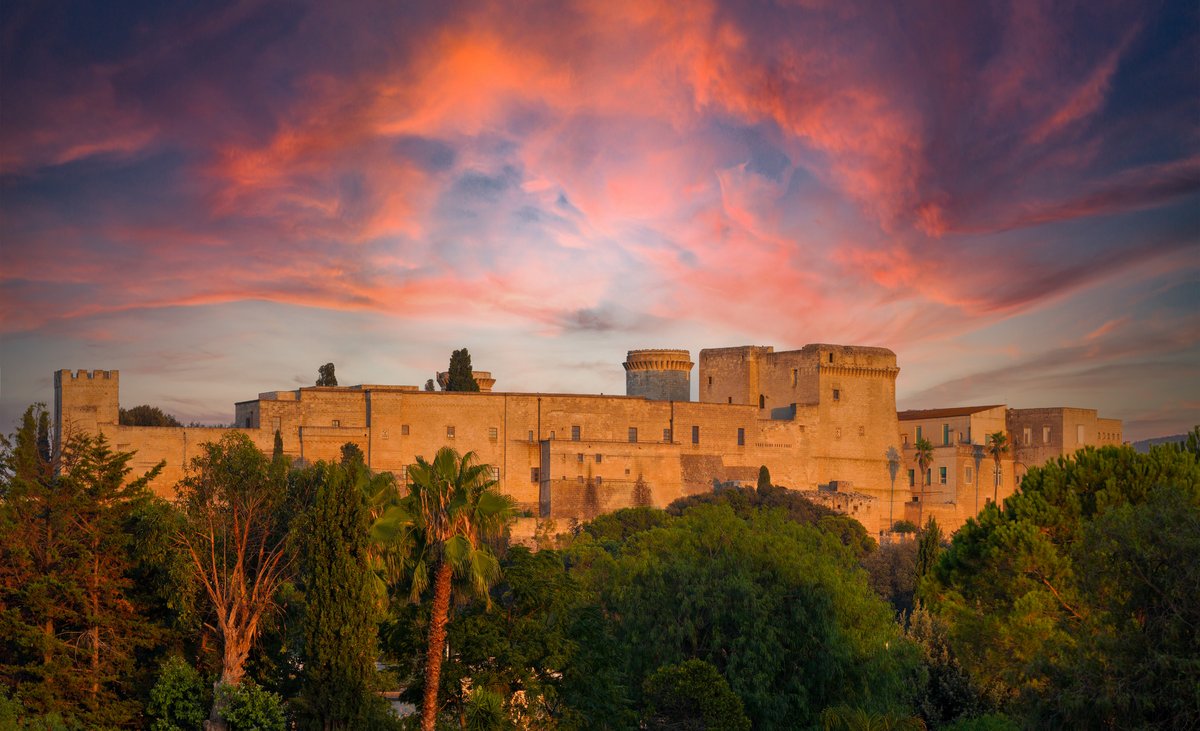
The Swabian Castle of Oria, built between 1225 and 1233 by order of Frederick II, is a triangular-plan fortress overlooking the city. With its Angevin towers and vast parade ground, it tells centuries of history. Today, after restoration, it is reopening to the public with a new museum.
• Isosceles triangular plan, nicknamed ‘floating ship in the air’
• Frederick II’s square tower and Angevin cylindrical towers
• Crypt of Saints Crisantus and Daria, remains of an underground church
• Legend of Oria Fumosa and the Tower of the Leap
Introduction
The Swabian Castle of Oria suddenly appears before you, perched on the city’s highest hill. With its triangular shape resembling a ship, it seems to sail through the air above the Salento plain. It is nicknamed the stone vessel for a reason: from afar, it truly looks like a galleon suspended between sky and earth. Reaching it, climbing up to the Torre dello Sperone, and gazing at the landscape stretching to the horizon is an unforgettable experience.
Introduction
The Swabian Castle of Oria suddenly appears before you, perched on the city’s highest hill. With its triangular shape resembling a ship, it seems to sail through the air above the Salento plain. It is nicknamed the stone vessel for a reason: from afar, it truly looks like a galleon suspended between sky and earth. Reaching it, climbing up to the Torre dello Sperone, and gazing at the landscape stretching to the horizon is an unforgettable experience.
Historical Notes
Built between 1225 and 1233 at the behest of Frederick II of Swabia, it stands on an ancient Messapian acropolis. Its commanding position made it a strategic point between Brindisi and Taranto. It underwent modifications in the Angevin period (cylindrical towers) and Renaissance (gun ports), and withstood several sieges, including that of Giacomo Caldora in 1433. Notable figures such as Maria d’Enghien stayed here, and in 1480, Alfonso II departed from here to liberate Otranto from the Turks. Since 1933, it has been owned by the Martini Carissimo counts, who restored it after the tornado of 1897.
Historical Notes
Built between 1225 and 1233 at the behest of Frederick II of Swabia, it stands on an ancient Messapian acropolis. Its commanding position made it a strategic point between Brindisi and Taranto. It underwent modifications in the Angevin period (cylindrical towers) and Renaissance (gun ports), and withstood several sieges, including that of Giacomo Caldora in 1433. Notable figures such as Maria d’Enghien stayed here, and in 1480, Alfonso II departed from here to liberate Otranto from the Turks. Since 1933, it has been owned by the Martini Carissimo counts, who restored it after the tornado of 1897.
Architecture and Legends
The triangular layout is unique, with three walls measuring 88, 107, and 110 meters. The Square Tower (or Mastio) is the oldest core, from the Norman period, while the cylindrical towers are Angevin. At the north vertex, the Spur Tower resembles a ship’s prow: from there the view is breathtaking. The legend of the ‘Oria Fumosa tells of a magical fog that envelops the castle at sunset, when the stones turn red. Another story speaks of Bianca Guiscardi, who threw herself from the Tower of the Leap to escape an unwanted suitor.
Architecture and Legends
The triangular layout is unique, with three walls measuring 88, 107, and 110 meters. The Square Tower (or Mastio) is the oldest core, from the Norman period, while the cylindrical towers are Angevin. At the north vertex, the Spur Tower resembles a ship’s prow: from there the view is breathtaking. The legend of the ‘Oria Fumosa tells of a magical fog that envelops the castle at sunset, when the stones turn red. Another story speaks of Bianca Guiscardi, who threw herself from the Tower of the Leap to escape an unwanted suitor.
The Parade Ground and the Crypt
Inside there is a vast parade ground, capable of holding up to 5000 soldiers. It was once the defensive heart of the castle. At the foot of the Torre del Salto lies the crypt of Saints Crisante and Daria, ancient protectors of Oria. It is a hypogeum church commissioned by Bishop Theodosius around the 9th century, with frescoes from the Byzantine period. Entering it is like taking a plunge into the Middle Ages, a silent place contrasting with the grandeur of the fortress.
The Parade Ground and the Crypt
Inside there is a vast parade ground, capable of holding up to 5000 soldiers. It was once the defensive heart of the castle. At the foot of the Torre del Salto lies the crypt of Saints Crisante and Daria, ancient protectors of Oria. It is a hypogeum church commissioned by Bishop Theodosius around the 9th century, with frescoes from the Byzantine period. Entering it is like taking a plunge into the Middle Ages, a silent place contrasting with the grandeur of the fortress.
Why Visit It
Three good reasons: first, it’s free – you can enter without spending a euro, which is rare for such an imposing castle. Second, the view from the Torre dello Sperone is among the widest in Salento: on clear days you can see all the way to the sea. Third, the crypt of Saints Chrysanthus and Daria is a small hidden gem, often overlooked by hurried visitors. Bring a torch to better appreciate the frescoes.
Why Visit It
Three good reasons: first, it’s free – you can enter without spending a euro, which is rare for such an imposing castle. Second, the view from the Torre dello Sperone is among the widest in Salento: on clear days you can see all the way to the sea. Third, the crypt of Saints Chrysanthus and Daria is a small hidden gem, often overlooked by hurried visitors. Bring a torch to better appreciate the frescoes.
When to Go
The perfect moment is at sunset. The golden light sets the stones ablaze and the legend of the Oria Fumosa comes to life. The atmosphere is magical, with the castle appearing to be on fire. Avoid the midday hours in summer, when the sun beats down and the white stone reflects the heat. Spring or autumn are better, with cool air and more vivid landscape colors.
When to Go
The perfect moment is at sunset. The golden light sets the stones ablaze and the legend of the Oria Fumosa comes to life. The atmosphere is magical, with the castle appearing to be on fire. Avoid the midday hours in summer, when the sun beats down and the white stone reflects the heat. Spring or autumn are better, with cool air and more vivid landscape colors.
In the Surroundings
Just a short walk away, Oria’s historic center is worth a stroll through white alleys and artisan workshops. Don’t miss the Oria Cathedral with its crypt. If you love nature, the Bosco di Oria is a relaxing place for a walk in the shade of the trees. Alternatively, following the Via Appia (now a tourist route) will take you through ancient landscapes to Brindisi or Taranto.
In the Surroundings
Just a short walk away, Oria’s historic center is worth a stroll through white alleys and artisan workshops. Don’t miss the Oria Cathedral with its crypt. If you love nature, the Bosco di Oria is a relaxing place for a walk in the shade of the trees. Alternatively, following the Via Appia (now a tourist route) will take you through ancient landscapes to Brindisi or Taranto.