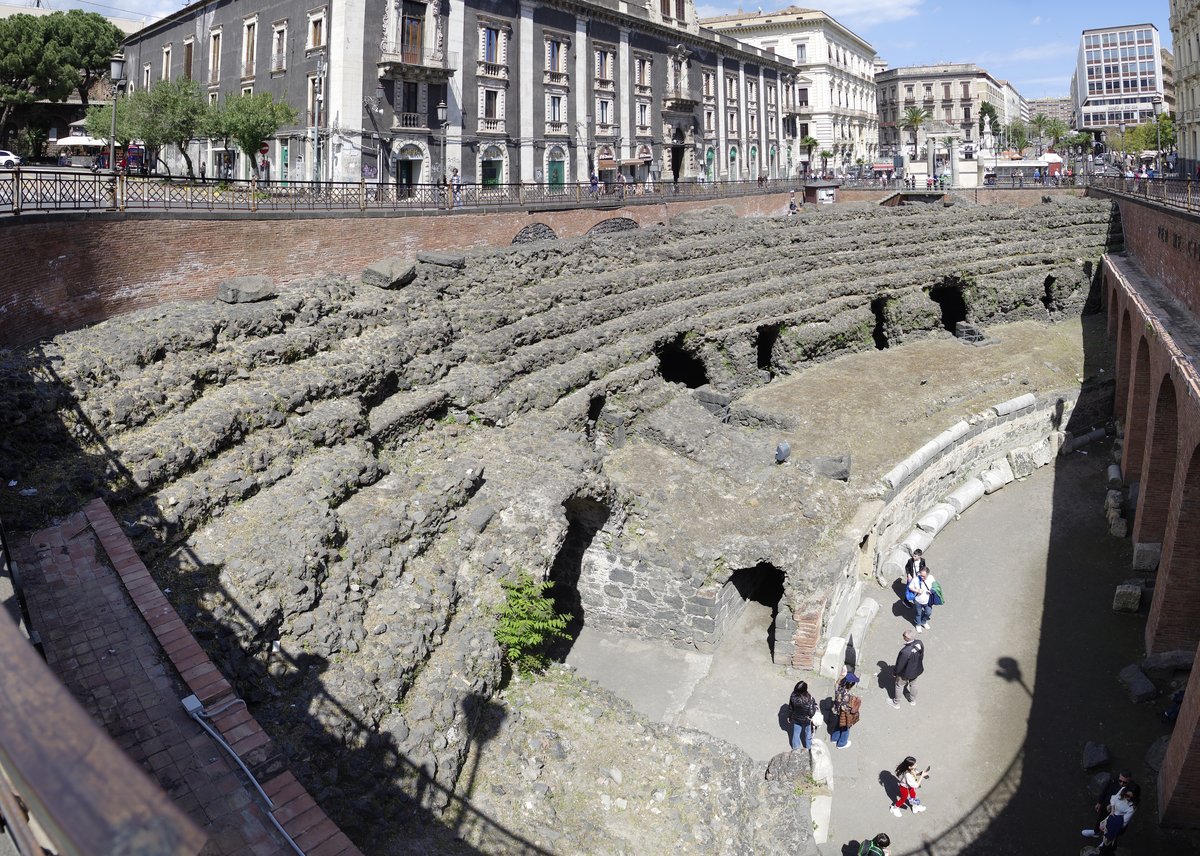
The Roman Amphitheatre of Catania, built in the 2nd century AD, is only partially visible today in Piazza Stesicoro, with much still buried. The excavated portion shows the seating area in lava stone and arches in red brick. Here’s what to know for your visit:
– Structure: seating of 14 steps, external diameter 125 m, about 15,000 seats
– Tickets: full €4, reduced €3, free for under 10
– Hours: 9:00-19:00 (summer), 9:00-17:00 (winter), closed 25 December
– Access: from Piazza Stesicoro, not wheelchair accessible
A Giant of Lava and History
Strolling through Piazza Stesicoro, you wouldn’t expect to find a Roman amphitheater emerging from the underground. Yet there it is, the Roman Amphitheater of Catania, the largest in Sicily. What you see today is only a tenth of the original structure; the rest lies beneath the surrounding houses and streets. The lava stone from Mount Etna and the red bricks tell centuries of history. It’s a place that makes you imagine the roar of the crowd and the battles, just steps away from the chaos of the modern city.
A Giant of Lava and History
Strolling through Piazza Stesicoro, you wouldn’t expect to find a Roman amphitheater emerging from the underground. Yet there it is, the Roman Amphitheater of Catania, the largest in Sicily. What you see today is only a tenth of the original structure; the rest lies beneath the surrounding houses and streets. The lava stone from Mount Etna and the red bricks tell centuries of history. It’s a place that makes you imagine the roar of the crowd and the battles, just steps away from the chaos of the modern city.
Historical Background
Built around the
2nd century AD, the amphitheater could seat
15,000 spectators. After the 5th century, it was abandoned and used as a quarry. In the Middle Ages, the arches were walled up, and the 1693 earthquake buried it. The 18th-century excavations by the Prince of Biscari and those by Filadelfo Fichera in 1904-1906 uncovered part of it. During the war, it served as a shelter. Since 2024, it has been managed by the municipality. Here are the key moments:
- 2nd century AD – Construction
- 5th century – Abandoned and used as a quarry
- 1693 – Earthquake and burial
- 1700s – Biscari excavations
- 1904-1906 – Fichera excavations
- 1940s – Air-raid shelter
- 2024 – New management
Historical Background
Built around the
2nd century AD, the amphitheater could seat
15,000 spectators. After the 5th century, it was abandoned and used as a quarry. In the Middle Ages, the arches were walled up, and the 1693 earthquake buried it. The 18th-century excavations by the Prince of Biscari and those by Filadelfo Fichera in 1904-1906 uncovered part of it. During the war, it served as a shelter. Since 2024, it has been managed by the municipality. Here are the key moments:
- 2nd century AD – Construction
- 5th century – Abandoned and used as a quarry
- 1693 – Earthquake and burial
- 1700s – Biscari excavations
- 1904-1906 – Fichera excavations
- 1940s – Air-raid shelter
- 2024 – New management
Lava, Brick, and Marble: The Construction
The amphitheater was a perfect ellipse: outer diameters 125×105 meters, arena 70×50 meters. The materials? Lava stone from Mount Etna for the walls, red bricks for the arches, marble cladding for the cavea. There were 14 rows of seats, divided into three tiers, with covered corridors on three levels. A velarium provided shade from the sun. Today, walking under the porticoes and visiting the small antiquarium, it is easy to imagine the crowd filling those seats.
Lava, Brick, and Marble: The Construction
The amphitheater was a perfect ellipse: outer diameters 125×105 meters, arena 70×50 meters. The materials? Lava stone from Mount Etna for the walls, red bricks for the arches, marble cladding for the cavea. There were 14 rows of seats, divided into three tiers, with covered corridors on three levels. A velarium provided shade from the sun. Today, walking under the porticoes and visiting the small antiquarium, it is easy to imagine the crowd filling those seats.
How to Visit the Amphitheater Today
Since July 3, 2024, it has reopened under new management. The entrance is in Piazza Stesicoro, with a gate decorated with ancient fragments. Full ticket costs €4, reduced €3. Open every day: summer 9:00–19:00, winter 9:00–17:00 (last entry half an hour before closing). Closed only on December 25. Unfortunately, it is not wheelchair accessible. Tip: visit on your own, the panels are clear. For info: 0957150508.
How to Visit the Amphitheater Today
Since July 3, 2024, it has reopened under new management. The entrance is in Piazza Stesicoro, with a gate decorated with ancient fragments. Full ticket costs €4, reduced €3. Open every day: summer 9:00–19:00, winter 9:00–17:00 (last entry half an hour before closing). Closed only on December 25. Unfortunately, it is not wheelchair accessible. Tip: visit on your own, the panels are clear. For info: 0957150508.
Three Good Reasons Not to Miss It
First: it’s a unique piece of history. It’s Sicily’s largest amphitheater, and seeing what remains gives you a sense of Catania’s importance in Roman times. Second: the ticket costs very little. For €4, you leap back two thousand years. Third: it’s in the center. Piazza Stesicoro is one of the liveliest squares, full of bars and shops. While waiting for an aperitivo, slip into the amphitheater and then come out with your mind full of gladiators.
Three Good Reasons Not to Miss It
First: it’s a unique piece of history. It’s Sicily’s largest amphitheater, and seeing what remains gives you a sense of Catania’s importance in Roman times. Second: the ticket costs very little. For €4, you leap back two thousand years. Third: it’s in the center. Piazza Stesicoro is one of the liveliest squares, full of bars and shops. While waiting for an aperitivo, slip into the amphitheater and then come out with your mind full of gladiators.
The Best Time to Immerse Yourself
Open year-round, but the ideal time is spring or autumn, with mild temperatures and low light filtering through the arches, creating plays of shadow. In summer, go early morning or late afternoon: the heat can be intense. In winter, the atmosphere is more intimate. Check seasonal hours. If it coincides with events like Museum Night, it can be a special experience.
The Best Time to Immerse Yourself
Open year-round, but the ideal time is spring or autumn, with mild temperatures and low light filtering through the arches, creating plays of shadow. In summer, go early morning or late afternoon: the heat can be intense. In winter, the atmosphere is more intimate. Check seasonal hours. If it coincides with events like Museum Night, it can be a special experience.
What to See Near the Amphitheater
Piazza Stesicoro is an excellent starting point. A few steps away, the Cathedral of Catania (via Etnea) has reused stones from the amphitheater in its apses. It’s worth walking around it. Then, the Roman Theatre and Odeon on via Vittorio Emanuele, a 10-minute walk away: another smaller but well-preserved Roman gem. If you have time, go up to Castle Ursino (Civic Museum). All stops within walking distance.
What to See Near the Amphitheater
Piazza Stesicoro is an excellent starting point. A few steps away, the Cathedral of Catania (via Etnea) has reused stones from the amphitheater in its apses. It’s worth walking around it. Then, the Roman Theatre and Odeon on via Vittorio Emanuele, a 10-minute walk away: another smaller but well-preserved Roman gem. If you have time, go up to Castle Ursino (Civic Museum). All stops within walking distance.