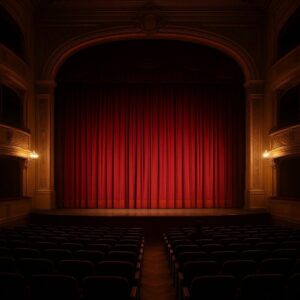
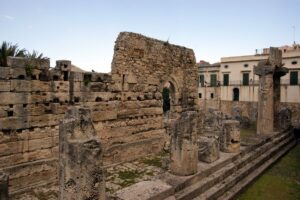
The Regional Antiquarium of the Roman Theatre, located in the Greco-Roman archaeological park of Catania, is a museum that preserves artifacts from the theater excavations. Housed in two buildings – Casa Pandolfo and Casa Liberti – it offers an overview of local history. Among the artifacts, notable are capitals from the 2nd-3rd century, a Roman copy of Leda and the Swan, and a pillow shaped like a dolphin. Additionally, you can admire the theater from a terrace.
– Architectural artifacts from the Roman theater
– Prehistoric section with Mesolithic axes
– House of the Earthquake collection with 17th-century majolica
– 19th-century kitchen of Casa Liberti
Evocative Introduction
The Regional Antiquarium of the Roman Theater of Catania is a museum that surprises you. You don’t expect it, hidden in two historic buildings, Casa Pandolfo and Casa Liberti, nestled in the heart of the archaeological park. You walk in and find yourself face to face with artifacts that tell a story spanning millennia. Then, you climb to the terrace and the Roman theater appears below you, in all its grandeur. A place that feels authentic, far from the crowded tourist circuits. If you’re passing through Catania, it’s worth a stop.
Evocative Introduction
The Regional Antiquarium of the Roman Theater of Catania is a museum that surprises you. You don’t expect it, hidden in two historic buildings, Casa Pandolfo and Casa Liberti, nestled in the heart of the archaeological park. You walk in and find yourself face to face with artifacts that tell a story spanning millennia. Then, you climb to the terrace and the Roman theater appears below you, in all its grandeur. A place that feels authentic, far from the crowded tourist circuits. If you’re passing through Catania, it’s worth a stop.
Historical Notes
The museum was built between 1999 and 2001 based on a design by architect Giuseppe Pagnano, combining two 18th-century buildings erected on the remains of the theater. The theater itself dates back to the 2nd century AD, but it stands on an earlier Greek theater. In 1098, at the behest of Count Roger,
its marble was dismantled to build the Cathedral of Sant’Agata. Here are the key moments:
- 2nd century AD: construction of the Roman theater
- 1098: removal of marble for the cathedral
- 1997-2007: excavation campaigns that brought artifacts to light
- 1999-2001: creation of the Antiquarium
Historical Notes
The museum was built between 1999 and 2001 based on a design by architect Giuseppe Pagnano, combining two 18th-century buildings erected on the remains of the theater. The theater itself dates back to the 2nd century AD, but it stands on an earlier Greek theater. In 1098, at the behest of Count Roger,
its marble was dismantled to build the Cathedral of Sant’Agata. Here are the key moments:
- 2nd century AD: construction of the Roman theater
- 1098: removal of marble for the cathedral
- 1997-2007: excavation campaigns that brought artifacts to light
- 1999-2001: creation of the Antiquarium
Casa Pandolfo: Treasures Underfoot
In Casa Pandolfo, three rooms showcase the most spectacular artifacts. Beneath the floor, however, lies a surprise: the remains of a medieval structure with hexagonal tiles and a door jamb. Among the highlights is the Leda and the Swan, a Roman copy of a Greek original from 360 BC. Then there’s a marble dolphin-shaped armrest from a chair, complete with visible restoration stages. Capitals from the 2nd-3rd century, fragments of statues: each object has a story that comes to meet you.
Casa Pandolfo: Treasures Underfoot
In Casa Pandolfo, three rooms showcase the most spectacular artifacts. Beneath the floor, however, lies a surprise: the remains of a medieval structure with hexagonal tiles and a door jamb. Among the highlights is the Leda and the Swan, a Roman copy of a Greek original from 360 BC. Then there’s a marble dolphin-shaped armrest from a chair, complete with visible restoration stages. Capitals from the 2nd-3rd century, fragments of statues: each object has a story that comes to meet you.
Casa Liberti: A Journey Through Time
Cross the courtyard, climb a 19th-century staircase, and you’ll find yourself in Casa Liberti. Six rooms arranged in chronological order, from Prehistory to the 19th century. Mesolithic axes, ceramics from the Castelluccio culture, then Byzantine and medieval artifacts. Room IV houses the furnishings from the House of the Earthquake, including 17th-century majolica. The last room is a perfectly preserved wood-fired kitchen with a washbasin and utensils: you can almost smell the freshly baked bread.
Casa Liberti: A Journey Through Time
Cross the courtyard, climb a 19th-century staircase, and you’ll find yourself in Casa Liberti. Six rooms arranged in chronological order, from Prehistory to the 19th century. Mesolithic axes, ceramics from the Castelluccio culture, then Byzantine and medieval artifacts. Room IV houses the furnishings from the House of the Earthquake, including 17th-century majolica. The last room is a perfectly preserved wood-fired kitchen with a washbasin and utensils: you can almost smell the freshly baked bread.
Why Visit
First: it’s a two-in-one ticket – visiting the Roman Theatre is included, and the Antiquarium terrace gives you a perspective you wouldn’t get from the ground. Second: the artifacts are unique, like Leda and the Swan and the dolphin. Third: it’s not very crowded, so you can enjoy the experience at a leisurely pace. An opportunity to discover a side of Catania beyond the chaos of the center.
Why Visit
First: it’s a two-in-one ticket – visiting the Roman Theatre is included, and the Antiquarium terrace gives you a perspective you wouldn’t get from the ground. Second: the artifacts are unique, like Leda and the Swan and the dolphin. Third: it’s not very crowded, so you can enjoy the experience at a leisurely pace. An opportunity to discover a side of Catania beyond the chaos of the center.
When to Go
The best time is late afternoon, around 5 PM: the golden light illuminates the theater’s cavea and the colors become warm. If you want to avoid the crowds, come early in the morning at opening time. Spring or autumn offer perfect weather. In summer, it’s best to visit on a weekday when the museum is less crowded. Bring a camera: the view from the terrace is picture-perfect.
When to Go
The best time is late afternoon, around 5 PM: the golden light illuminates the theater’s cavea and the colors become warm. If you want to avoid the crowds, come early in the morning at opening time. Spring or autumn offer perfect weather. In summer, it’s best to visit on a weekday when the museum is less crowded. Bring a camera: the view from the terrace is picture-perfect.
Nearby
Just outside the Antiquarium, the Roman theater and the Odeon await you: they are included in the same ticket. Stroll among the steps and imagine the performances from two thousand years ago. A few steps away, the Cathedral of Sant’Agata in Piazza del Duomo: its very marbles were taken from the theater. A historic route just steps away, perfect for archaeology lovers.
Nearby
Just outside the Antiquarium, the Roman theater and the Odeon await you: they are included in the same ticket. Stroll among the steps and imagine the performances from two thousand years ago. A few steps away, the Cathedral of Sant’Agata in Piazza del Duomo: its very marbles were taken from the theater. A historic route just steps away, perfect for archaeology lovers.