Palazzo Visconti di Modrone: An Introduction
A jewel of 18th-century Milan in the heart of San Babila: frescoed halls, a courtyard with paired columns, and the ballroom designed by Gersam Turri. Open for events and guided tours on Via Cino del Duca, this palazzo is one of those places in Milan that go almost unnoticed but, once you cross the threshold, surprise you. You step in and the traffic of Corso Venezia disappears. What remains are the frescoes, the elegant rooms, the suspended atmosphere of a time that no longer exists. It is an intimate rococo, not monumental, and perhaps that is why it strikes you even more.
Historical notes
The history begins in 1708, when Isabella Boselli brings as dowry to the noble Spaniard Giuseppe Bolagnos a seventeenth-century house. Giuseppe, arrived with Charles VI, purchases the neighboring buildings and creates a palace that testifies to the family’s prestige. At his death, in 1732, his son Carlo completes the works. The palace passes to the Ospedale Maggiore and then, in 1759, to Marquis Giuseppe Viani, who enlarges it. In 1840 Uberto Visconti di Modrone buys it. At the beginning of the 20th century, Giuseppe Visconti entrusts Alfredo Campanini with the renovation and Gersam Turri with the fresco of the ballroom. Tradition also recalls a concert by a very young Mozart within these walls. In 1959 the Carlo Erba Foundation was founded here.
- 1708 – Boselli dowry and beginning of works
- 1732 – Carlo Bolagnos completes the palace
- 1759 – purchase by Giuseppe Viani
- 1840 – purchase by Uberto Visconti di Modrone
- 1907-1908 – Campanini renovation and Turri fresco
- 1959 – seat of the Carlo Erba Foundation
Architecture: A Courtyard Like a Small Treasure Chest
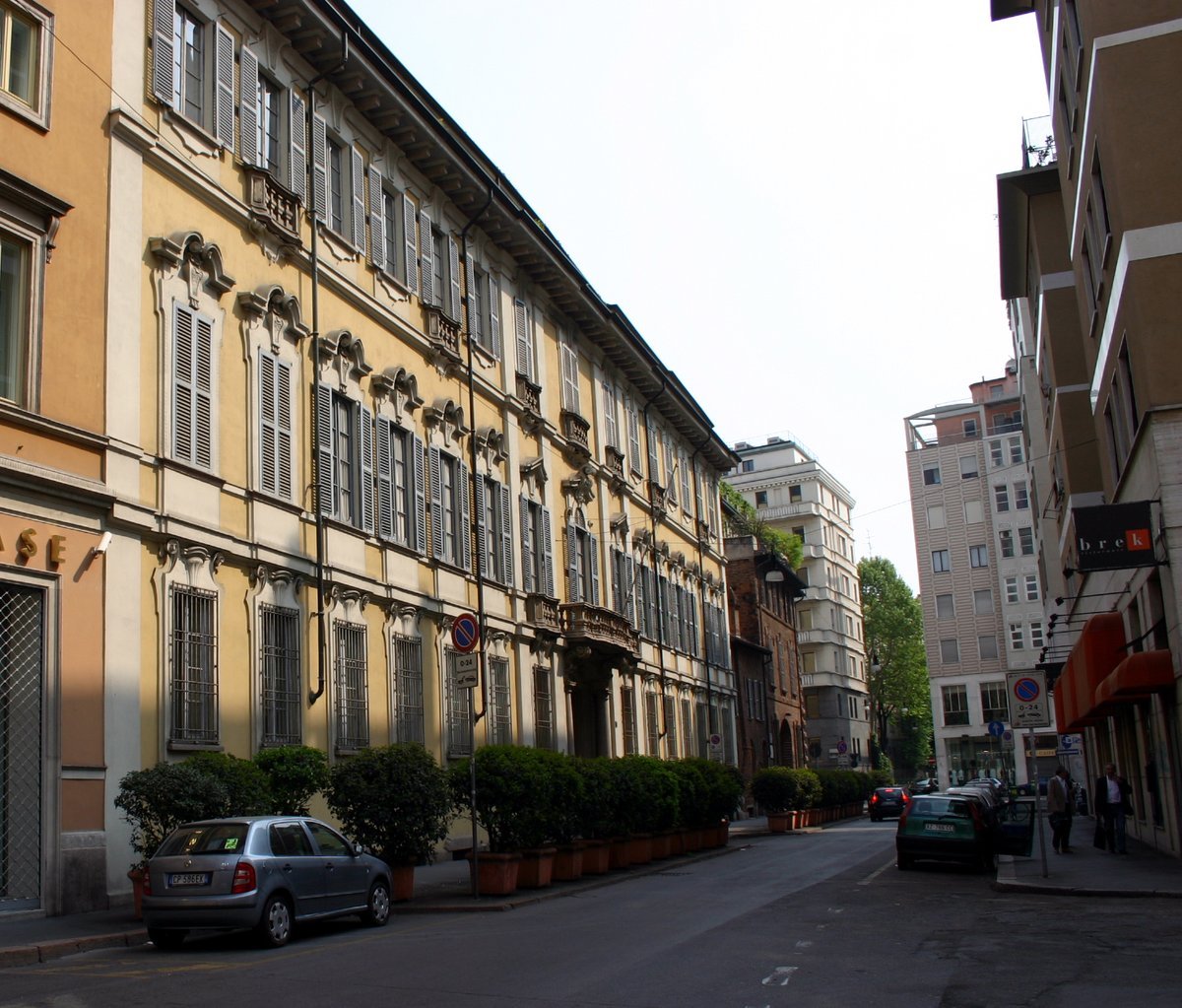
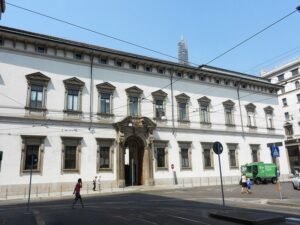
The three-story façade is already a calling card: a doorway crowned by a large irregular balcony, windows with mixtilinear pediments. But it is in the courtyard that the palace shows its best. The paired columns of the porticoes create a continuous rhythm, and from there you pass to a second courtyard with a small artificial grotto. An unexpected detail that makes the place even more charming. The building is arranged in a C around the quadrangular courtyard, and every corner tells of Milanese eighteenth-century taste. There is nothing cold or museum-like: it is architecture that lives.
The State Rooms of the Noble Floor, Between Stucco and Frescoes
The noble floor is the heart of the palace. The Sala Visconti, designed by Alfredo Campanini in the Lombard Baroque style, was used as a ballroom: walls with stucco, canvases, and frescoes, and a double-height ceiling. Above, the fresco by Gersam Turri, considered his masterpiece, adorns the room. The ballroom also features 18th-century frescoes by Nicola Bertucci. Next door, the Sala Specchiera takes its name from an old mirror above the fireplace, while the Sala Gentildonna is luminous and elegant. Walking through these rooms is like stepping back in time, among glamorous receptions and dancing evenings.
A Living Venue: Events and Guided Tours
Today the palace is not a closed museum: it is an event venue managed by Socrea, with five rooms that can hold about 300 people for dinner and 360 in theater. Weddings, presentations, photo shoots, and conferences are organized here. And for those who want to discover it, there are guided tours upon reservation, often in conjunction with events like Milan Design Week. The nice part is that you can see Milanese Rococo while it is still in use, not just preserved. Info and contacts are available on the official website.
Why Visit It
First: it is one of the richest and least-known examples of Milanese Rococo, far from museum queues. Second: the ballroom with frescoes by Nicola Bertucci and the ceiling by Gersam Turri is something you wouldn’t expect in a private palace. Third: with guided tours by reservation you can access a place normally reserved for events, and experience the atmosphere of an eighteenth-century salon. If you love historic palaces, this is not to be missed.
When to Go
If you can, choose a weekday, when the venues are quieter. The best time? Late afternoon, when the low sun lights up the stuccoes and frescoes. In autumn, with the artificial lights already on, the contrast between the interior and the Milanese evening is magical. And if you happen to be there during Milan Design Week, the palace hosts temporary installations that dialogue with the past. No fixed opening hours: better to check the website and book a visit.
Nearby
Since you’re in the heart of San Babila, I’d take the opportunity to visit the Church of San Babila and then stroll towards the Duomo. If you’re up for more palaces, the fashion district is practically right around the corner. And for a coffee, Corso Vittorio Emanuele II is your most convenient bet. The beauty of this area is that it brings together art, shopping, and local life without you having to go far.