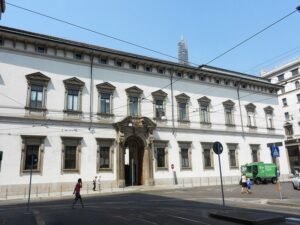
Palazzo Chiesa: First Impression
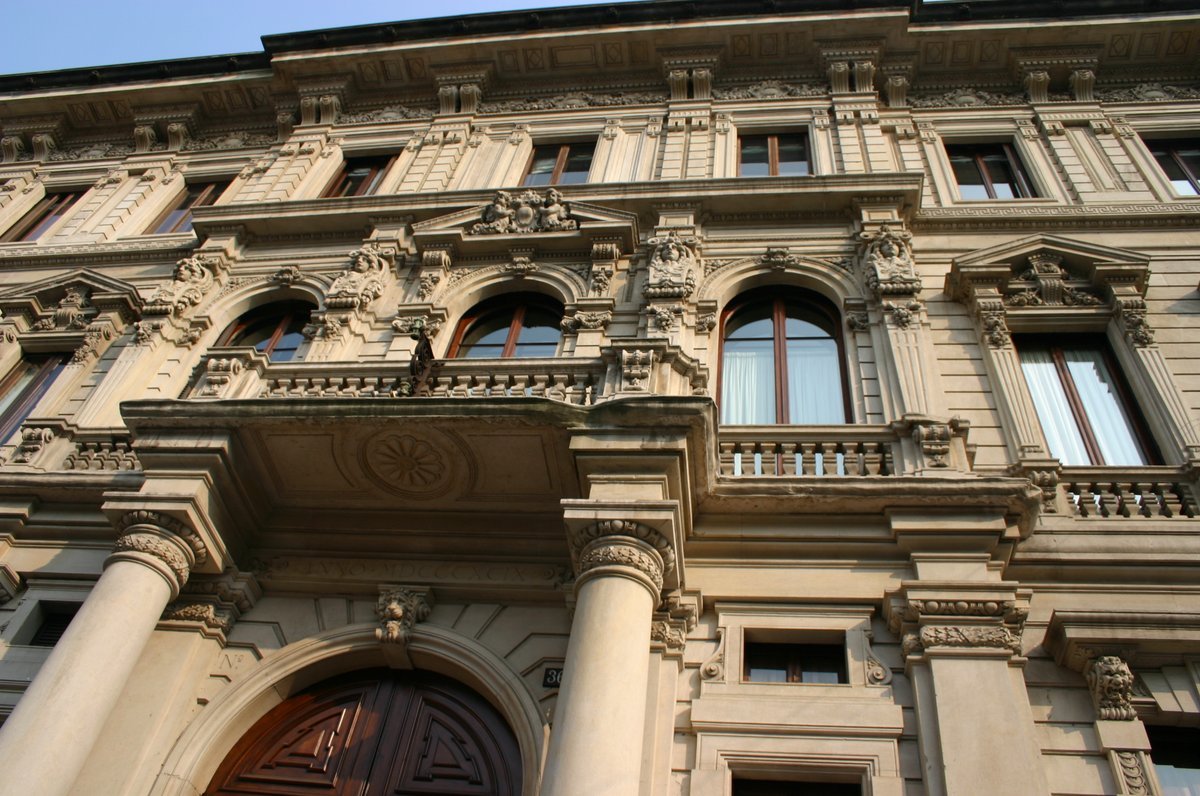
There’s a building on Corso Venezia that seems to have come from another city. It’s Palazzo Chiesa, at number 36: an eclectic façade, a Doric pronaos, and a portal that hardly goes unnoticed. Few know that behind those windows lies a courtyard with frescoed ceilings and a historic garden inhabited by flamingos. The contrast with Milan’s traffic is immediate, almost unbelievable. It’s one of those places that you pass by for years without paying attention; then you discover that during Design Week it opens its doors and you find yourself climbing a staircase of red Verona marble. In short, it’s not your typical Milanese palace.
Historical Notes
The story begins in the late 19th century, when a prestigious residence was built on the site of the gardens of a Capuchin convent — suppressed by the Austrian government. The project started between 1897 and 1899; the style is an eclecticism inspired by the Genoese Renaissance. The building anticipates Art Nouveau (Liberty), before its triumph at the 1906 International Exposition. Over time it has preserved marbles, stuccoes, stained glass and frescoes. In 2023, during Design Week, the courtyard was transformed by Bentley Home into a Mediterranean garden. Here are the key steps:
- 1897/1899 – work begins on the former convent area
- 1906 – already a forerunner of Liberty
- 2023 – Bentley Home installation in the courtyard
Facade and pronaos: a little theatrical twist
Set there, with its entrance slightly off-center to the left, Palazzo Chiesa plays with your gaze. The portal is topped by a monumental Doric pronaos that holds up the balcony of the piano nobile. Above, an explosion of decorations: herms, mascherons, pilasters, curved and triangular pediments. Some might call it over-the-top; I find it fascinating, blending Neoclassicism, Genoese taste, and an elegance that has fallen out of fashion. The beauty is that you don’t need to go inside to enjoy it: just look up from the sidewalk on Corso Venezia. And if you happen to catch it during an open moment, the interiors are the real surprise.
The grand staircase, the garden, and the flamingos
Inside, the highlight is the grand staircase: neo-Baroque, carved in red Verona marble, it seems made for entering another world. Around it, halls with marbles, stuccoes, and stained glass that tell of measured luxury, not ostentatious. Then there’s the historic garden, a green corner overlooking Via Cappuccini: it’s one of the few private places in Milan where flamingos are said to have lived. During Milan Design Week or Fashion Week, these spaces open to the public and you might see contemporary installations in the courtyard, like the Mediterranean vegetation curated by Paper Factor for Bentley Home in 2023.
Why Visit
The main reason is its rarity: it is not a museum but a private residence, so seeing it open is an opportunity that only occurs a few times a year. Take advantage of the Milano Design Week or Fashion Week to enter, climb the red marble staircase, and stroll through the garden. Second reason: you are looking at an example of eclecticism that few know about, just steps from the Indro Montanelli Gardens. Third: entry is often free, but you need to register. In short, it’s the classic ‘did you know…’ place to tell your friends about.
When to go
If you want the full magic, aim for a weekday when traffic on Corso Venezia is less invasive and the sunset casts long shadows on the pronaos. Alternatively, choose event days: the natural light coming through the windows and courtyard makes the grand staircase even warmer. No specific month is needed: the building is beautiful in every season, but the right time is when you can see it at a leisurely pace, perhaps after a walk in the Indro Montanelli Gardens. In the evening, the illuminated façade has a different charm, even though the interior is closed.
In the Surroundings
After your visit, take a stroll through the Indro Montanelli Public Gardens: they’re right there, just a few steps away, and offer a green break from the chaos. Continue toward the Gallery of Modern Art and the Villa Reale: the route is pleasant and pairs art with architecture. If you feel like shopping, the Fashion District is just around the corner. All real, nearby places that round out a morning or afternoon dedicated to beauty.