Villa Saraceno: Palladio’s Purest Work in Finale
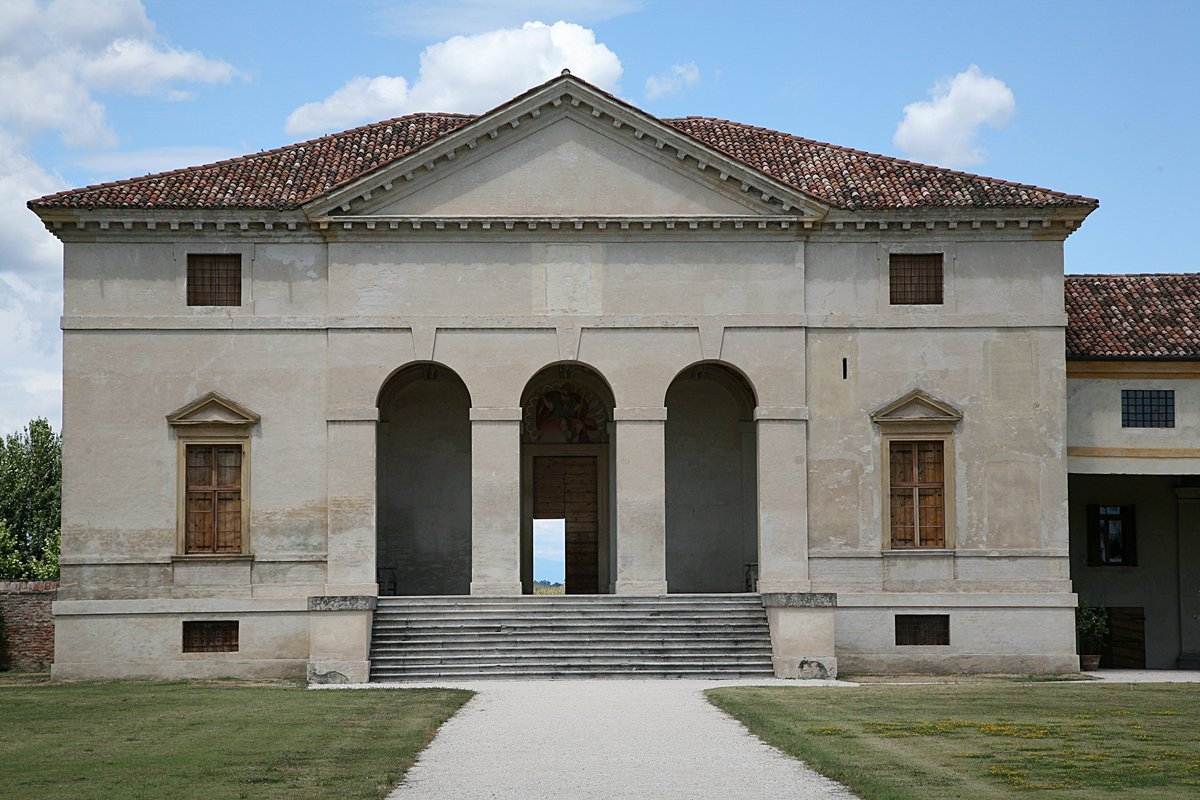
There’s a place, in Finale di Agugliaro, that seems to have come out of a pencil drawing: Villa Saraceno. It is a youthful masterpiece by Andrea Palladio, a UNESCO World Heritage site since 1996, but don’t expect gold and stucco: here beauty is made of voids, proportions, brick, and plaster. The three-arched loggia, the clean tympanum, the silence of the countryside: everything speaks of an architecture that needs no excess. You arrive almost by chance, after a straight road through the fields, and you find yourself in front of a pure volume, raised almost two meters. Inside, the T-shaped salon is the heart: from there you go to the orchard, to the loggia, and you breathe in the idea of the villa as a cultured and agricultural refuge. It is not the most famous of the Palladian villas, and that’s exactly why I recommend it: here you will find no queues or souvenirs, only the essence of the Renaissance. And in the morning, with grazing light, it feels like stepping back five hundred years.
A Brief History
Biagio Saraceno, a public figure from Vicenza, called on Palladio to transform an old farmstead into a villa befitting his status. The project, published in the Four Books on Architecture, also included the barchesse, but only the main building was realized. The dates are derived from two tax assessments: in 1546 the old building is still mentioned, in 1555 the new villa. Work probably began in 1548, when Biagio obtained a political office. Later, his son Pietro had the interiors decorated with frescoes by Brusasorci. Over the centuries, the villa underwent modifications and a fire. In 1989 it was purchased by the Landmark Trust, which restored it. Here are the key dates:
- 1546: pre-existing building cited
- 1548: probable start of work
- 1555: new villa described
- late 1570s: frescoes commissioned by Pietro Saraceno
- 1989: purchase by the Landmark Trust
- 1994: restoration completed
- 1996: UNESCO inscription
The Loggia and the T-Shaped Hall
The facade of Villa Saraceno is an exercise in essentiality: a rectangular volume of brick and plaster, with a projecting central section and a three-arched loggia on pillars. Above, a triangular pediment without coats of arms or statues: a very rare choice in Palladian villas, which relies entirely on geometry. Climb the few steps and you are in the loggia, which filters the passage between the courtyard and the hall. The T-shaped hall is the focal point: two side rooms, with stairs in the right bay, determine its shape, while two small ramps descend to the garden (brolo) and the loggia overlooks the countryside. The spaces follow precise proportional ratios, as Palladio liked. Below, the rooms are not all cellars: due to the water table and clayey soil, many spaces are filled with compact sandy earth. A technical solution that makes us smile today, but it has allowed the villa to stand for centuries.
Frescoes, Granaries, and a ‘Noble’ Barchessa
From the loggia vault, the allegory of Wealth looks down at you—a sixteenth-century fresco. In a side room, a frieze attributed to Domenico Brusasorci continues the story. This is not a gigantic cycle: they are fragments, yet they evoke the patrons’ taste and the shift from Renaissance to Mannerism. Climbing up, you reach the attics with small windows: these were the granaries, designed to store the harvest—tangible evidence of the villa’s agricultural function. On the east side, the barchessa with its trabeated portico is a later addition with a fraught history: first thatched in 1604, then ‘noble’ in 1659, damaged by fire and rebuilt in the mid-19th century. In short, the villa is a six-century construction site, yet Palladio’s hand holds it all together.
Why visit it
Three concrete reasons. First: it is a ‘pure’ Palladio. Among his earliest surviving villas, it is less showy than many others, but it is precisely this sobriety that makes reading the architecture more direct: you truly grasp how Palladio thought. Second: you can even stay the night. The Landmark Trust rents it out for holidays, and there is no better way to enjoy it in the evening, after the visitors have gone, perhaps with a book in the loggia at sunset. Third: the visit is carefully managed, without any crowding, and it pairs beautifully with other Palladian sites in the area. If you want direct contact with architecture, without barriers and glass cases, this is your chance. And then: a UNESCO site almost deserted on a Wednesday afternoon is a luxury you don’t often come across in the Veneto.
When to go
The beauty of Villa Saraceno is that it changes with the light. I prefer it in the late afternoon, when the low sun makes the bricks glow and the loggia casts long shadows across the courtyard. On a clear day in late spring, with the kitchen garden in full green and a crisp breeze, it’s perfect. But autumn too, with freshly plowed fields and a sky turning pink, brings powerful emotions. My advice: choose a moment when you’re the only ones there. Silence here isn’t a detail—it’s the villa’s soundtrack. And if you’re lucky enough to catch a morning with light fog rising from the fields, the effect is breathtaking: you feel like you’re watching this perfect box come to life. All in all, avoid the midday hours: the flat light flattens the volumes.
In the Surroundings
Two stops that enrich your visit. Villa Pisani in Bagnolo di Lonigo is another Palladian masterpiece, more scenic and stately: the contrast with the purity of Villa Saraceno is illuminating, almost a dialogue at a distance between two ideas of the countryside. Then, Montagnana: its medieval city walls are among the most beautiful in the Veneto, and a stroll along the walls or through the alleys of the old town ends the day with a dip into the past. They are close by, but I won’t tell you the kilometres: take it easy, it’s better that way. And if the weather is on your side, the sunset light on the walls of Montagnana is a spectacle you won’t forget. And if you still have time, the countryside between these stops is dotted with lesser-known Venetian villas, each with its own story: seek them out.