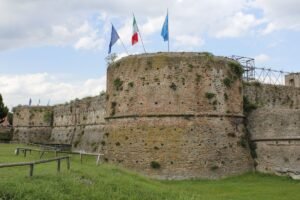
Felino Castle: a medieval fortress on a hill between the Parma and Baganza streams, 18 km from Parma, with a moat, corner towers, and centuries of history amid the Rossi, Sforza, and Farnese families. Visit the courtyard with its well, the Oratory of Saint Peter, and the cellars of the Salami Museum, in the green of the Parma Hills.
– Address: Strada al Castello 1, Felino (PR).
– Opening times: weekends and holidays in the warmer months; groups by reservation in other months.
– Tickets: €5 full price, €4 reduced for groups, free for under-6s.
– Inside the castle, you’ll find a gourmet restaurant and suites for events or stays.
Felino Castle, medieval fortress and Salami Museum
A dive into the Middle Ages, 18 km from Parma in the Parma Hills: Felino Castle is the classic fortress you’d expect to find in fairy tales. Stone and brick towers, a moat, and a masonry bridge in place of the ancient drawbridge: as you arrive, time slows down. Inside, the courtyard with its well and arcades opens the way to a journey that descends from the 15th-century manor into the cellars of the Felino Salami Museum. This is a lived-in place, not a monument under glass: you can dine with chef Romano Tamani, weddings are held here, and if you like, you can even sleep in a suite. In short, history continues.
Historical Notes: From Luppone to Today’s Restorations
According to tradition, the castle was founded in 890 at the behest of Marquis Luppone, although the earliest written records date back to the 12th century. Its golden age is linked to the Rossi family: Pier Maria transformed the manor into a lordly fortress and ruled it for over a century.
In 1483 Ludovico il Moro seized it by deceit and had its defenses razed. Then it passed to the Pallavicino, Sforza, and Farnese families, until the bishops of Parma, who from the 18th century to 1935 used it as a country residence. That year the castle was sold to private owners; in 1974 the Alessandrini family purchased and restored it. Here are the key milestones:
- 890 – presumed construction ordered by Marquis Luppone
- 12th century – first records of the castrum
- 14th-15th century – greatest splendor under the Rossi
- 1483 – Ludovico il Moro conquers and dismantles the fortifications
- 1502 – sold to the Pallavicino for 15,000 gold ducats
- 1763-1935 – property of the bishops of Parma
- 1974 – purchase by the current owners
- 2004 – opening of the Felino Salami Museum
A Courtyard Among Towers and Porticoes: The Architecture
From the outside, the castle is massive, with four corner towers, sheer walls, and a moat that still surrounds it. You enter over a stone bridge that was once a drawbridge, and immediately you find yourself in the inner courtyard: a rectangle with a central well, porticoes, and a loggia. On the north facade you can see the remains of a double row of arches, perhaps an ancient loggia. The keep, to the northwest, was the lords’ refuge; the guard tower still shows the grooves where the bridge rope ran. Then you go down: beneath the vaults lie the prisons and the ancient kitchens, complete with their original fireplace and oven. Every corner has a story to tell.
Oratory of Saint Peter and the Hidden Treasures
On the first floor of the east tower stands the Oratory of Saint Peter the Apostle, a small treasure chest preserving frescoes with noble and cardinal coats of arms. Among these, the Madonna of the Robin stands out, a votive fresco from the fifteenth century. There is also a bell from 1652, cast for Ranuccio II Farnese, Duke of Parma and Piacenza. These works require time: a quick glance is not enough. I advise you to pause for a moment in silence and observe the symbols of the families that have alternated in the castle. Meanwhile, the view from the towers stretches over the Parma Hills and makes everything more beautiful.
Felino Salami Museum: A Taste of the Cellar
A visit to Felino Castle is not complete without descending into the ancient kitchens and vaulted cellars. Here you will find the Felino Salami Museum, founded in 2004: five sections that tell the story of the black Parma pig, production techniques, and the voices of the producers. The route is interactive and suitable for children, making it perfect for a family outing. Fun fact: Felino salami is so rooted in local culture that it appears in the bas-relief of Parma Baptistery by Benedetto Antelami. Finally, you can add a tasting with the ‘flute beak’ cut. For me, it is the perfect finale.
Why Visit It
Felino Castle is not a cold museum. It is one of the few places where you can take a journey back to the Middle Ages and, at the same time, discover a quintessential product of the Parma Food Valley. What’s more, the venue is full of life: there’s a restaurant run by Romano Tamani, suites to sleep in, and often events that bring the courtyard to life. And then, let’s face it, the location on the Parma hills is perfect for combining your visit with a tasting of salami, perhaps sliced on the spot. Book in advance and try to avoid days of private ceremonies, so you don’t risk finding the castle closed to visitors.
When to go
My favourite moment? Late afternoon on a clear day, when the low sun lights up the stone towers and Val Baganza glows below the castle. If you can, choose spring or late autumn: the Parma hills are more alive, with warm hues and often some tasty event on the calendar. In winter, on the other hand, the pace is slower and visits are by reservation for groups: less crowd, certainly, but also a more intimate atmosphere. Don’t fixate only on perfect weather: the castle, with the right light, works in any season.
Nearby
To continue your journey among the Rossi fortresses, I recommend Torrechiara Castle, the other great historical presence in the Parma area linked to the same family. Then, if you want to complete the circle of taste, return to Parma and look in the Baptistery for the bas-relief with Felino salami carved by Benedetto Antelami: after seeing it in the museum, it’s a fun game to spot it in the city. While you’re in the area, stop at a local deli for a true tasting, away from the most touristy paths.