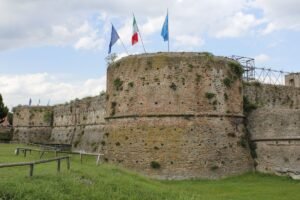
The Rocca Sanvitale overlooks Sala Baganza, in the province of Parma, with the appearance of a long rectangular block and two large towers. Here visitors can explore 16th-century halls frescoed by Ercole Procaccini and Cesare Baglione, the 18th-century apartment of Antonio Farnese, and the Wine Museum in the old cellars. April to October is the best time to visit; closed on non-holiday Mondays, with guided tours and tickets from €5.
– Frescoes: Hall of the Aeneid, Cabinet of Busts, Baglione’s Study, and Hall of Hercules.
– Farnese Apartment: 12 Rococo rooms by Sebastiano Galeotti, visitable by reservation.
– Wine Museum: a sensory route through the cellars and the former icehouse.
– Farnese Garden: 3 hectares laid out as a potager, sixteen plots and a central pool, open all year round.
Rocca Sanvitale: the castle of Sala Baganza
The Rocca Sanvitale appears suddenly in the center of Sala Baganza, with its long stone-and-brick body and the remains of its towers. It is not the classic postcard castle: it is a stately residence that has lost three sides and preserves a soul suspended between the sixteenth and eighteenth centuries. What strikes me is the asymmetry of the facade, the round-arched portal, and that Farnese garden opening at the foot of the building like a geometric design. Inside, the halls tell the story of the Sanvitale, Farnese, and Bourbon families, with frescoes, grotesques, and stuccoes. The Wine Museum, in the cellars and the former icehouse, adds a sensory touch. It is a place to visit calmly, without expecting an intact manor, but for that very reason more authentic and surprising.
Historical background
Its origins are medieval: the first record dates back to 1141, when a Castellum de Sala existed. From 1258 the Sanvitale family held the fortress for over 350 years. In 1477 Gilberto III Sanvitale obtained the title of Count of Sala and expanded the building with a moat and wall; in 1482 Donella Rossi defended it against her father’s troops. In the sixteenth century Giberto IV summoned artists to decorate the piano nobile. In 1612, after the conspiracy of the feudal lords, the Farnese confiscated the Sanvitale assets. The fortress became a ducal residence with Antonio Farnese and the Bourbons. In the nineteenth century Michele Varron had three sides demolished. In 1988 the Municipality bought the western portion; it opened to the public in 2003. In 2024, 12 rooms of the Farnese apartment were opened.
- 1141: first record.
- 1258: the Sanvitale family.
- 1477: expansion by Gilberto III.
- 1482: defense by Donella Rossi.
- 1612: Farnese confiscation.
- 1720-1726: frescoes by Galeotti.
- 1819-1823: demolition of three sides.
- 1988: municipal purchase.
- 2003: opening to the public.
- 2024: Farnese apartment.
Sixteenth-century halls and frescoes
The route through the Renaissance wing is the heart of the visit. You enter the Hall of the Trusses, with a wooden truss ceiling and traces of 16th-century frescoes depicting architecture, animals, and mythological scenes. Then there is the Bust Cabinet, a small study decorated by Cesare Baglione with busts and grotesques. The Aeneid Room, attributed to Ercole Procaccini, was a bedroom with a vault frescoed with episodes from the life of Aeneas and Venus on the clouds. The Baglione Chamber, Countess Livia’s study, is an intricate play of grotesques on a white background, with seasons, hunts, and battles. In the Hall of Hercules, the Baroque overmantel and the stories of Hercules stand out, with Jupiter thundering. The Palatine Chapel preserves sacred frescoes and Christian symbols. Along the route you also encounter the permanent sculpture exhibition by Jucci Ugolotti, Sacred and Profane. The rooms are not huge, but the decorative density is remarkable.
Farnese Apartment and Wine Museum
The eighteenth-century section is a journey of its own. The Apartment of Antonio Farnese has thirteen Rococo rooms, with stuccoes and frescoes by Sebastiano Galeotti made between 1720 and 1726. The rooms are connected by painted doors and depict allegories of the virtues; the route culminates in the Hall of the Apotheosis, where the vault celebrates the Farnese dynasty amid classical deities and allegories. Since 22 September 2024, 12 rooms of this apartment have been open, an opportunity to see a lesser-known Parma Rococo. Going down to the basement, you visit the Wine Museum, housed in the cellars and the former ice house: an exhibition and sensory itinerary dedicated to Parma wine, its history and culture. Admission is separate. I liked the contrast between the noble frescoes and the cool, slightly misty atmosphere of the cellars.
The Farnese Garden
At the foot of the fortress lies the Farnese Garden, also known as the Pomegranate Garden. It is a potager of about three hectares, enclosed by 18th-century walls commissioned by the Farnese family to protect the vegetable plot and the trees from thieves, wind and rain. Its present layout draws on Petitot’s 18th-century design and was restored and reopened in 2009. The garden is divided into sixteen squares by gravel paths, with a circular basin at its centre that also served as a reserve for irrigation. Around it grow flowering apple trees and quince trees, while evergreen holm oaks act as a screen against the sun. In spring the apple trees are covered in white blossom; in autumn and winter the scarlet fruits stay visible until March, tracing the geometric pattern. It is a simple place, perfect for a slow stroll or for letting children play.
Why visit it
Three concrete reasons. First: here you see a castle that is no longer a castle, but a stately residence with Mannerist and Rococo frescoes, without the crowds of other ducal residences. Second: the Antonio Farnese Apartment has recently opened and features thirteen rooms with stuccoes and allegories by Galeotti, a little-known itinerary. Third: the Farnese Garden is a restored potager, free and also suitable for a stop with children. What’s more, the fortress is part of the Castles of the Duchy of Parma, Piacenza and Pontremoli circuit and Sala Baganza is among the Jewels of Italy. For those visiting Parma and looking for a different day trip, it’s a smart stop: small, authentic, with the Wine Museum completing the picture.
When to go
You don’t need a specific day: the fortress has a character that changes with the light. In my opinion, the best moment is a spring morning, when the garden comes alive with white flowers and the air is still cool. The sixteenth-century halls, with their frescoed vaults, are at their best in the slanting light of early afternoon, especially in autumn, when outside there is that typical mist of the Parma countryside. If you happen to be there on a rainy day, so much the better: the contrast between the grey outside and the decorated interiors is part of the charm. In summer the garden is perfect for a walk in the shade of the holm oaks, but avoid the middle hours of the day. In winter the atmosphere is more intimate and quiet; the Wine Museum, in the cellars, becomes a pleasant stop. Always check the calendar before setting off.
In the Surroundings
Sala Baganza is worth a stroll through the village, but nearby there are two stops that pair well with the Rocca. The first is the Casino dei Boschi, a complex commissioned by Marie Louise of Austria: it includes a neoclassical villa, a Doric colonnade, a small pavilion with a clock and bell tower, and an English-style park with meadows, woodlands, and monumental trees such as yew and sequoia. The villa is closed to the public, but you can visit the small pavilion, the rustic courtyard, the stone house with ice cellars, the park, and the monumental garden. The second is a detour to San Vitale Baganza, where you can see the remains of the 15th-century aqueduct, perhaps built by the Sanvitale family and later restored by the Farnese. These are quiet places, perfect for extending your visit without going too far.