Bargone Castle: The Pallavicino Fortress
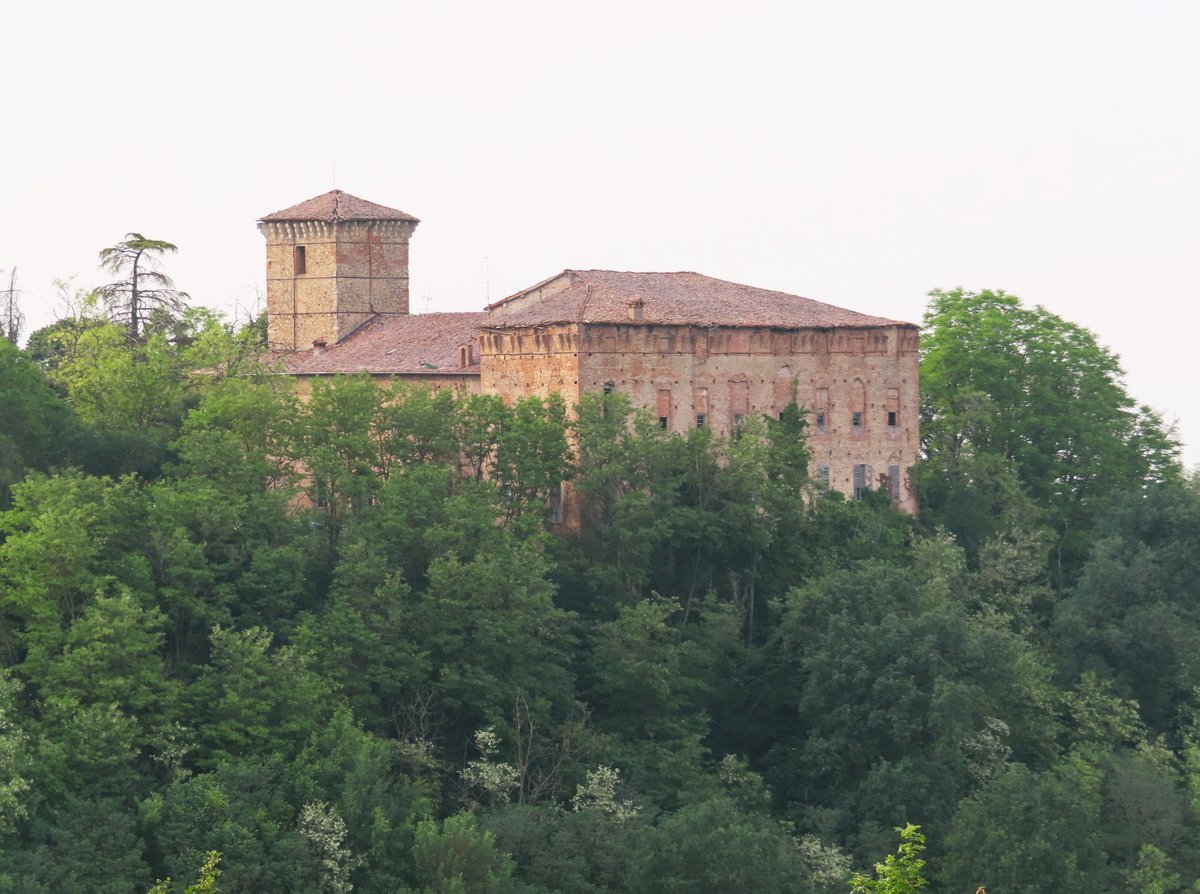
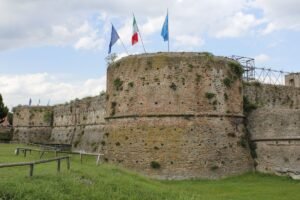
The Bargone Castle suddenly appears among the woods above Salsomaggiore Terme, on a hill about 230 metres high. It is the Pallavicino stronghold, stern and a little mysterious, with the keep overlooking the courtyard. Today it is a private residence, not open for visits inside, but the exterior and the setting are worth the walk. The stone and brick of the façades, the entrance ravelin and the Ghibelline battlements tell of centuries of sieges, rebuildings and changes of hands. The atmosphere is that of a suspended place: the surrounding woods, the little church of Beato Rolando just below, the paths climbing up from Salsomaggiore. Don’t expect a museum-castle: people come here for the landscape, the history and the evocative pull of a fortress that controlled the salt works and the Via Francigena.
Historical Background
Built before the year 1000, perhaps as early as 846, it controlled the salt pans and the Via Francigena. From the bishops of Parma it passed to the Pallavicino family in the 13th century, with the investiture of Oberto in 1249. It was contested, dismantled and rebuilt several times. In 1386 the Blessed Rolando de’ Medici died there. In 1405 Ottobuono de’ Terzi destroyed it; in 1457 Francesco Sforza restored it to Gian Lodovico Pallavicino. In 1587 the Farnese arrived, then Felice Mari, Lomellino, Pratolongo and finally the Farioli. After 2017 it has been abandoned and declared unfit for use.
- 846 circa: first fortification by the bishops of Parma
- 1144: assigned to Bertoldo IV of Zähringen
- 1249: Frederick II enfeoffs Oberto Pallavicino
- 1267: the Parmesan people dismantle it
- 1360: Charles IV enfeoffs Oberto III Pallavicino
- 1386: death of the Blessed Rolando de’ Medici
- 1405: destruction by Ottobuono de’ Terzi
- 1457: restoration to Gian Lodovico Pallavicino
- 1587: conquest by the Farnese
- 2017: death of Silvio Farioli, abandonment
Architecture: keep, courtyard and secret passages
The structure develops around a square central courtyard. At the foot of the hill there is a small medieval ravelin with a pointed arch, Ghibelline battlements and the slots of the drawbridge. The stone and brick facades are austere, but the eastern side opens onto five levels of windows. In the south-west wing stands the fortified keep. Inside, the 16th-century Renaissance courtyard has a corner portico on two sides, with Tuscan columns in a Serliana arrangement. The Hall of Arms is divided by a colonnade into two naves with cross vaults and stucco decorations. In the basement are the ancient prisons, a well connected to a room with a trapdoor and an escape passage. A spiral staircase leads up to the tower, from which you can enjoy the landscape.
The Frescoes of Girolamo Magnani
Despite its rough appearance, the castle’s grand hall preserves a decoration of great grace. It was frescoed between 1864 and 1884 by Girolamo Magnani, an artist from Fidenza known as Verdi’s set designer and creator of decorations for the Teatro Regio in Parma and the Teatro Magnani in Fidenza. Here Magnani painted small cameos with views of the castle at different hours of the day and night, and four large seasonal landscapes, with settings, figures, and animals. It is a surprise: from the outside you expect a fortress, inside a theatrical set. Today the interiors cannot be visited, but the story of these frescoes remains one of the reasons Bargone is mentioned among the decorated residences of the Parma area.
Why visit it
First reason: the setting. The castle is a stop along the hiking and cycling trails above Salsomaggiore Terme, surrounded by woods, and offers views that reward the climb. Second: the history. Here the bishops of Parma, the Pallavicino, the Farnese and the salt works all intersect, with a dense timeline of sieges and reconstructions. Third: the atmosphere. It isn’t a castle-museum: it’s a private residence, currently unusable and not open to the public, so you visit it from the outside. Precisely for this reason it retains a rustic and slightly decadent charm, far from the most well-trodden tourist routes. If you’re looking for a perfectly restored fortress, perhaps this isn’t the right place; if you like genuine strongholds set in greenery, then yes.
When to Go
The most atmospheric time is early in the morning, when mist rises through the woods and the stone of the keep slowly begins to glow. In spring or autumn the paths are more rewarding, with better colors and temperatures; in summer it is best to avoid the middle hours, because the climb to the hill can be muggy. Even a clear winter day has its appeal: the castle, with its battlements and ravelin, seems even more forbidding. Avoid days of heavy rain, because the routes through the woods become slippery. Do not expect entry or opening times: the building is private and unsafe, so the visit is mainly external and tied to the walk.
In the Surroundings
After Bargone you can go down to Salsomaggiore Terme, famous for its thermal baths and linked to the salt works that the castle controlled. Another stop is Fidenza, ancient Borgo San Donnino, on the route of the Via Francigena: the manor served precisely to control that road and the salt trade. In the woods below the castle there is also the little church of Beato Rolando, rebuilt in the 18th century, but it is part of the Bargone context rather than a separate place. For those who love castles, there are other Pallavicinian fortresses in the surrounding area, but Bargone remains the most secluded.