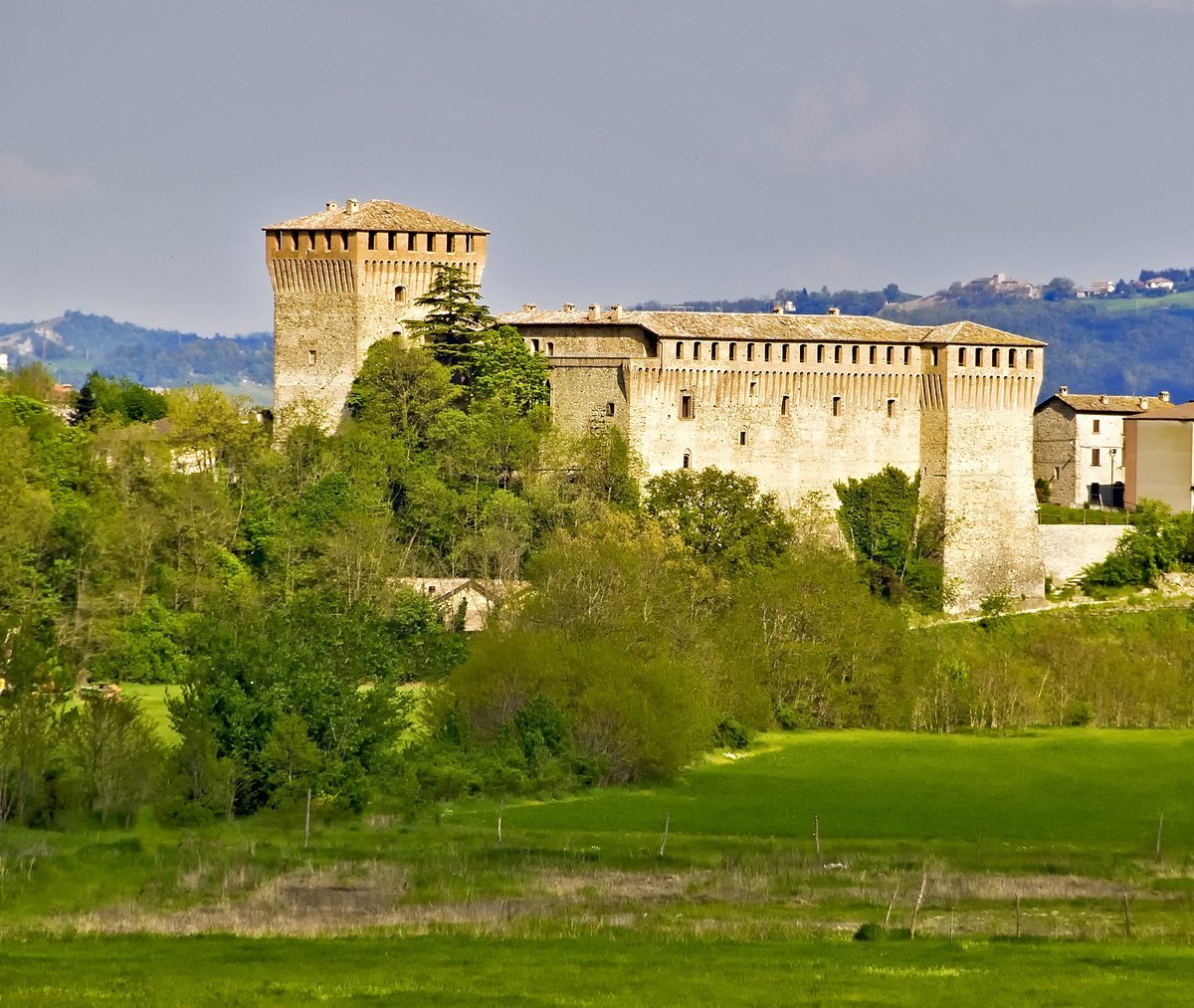
The Pallavicino Castle in Varano de’ Melegari is a medieval fortress perched on a sandstone outcrop, with three aligned towers and a 13th-century keep. Guided tours, led by guides in period dress, reveal the Bentivoglio prison, the patrol walkways, and the frescoed Hall of Honour. Open on weekends from March to October, it hosts events, reenactments, and family activities. Here is what makes it unique:
– Defensive architecture with walls up to 4 meters thick and a concealed entrance.
– The legend of the ghost of Beatrice Pallavicino, sighted in a white gown.
– Costumed tours and the “Secret of the Templars” escape room.
– Panoramic views over the Ceno Valley and an authentic atmosphere.
Introduction: Pallavicino Castle in Varano de’ Melegari
The Pallavicino Castle in Varano de’ Melegari does not go unnoticed: it stands on a sandstone crag, in a strategic position overlooking the Ceno valley, near its confluence with the Taro. Arriving from the village, it feels like a medieval fortress built to be impregnable, with walls up to four metres thick and a profile that follows the rocky spur. What is most striking? The entrance system: three massive towers aligned on the same side, with the gate set back at the base of the central one. Inside, the square courtyard, the keep, the walkways and the garden create an intimate route, almost suspended above the village. Today you can visit with guides in medieval dress, among Bentivoglio’s prison, the frescoed hall and views over the hills. A place where stone tells more than a thousand years of history, without the need for too much explanation.
Historical background: Pallavicino, Visconti and sieges
The first traces date back to the
Pallavicino Chronicle of 1087, when the castle belonged to Uberto Pallavicino. In 1208 the Commune of Parma rebuilt it on an 11th-century fortification; in 1249 Frederick II invested Oberto II with the fief. In 1297 Parma, hostile to the Ghibelline Pallavicino, ordered its destruction: sources disagree about the demolition. From the 15th century the Pallavicino rebuilt it; in 1431 Rolando the Magnificent was invested with it by Filippo Maria Visconti. In 1442 the castle became the prison of Annibale I Bentivoglio, freed on 6 June 1443. Rolando renovated it in 1452, giving it its current appearance. In 1550 it was sacked; in 1551 it was occupied during the War of Parma. In 1636 it was set on fire by the Spanish. In 1782 the last marquis Ercole died; in 1805 the fiefs were abolished. In 1828 it passed to the Grossardi; in 1965 to the Tanzi and in 2001 to the Commune.
- 1087: first mention
- 1208: reconstruction
- 1297: order of destruction
- 1431: Rolando the Magnificent
- 1443: Bentivoglio’s escape
- 1452: renovation
- 2001: municipal acquisition
The defensive system: three towers and the keep
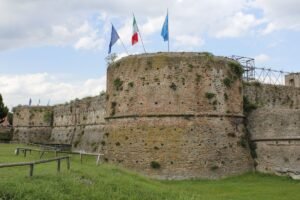
The distinguishing feature of Castello Pallavicino is its defensive system. The three massive towers are aligned along the south-east side, the one open toward the village and the Ceno River, with the entrance set back on the flank of the central tower: in this way, ranged attacks and battering rams could not take hold. The keep, on the northern corner, is the oldest part and was once connected to the rest by a drawbridge, later replaced by a masonry structure. Around the keep is a small garden that connects it to the square courtyard. On the corners of the courtyard, the holes that supported the wooden walkways with retractable ladders are still visible. The walls, up to four metres thick, follow the edges of the rocky spur; the western corner has no towers, directly above the sheer crag. At the top run the patrol walkways, at a higher level, from which you can enjoy an open panorama over the valley.
Inside the Castle: Prison, Hall and Legend
From the courtyard, you step into the everyday history of the fortress. On the ground floor are the ancient prisons, where Annibale I Bentivoglio was imprisoned in 1442. On the first level is the tribunal hall, followed by the castellan’s room and the servants’ room, once also used as a granary. The tour route includes the Hall of Arms, the old kitchens, the 18th-century grand staircase, the study, and the frescoed Hall of Honour. Visits are led by guides in medieval dress, who share anecdotes and curiosities. There is also a legend: according to a 2013 séance, a medium is said to have sensed the presence of a young woman in white, Beatrice Pallavicino, a marchioness who died at the age of 21 in 1683. Believe it or not, the atmosphere of the keep and the walkways plays its part.
Why visit it: three concrete reasons
First: it is one of the finest examples of medieval defensive architecture in the area, with mighty walls, three aligned towers and a keep that seems straight out of a fortification manual. Second: costumed guided tours make the castle’s daily life easy to imagine; you walk through the Bentivoglio prison, kitchens, arms hall, ramparts and frescoed hall. On special occasions the dungeons also open, and there is a Templar-themed escape room. Third: the castle is one of the most sought-after event venues in the province of Parma, with workshops for schools, weddings, gala dinners and team building. It is pet-friendly; dogs must be kept on a leash or carried. The view over the Ceno Valley alone is worth the climb. A place for those who want history, not just a postcard.
When to go: the right light on the sandstone
The castle is mainly open for visits at weekends, with guided tours running at various times of day. The most atmospheric moment? In the late afternoon, when the low light sets the sandstone aglow and shadows trace the three towers. A clear morning works well too, especially if you want to walk the ramparts without the strongest glare. I’d avoid the middle hours of the hottest days, when the rock stays exposed and the courtyard can turn into a furnace. If you can, choose a period when the surrounding hills begin to take on colour: the atmosphere becomes warmer and the view over the Ceno valley is more dramatic. When it is colder, the castle has a sterner charm, but always check opening times. Night visits, when available, are an experience apart.
Around the area: the village, Roccalanzona and Val Ceno
Varano de’ Melegari is worth a stroll through its village, either before or after your visit: it’s small but authentic, and from the castle you can clearly see how it once controlled the valley’s roads. Nearby, you can add Roccalanzona Castle, mentioned in sources as a point controlled by Varano’s keep; it’s a way to understand the Pallavicino defensive system on a territorial scale. The Val Ceno also offers scenic roads and villages where you can stop to eat. If you’re looking for something different, Varano is home to the Dallara Academy, a motorsport-related institution that may intrigue even those who aren’t enthusiasts. The area also has typical products of the Parma Apennines: cured meats, mushrooms and cheeses. Fit these stops into a slow day, without rushing: the castle takes time to be savored.