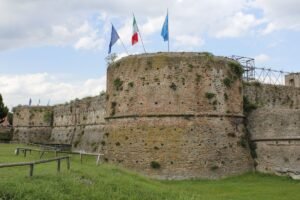
The Castle of Borgonovo Val Tidone was founded in 1196 as an oppidum of the Municipality of Piacenza and today is the seat of the town hall, in the heart of the historic centre. The brick fortress retains the dry moat, two entrances over masonry bridges in place of the drawbridges, and an 18th-century courtyard with a three-tiered loggia. Don’t miss the semicircular tower and the entrance hall with a frescoed cross vault.
– Seat of the Town Hall: can be visited during office hours; the exterior is always visible.
– Dry moat and the slots of the old drawbridges on the entrance walls.
– 18th-century courtyard: three-tiered loggia and double-ramp staircase.
– Chisöla and Fiera dell’Angelo: local gastronomy and tradition of the village.
Borgonovo Val Tidone Castle: the Fortress of the Town Hall
The Castello di Borgonovo Val Tidone is one of those places that surprises you with how history has intertwined with everyday life. We are in the province of Piacenza, in the lower Val Tidone, and this brick fortress from 1196 is not a dusty museum but the town hall. Walking around its walls, you immediately notice the dry moat and look for the drawbridge that is no longer there: in its place, two masonry bridges on pointed arches. The building is a compact block of brick, with corner towers and a semicircular tower rising to the south. The atmosphere is quiet, almost understated, but just look up to see the sawtooth pattern on the crowning, typical of the 14th-century Po Valley. It is the classic example of how a castle can still live, among municipal offices and ancient memories. It stands right in the heart of the town, along the former Strada Statale 412 della Val Tidone.
Historical Background
Founded in
1196 as an
oppidum by the Commune of Piacenza to defend the western border, the castle was destroyed several times: by the forces of Pavia in 1199, by the people of Piacenza themselves in 1237 so as not to leave it to Frederick II, and by Ubertino Landi in 1267. It then passed to the Arcelli, the Visconti, the Piccinino, and the Sforza families. In 1482 it was besieged by the French, but Franceschina Borromeo resisted. In 1691 the Zandemaria marquises transformed it into a noble residence. In 1875 it was sold to the Commune for 80,000 lire and became the town hall. Here are the key moments:
- 1196: founding of the oppidum Borgonuovo.
- 1199: destruction by the forces of Pavia.
- 1237: set on fire by the people of Piacenza.
- 1267: damage by Ubertino Landi.
- 1412: fief to the Arcelli, counts of Val Tidone.
- 1438: marquisate of Niccolò Piccinino.
- 1691: the Zandemaria transform it into a noble residence.
- 1875: municipal purchase for 80,000 lire.
The Brick Fortress: Architecture and Transformations
The castle is a compact brick block, with a rectangular plan and corner towers. To the south rises a semicircular tower taller than the rest, while the north-east wing, with its battered base, has a more rustic and uneven appearance, a sign of later periods. The facade is embellished by the saw-tooth motif, typical of fourteenth-century Po Valley castles, and by small windows with segmental arches. The moat, now dry, surrounds the fortress: it was once crossed by two drawbridges, replaced by masonry bridges on pointed arches. During the twentieth-century restorations, the drawbridge slots came to light and are still visible. There is also a postern gate, a small door with a drawbridge. Outside the moat is the outer enclosure, a rustic structure with small segmental-arched windows and saw-tooth decoration. The whole gives the impression of a solid fortress, designed to resist, yet also capable of adapting over the centuries.
Inside the castle: from the drawbridge to the eighteenth-century loggia
Once you cross the threshold, the entrance hall with a cross vault decorated with sixteenth-century frescoes leads into a courtyard that is a small surprise. Here a three-arched portico opens up, but it is the three-storey loggia, built in the eighteenth century by the Marquises Zandemaria, that captures attention. The double-ramp staircase with terracotta balustrades is theatrical and makes you imagine noble receptions. The Zandemaria transformed the fortress into a stately residence, also setting up a picture gallery of 240 works, with paintings by Correggio, Guercino and Andrea del Sarto. Until the 1980s, the top floor housed the district prisons. Today the castle is the town hall: municipal offices coexist with these traces, and the courtyard is open to the public during opening hours.
Why visit it
There are at least three reasons to stop here. First: it is a medieval castle still in use as a town hall, which is uncommon. You can see the dry moat, the slots for the drawbridges, and the postern gate, all features that tell of its defensive role. Second: inside, a surprise awaits with the 18th-century loggia and the double-ramp staircase, a corner of aristocratic elegance within a fortress. Third: access is easy and free during office hours, and you can combine the visit with a tasting of Chisöla, the focaccia with pork cracklings typical of Borgonovo. In short, a place that brings together history, architecture, and flavors.
When to go
The most atmospheric time? It depends on what you’re looking for. If you want to immerse yourself in local tradition, aim for the Fiera dell’Angelo, on Easter Monday, when the town comes alive. In September there’s the Festa della Chisöla, dedicated to focaccia with cracklings. For a quiet visit, choose a late afternoon in spring or early autumn: the warm light on the bricks brings out the terracotta hues, and the dry moat becomes a theatre of shadows. In winter, if there’s fog, the atmosphere becomes even more mysterious, but the colors are muted. Summer can be muggy, so early morning is better. In short, avoid the middle hours of the hottest days and enjoy the castle at your leisure.
In the Surroundings
After the castle, it’s worth exploring the village. In the village, you’ll find the Collegiate Church of Santa Maria Assunta, of Romanesque origin, which preserves a wooden polyptych from 1474 by the Lupi Brothers. A little further on, the Church of San Rocco and the Convent of San Bernardino on the road to Pianello. If you have time, head towards Ziano Piacentino, nestled among the vineyards of the Piacenza hills, along the Piacenza Hills Wine and Food Route. Alternatively, Castelnovo Val Tidone offers another castle, privately owned but open for visits by reservation. A way to enrich your day with art, faith, and rolling hills.