Rocca d’Olgisio: A Dauntless Fortress in the Piacenza Hills

The Rocca d’Olgisio is a fortified complex dating from the 11th century in Pianello Val Tidone, perched at 564 metres between the Tidone and Chiarone streams. It preserves six wall circuits, the keep with a 16th-century loggia, the Hall of Arms and a well about 50 metres deep. Visits are guided and, from May to October, take place on the first Sunday of the month or by reservation for groups.
– Motto Arx impavida and traces of the drawbridge
Natural caves linked to Saints Liberata and Faustina
– Views over the Po Valley, Milan and Monte Rosa
CAI trails and hiking loops among vineyards and woods


Events nearby

Copertina itinerario Rocca d'Olgisio: A Dauntless Fortress in the Piacenza Hills
A thousand-year-old fortress at 564 metres between Val Tidone and Val Chiarone: six wall circuits, the motto Arx impavida, prehistoric caves and CAI trails. Open from March to October.

Good to know


Rocca d’Olgisio: A Fearless Fortress in the Piacenza Hills

There is a spot between the Tidone Valley and the Chiarone Valley where stone seems to grow straight out of the rock. This is Rocca d’Olgisio, in Pianello Val Tidone, in the province of Piacenza. Perched at 564 metres, it appears suddenly to those driving the roads of the Piacenza Hills: six rings of walls, an irregular profile, and the motto Arx impavida carved on the jamb of the main gate. It is not the usual romantic ruin: it is a living complex, restored by the Bengalli family since 1979, blending Middle Ages and Renaissance without discord. From up there, the gaze sweeps over the Po Valley and, on clear days, reaches as far as Milan and Monte Rosa. The natural caves around it speak of prehistoric presence; the CAI trails make it a destination for walkers too. What struck me was the silence of the courtyard, broken only by the wind: you can almost still hear the cannon fire of the 1500s.

Historical Background

Legend traces its foundation to 550, by Giovannato Miles, father of Saints Liberata and Faustina. The first written record, however, dates to 1037, when the canon Giovanni ceded the stronghold to the monks of San Savino di Piacenza. In 1296 it passed to Uberto Campremoldo, then to Alberto Della Rocca and, in 1325, to Bartolomeo Fontana. In 1352 it entered the Visconti sphere; in 1378 Gian Galeazzo Visconti assigned it to Jacopo Dal Verme, a condottiere. The Dal Verme family held it, with interruptions, until the mid-19th century. In 1478 a fire devastated part of the fortress; in 1485 Pietro Dal Verme died of poisoning. In the early 1500s it withstood 1,160 French cannon shots, but fell through betrayal. During World War II it was the command post of the II Partisan Division of Piacenza and suffered two German attacks. Since 1979 it has belonged to the Bengalli family.

  • 1037: transfer to the monks of San Savino
  • 1378: Jacopo Dal Verme receives the fief
  • 1478: fire
  • 1500: French siege
  • 1979: Bengalli family

Architecture: six wall circuits and the motto Arx impavida

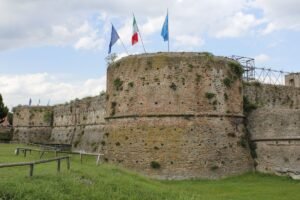
The fortress has an irregular plan and adapts to the rocky spur. Access is on the north side, via a steep road; the more vulnerable south side is protected by a triple ring of walls. In all, there are six wall circuits, layered between the Middle Ages and the nineteenth century. On the third circuit is a rusticated arch with a faded painting of a saint and two embrasures for grazing defense. On the inner jamb reads the motto Arx impavida. There were once a drawbridge and a portcullis. In the courtyard is a well about 50 meters deep: legends speak of a secret tunnel halfway along the shaft. On the west front are the oratory, dedicated to Faustina and Liberata, and the rectangular keep with frescoed halls, the Hall of Arms with catapult and cannonballs, and a sixteenth-century loggia. The bell tower was lowered at the beginning of the nineteenth century to prevent it from sounding the alarm against Napoleon. Details such as the balustrade with 13 mascarons are from the sixteenth century.

Caves, Garden and Microclimate

An unexpected world unfolds around the fortress. The natural caves carved into the sandstone were used by prehistoric people as dwellings and burial places; today some are closed for safety, but can still be seen from the outside. The Grotta delle Sante (Cave of the Saints), linked to Faustina and Liberata, preserves steps and an altar; the Grotta del Cipresso, also known as the Drop Cave, has a basin carved into the rock. Then there is the Black Cave, its ceiling blackened by hearth smoke, and the Coscritti Cave, a refuge for those fleeing Napoleonic conscription. In the garden of the fortress, the microclimate of the Val Tidone allows rare species to grow: dwarf prickly pears, wild orchids and yellow amaryllis. The area is part of the SIC/ZSC site Rupi di Rocca d’Olgisio, with arid sandstone terrain and a southern exposure: an almost Mediterranean corner in Emilia. To me it felt more like Liguria than the Po Valley.

Why visit it

First reason: it is a genuine fortress, not a reconstruction. Its six wall circuits, the well, the keep and the motto Arx impavida tell of a thousand years of sieges, fires and changes of ownership. Second: the view. From the rock you look out over the Val Tidone and the Val Chiarone; on clear days you can make out the Po Valley, Milan’s skyscrapers and Monte Rosa. Third: it is also suitable for those travelling with dogs, thanks to a dog-sitting service, and for those looking for a B&B inside the walls, with five double rooms. Guided tours take you into the halls, gardens and cellars, where catapult balls and cannonballs are displayed. And then there are the prehistoric caves and CAI trails: a visit can turn into a full day of history and nature. This is not a place for a quick selfie: it deserves time.

When to go

For me, the best time is an early morning, when the mist rises from the plain and the walls seem to float, or late afternoon, when the sun lights up the sandstone. I would avoid the middle hours of summer: the stone burns and the light flattens the landscape. If you happen to be there on a clear day after rain, visibility is surprising: you can even make out Milan. In spring and autumn the colors are softer and the trails through the woods are pleasant. In winter the fortress is closed, but its outline on the hills remains evocative even just from the road. Opening dates change every year: it is best to check the official website before setting off.

In the Surroundings

Rocca d’Olgisio is not isolated. In Pianello Val Tidone you’ll find the Val Tidone Archaeological Museum, which preserves finds from the nearby Piana di San Martino, a Bronze Age site you can reach on foot. Also in the same municipality, the village of Pianello is worth a stroll among alleys and cellars. For walkers, the Tidone Trail and the CAI 209 path connect the hamlet of Chiarone to the fortress through woods and badlands. Alternatively, the circuit of the Castles of the Duchy of Parma, Piacenza and Pontremoli offers other fortresses and villages in the area. Wine tourism enthusiasts can stop at estates in the Val Tidone: vineyards cover the slopes around the fortress. A tip: pause to look at the outline of the fortress from a distance, perhaps from a panoramic point over the valley. Its expression changes with every hour.

Itineraries nearby


💡 Did You Know…?

Legend has it that in the Cypress Cave the torture of the ‘drop on the head’ was practised and that the well hides a secret escape passage. In 1500 the fortress withstood 1,160 cannon shots, but fell through the betrayal of some officers. Count Pietro Dal Verme died of poisoning in 1485. Today the motto Arx impavida still stands proudly at the entrance.