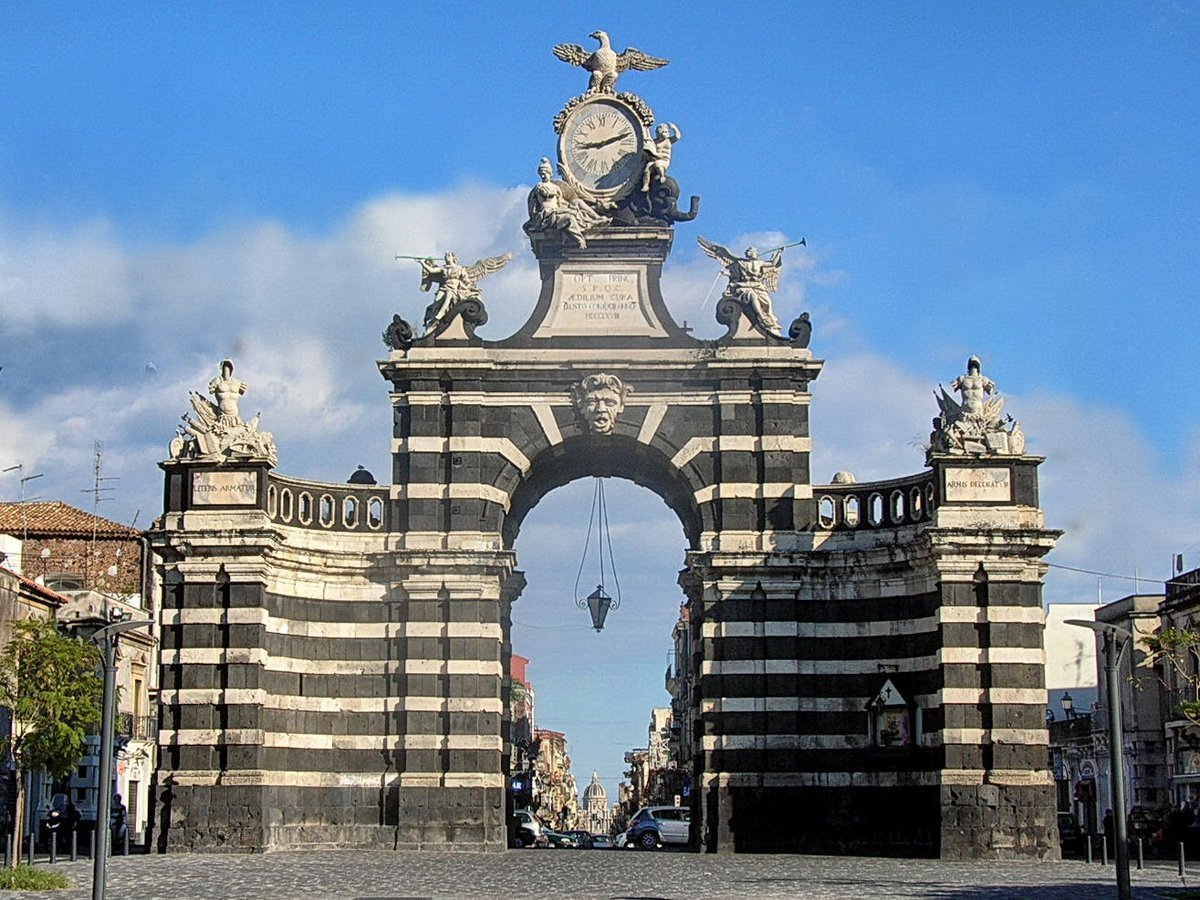
Porta Garibaldi, once known as Porta Ferdinandea, is the 1768 triumphal arch marking Catania’s western entrance between Piazza Palestro and Via Garibaldi, in the Fortino district. Designed by Stefano Ittar and Francesco Battaglia, it alternates Etna lava stone and white stone in a lively Baroque contrast, with a clock, eagle and phoenix. The site is free to visit, open-air, and pairs well with a walk along Via Garibaldi or through the historic centre.
– Baroque two-tone in black lava and white stone.
– Phoenix and motto ‘Melior de cinere surgo’ at the top.
– Bourbon history: from Porta Ferdinandea to Porta Garibaldi.
– Convenient location in Piazza Palestro, Fortino district.
Porta Garibaldi Catania: the Baroque Arch of Fortino
Porta Garibaldi isn’t your usual postcard monument: it almost catches you by surprise, between Piazza Palestro and Piazza Crocifisso, at the end of Via Garibaldi in the Fortino neighbourhood. And yet it makes an immediate impression. The eighteenth-century arch alternates white stone from Syracuse and dark Etna lava stone, creating a crisp two-tone effect that looks almost drawn. At the top stands the clock; below, among angels, trophies and inscriptions, you can read the story of a city that has been reborn too many times. Visiting is free and outside: you arrive, look, take photos, move on. I passed by without expecting much, yet found myself stopping to read every motto. That’s the beauty of it: Porta Garibaldi is a piece of Catania’s Baroque that doesn’t play the star, but tells the story of Catania better than many museum rooms.
A Brief History
It was built in 1768 by the architects Stefano Ittar and Francesco Battaglia. Its original name was Porta Ferdinandea: it was intended to celebrate the marriage of Ferdinand IV of Bourbon and Maria Carolina of Habsburg-Lorraine, in an area still marked by the 1669 eruption of Mount Etna. After Italian Unification, in 1862, it was renamed Porta Garibaldi in honour of Giuseppe Garibaldi, who entered the city. Over time, some Bourbon ornaments were removed or replaced, but the arch itself has remained. The neighbourhood is called Fortino after a small fortress commissioned by Viceroy Claudio Lamoral, Prince of Ligne, following the eruption that erased the medieval defences. All that remains of that small fortress is a gate on Via Sacchero. Timeline: 1768 construction to a design by Ittar and Battaglia; 1862 dedication to Giuseppe Garibaldi; 1930s demolition of some adjoining buildings; today restoration and regeneration of Piazza Palestro.
The two-tone architecture and the symbols on the arch
Seen up close, Porta Garibaldi is a small catalogue of symbols. The façade plays on alternating bands of black lava and white stone, a contrast typical of Catania’s Baroque. At the top centre is a clock; flanking it are an eagle and the elephant, the symbol of the city. Originally, in place of the clock, there was a tribute to the sovereigns: a marble bust of Ferdinand or, in other accounts, a medallion with their portraits. On the second level two angels blow trumpets; on the third, two armorial trophies accompany the inscriptions ‘Litteris armatur’ and ‘Armis decoratur’. On the east pediment, a phoenix rises from the flames with the motto ‘Melior de cinere surgo’: better I rise from the ashes. It is the perfect summary of Catania, a city destroyed by eruptions and earthquakes and always rebuilt. The two-tone colour scheme is also the most photogenic detail: up close, the blocks and sculptures are easier to see.
The Fortino, the square and the stories beneath the arch
Here you don’t just visit a gate: you walk through a neighbourhood. The name Fortino, in dialect ‘u Futtinu’, comes from the fortress built by the viceroy Prince of Ligne after 1669. Today little remains of that defensive system, and the area has a lived-in feel, with modest, asymmetrical buildings compared with the eighteenth-century plan. The redevelopment of Piazza Palestro has improved the overall view, but the arch retains something rough and authentic. A legend says that it was oriented so that newlyweds could catch a glimpse of the cathedral of Sant’Agata along via San Filippo, later Ferdinandea. During the revolt against the Bourbons, part of the dedication was erased; after Unification the name Garibaldi was added. Even today the procession of Sant’Agata passes beneath the arch, and the square hosts fireworks displays. I like to think of it as a threshold: on one side the city centre, on the other the Catania that stretches westward.
Why visit Porta Garibaldi
First reason: it is free and always visible from the outside. There’s no need to book a guided tour or buy a ticket; you simply stop and read it like a page in stone. Second: it is one of the best places to understand Catania’s Baroque without the crowds of Piazza Duomo. The lava-and-white two-tone stone, the clock, the phoenix and the Latin mottoes say a great deal about the city’s identity. Third: it is a short but substantial stop, useful for breaking up a walk along Via Garibaldi and discovering the Fortino district, less celebrated but full of details. To those looking only for flawless monuments it may seem modest; to those who love real cities, however, it will appeal for precisely that reason. Bring your camera: the contrast between dark stone and light stone comes across well, especially in raking light.
When to go
The time I recommend is late afternoon, when the light is no longer harsh and the arch’s two colours are easier to tell apart. The lava stone turns almost velvety, while the white stone warms with golden reflections; that’s when the façade shows its most striking side. If you’re there on a clear day, take a moment to look at the square from a distance too: the arch stands out at the end of Via Garibaldi, and the effect is stronger than it looks in photos. During the Sant’Agata celebrations, the procession passes through the gate and the area comes alive, but the square can get very crowded. I prefer a quiet visit, away from the crowds, with time to read the inscriptions and take a stroll around the neighbourhood. Avoid peak times if you want clean shots.
Nearby
From Piazza Palestro, you can continue towards the heart of Catania without losing the thread of the story. The natural first stop is Piazza del Duomo with the Elephant Fountain: the lava-stone elephant ideally converses with the symbols of Porta Garibaldi, and the Cathedral of Sant’Agata closes the circle. If you have time left, seek out the Mercato della Pescheria, lively and colourful, or extend your walk to Castello Ursino, which tells of another layer of the city. Even a simple stroll along Via Etnea works: shop windows, palazzi and people, without the need for a rigid plan. Don’t expect a continuous monumental route; beauty here arrives in pieces, between one square and another. That is precisely why Porta Garibaldi is not an isolated destination, but a gateway to a more everyday Catania.