Fonte Gaia: Siena’s fountain of marble and history
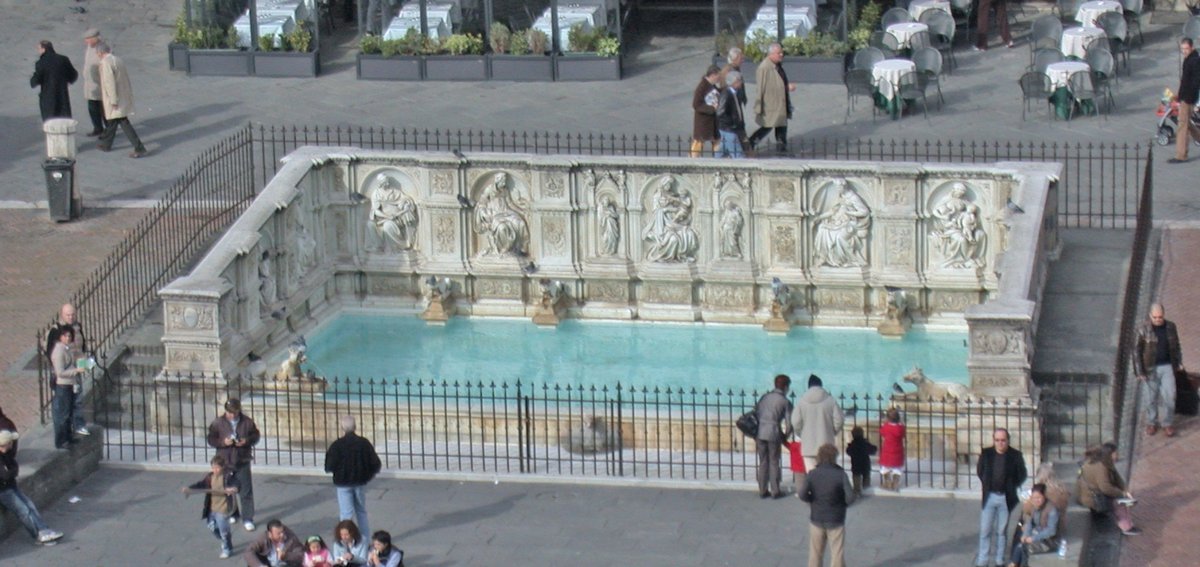
Fonte Gaia is where Piazza del Campo stops being just a square and becomes a stage set. You see it facing the Palazzo Pubblico, with its rectangular basin opening toward the palazzo and the railing following the slope of the brick shell. It is no ordinary fountain: it is Siena’s most important public fountain, a piece of civic history and a place locals pass through every day. At first, what strikes you is the contrast between the pale marble and the red of the square; then you notice the reliefs, the Virtues, the Madonna and Child, and the wolf heads from which the water flows. The fountain you see is a 19th-century copy, but the effect remains. Access is free, with no architectural barriers, and the square is always open. The water is not drinking water: it is an ornamental basin, not a drinking fountain.
Historical background: from water in the square to Jacopo della Quercia
Water reached Piazza del Campo through the Bottini, the medieval underground tunnels: city records recall the inauguration of the first fountain in 1346, welcomed with joy—hence the name Gaia. The 14th-century basin was replaced between 1409 and 1419 by Jacopo della Quercia’s monumental fountain, one of the masterpieces of Sienese Quattrocento art, poised between Gothic and Renaissance. The marble from Montagnola, however, proved fragile. In 1743, during the Palio, a spectator climbed onto a sculpture, broke it and died on the spot. Between 1859 and 1869 Tito Sarrocchi made the copy in more durable Carrara marble, and the fountain was slightly relocated with Giuseppe Partini’s railing. The original reliefs, restored, are now at Santa Maria della Scala.
- 1346: first fountain and arrival of water
- 1409-1419: Jacopo della Quercia
- 1743: accident during the Palio
- 1859-1869: Sarrocchi’s copy
- 1989-2010: restoration and museum
The marble that tells Siena’s story: virtues, Adam and Eve
Look at it up close, perhaps walking around the barrier. On the long side, in the centre, is the Madonna and Child enthroned, surrounded by the theological and cardinal Virtues: Faith, Charity, Hope, Prudence, Justice, Fortitude and Temperance. On the short sides appear biblical scenes from Genesis, the Creation of Adam and the Expulsion of the first parents. The front pillars once held Rhea Silvia and Acca Larentia, figures linked to the founding myth of Rome, accompanied by a dog and a monkey; they are not present in the nineteenth-century copy, but are mentioned in the sources. Water flows from wolf heads, a reference to the She-wolf of Siena. The whole blends sacred and profane, Bible and Roman myth: it is a lay altar in the middle of the square. The original sculptures had traces of polychromy. Up close, the marble shows signs of time and different finishes.
From the square to the museum: original or copy?
Here the obvious question is: but is it really Jacopo’s marble? The fountain in the square is Tito Sarrocchi’s copy, unveiled in 1869 and made of Carrara marble to better withstand the weather. The original 15th-century work, carved between 1409 and 1419, had deteriorated and in 1743 had even suffered the Palio incident. Today the restored original reliefs are displayed at the Santa Maria della Scala Museum, in a climate-controlled environment; admission costs about €9. Some sources specify that Sarrocchi’s marbles have also been moved to the museum and replaced outdoors by 20th-century copies. In the square, in short, what you see is a story in layers: copy, restoration, museum. A recent restoration, from October 2023 to February 2024, also used a Thunder Compact laser. It is not drinking water: do not fill your water bottle.
Why visit Fonte Gaia
First reason: it’s free and always accessible. There’s nothing to plan—you arrive in Piazza del Campo and Fonte Gaia is right there, in front of the Palazzo Pubblico. Second: within a few steps you understand Siena, because the fountain tells the story of the medieval water system of the Bottini, civic power, the transition from Gothic to Renaissance, and devotion to the Virgin. Third: the interplay between the square and the museum is the most interesting part. Sarrocchi’s copy gives you the theatrical effect; Jacopo della Quercia’s originals at Santa Maria della Scala let you see the worn marble and details up close. If you’re short on time, at least stop to look at the reliefs and the wolf heads. If you’re more curious, look for a Bottini tour. In my view, this isn’t a five-minute stop: it deserves a slow pause.
When to Visit Fonte Gaia
The square is always open, but timing changes everything. Early morning is my pick: Piazza del Campo is almost empty, the marble reads better and the reliefs aren’t covered by the shadows of the crowd. Avoid the middle hours of the hottest days, when the brick shell reflects the sun and the stone dazzles. Another good moment is towards evening, when the low light brings out the contrasts between the basin and the Palazzo Pubblico. If you find clear days in a mild season, even better: no crush and cleaner colours. During the Palio the fountain is protected with panels, so don’t expect an unobstructed view. Also check for restoration work: the fountain was closed for work from October 2023 to February 2024. Overall, allow yourself a short stop—but not just in passing.
Around Fonte Gaia
From Fonte Gaia, you can take your time heading toward the Palazzo Pubblico and climb the Torre del Mangia, Siena’s symbol towering over the square. It’s a natural way to connect the fountain with the city’s civic heart. A little further on, the Museo di Santa Maria della Scala completes the story: here you can see Jacopo della Quercia’s originals and understand just how important the fountain was for the water supply. If water is a subject that interests you, ask about the Bottini tours at the Visit Siena Tourist Office: these are the underground galleries that supplied Fonte Gaia. There’s no need to rush—these places are all in the historic centre and pair well with a stroll.