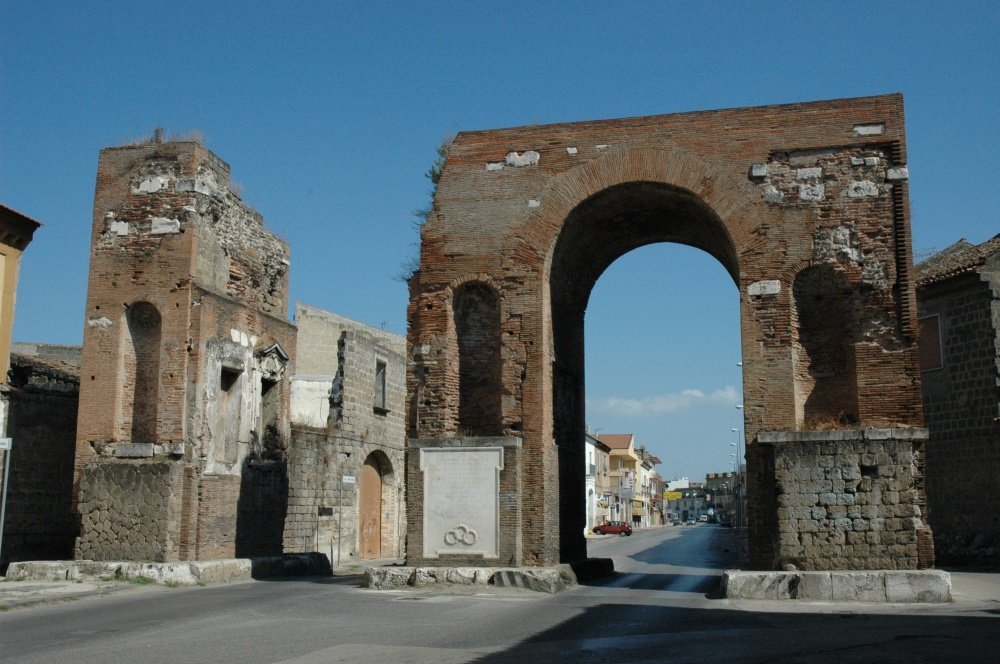
The Arch of Hadrian marks the ancient entrance to Capua on the Via Appia, now on the border between Santa Maria Capua Vetere and Capua. Of the triple arch, three piers and one side archway remain, together with the plaque commemorating the Battle of the Volturno. The site is open, free and always accessible, on level ground near the Campanian Amphitheatre.
– Roman remains: brickwork, traces of white limestone facing and niches on the piers.
– Dimensions: 10 m high, 18.5 m wide; central archway 4.85 m wide.
– Memory of 1860: plaque with text by Luigi Settembrini on one pier.
– Practical location: on the Via Appia, no steps and open to visitors at any hour.
Hadrian’s Arch in Santa Maria Capua Vetere: Via Appia
You come along Corso Aldo Moro and suddenly you see it: Hadrian’s Arch is not the usual fenced-off monument, but a piece of ancient Rome embedded in everyday life. It preserves three piers and a single side archway of the original triple arch, which once spanned the Via Appia and marked the monumental entrance to Capua. The first impression is strange: the bare brickwork, the modern additions, the traffic passing right beside it. Then you realize that this is exactly where its charm lies. It is neither polished nor perfect, yet it has stood here for centuries, about 10 metres high and 18.5 metres wide, serving as an ideal boundary between Santa Maria Capua Vetere and modern Capua. With free access and a level route, you can visit without a ticket and without steps: you approach it, walk around the piers, look at the niches and wonder how many people have passed beneath it.
Historical background
The history of the arch is less certain than it might seem. It was erected between the second half of the 1st century and the first half of the 2nd century AD, but its dedication is unknown: an inscription referring to Hadrian has been considered false by some scholars. Some suggest it was built under the Flavians, after Capua obtained the status of Colonia Flavia Augusta; other interpretations refer to a tribute to Hadrian around AD 130, linked to the embellishment of the Amphitheatre. In 1851 restoration work was carried out, with brick additions. In 1860 the Battle of the Volturno damaged it, and a commemorative plaque with a text by Luigi Settembrini was placed on one of its piers. Further restorations followed after 1883 and between 1945 and 1953–1955. Timeline: 1st–2nd century AD construction; 1851 restorations; 1860 Battle of the Volturno and plaque; 1883 restorations; 1945–1955 post-war repairs.
Three piers and one arch: what remains
What you see today is the last surviving section of a three-arched structure. The piers of the central passage remain, cut off at the springing of the arch, along with one of the side arches. The measurements help convey the scale: 10 metres high and 18.5 metres wide; all the arches spring at 6.2 metres, but the central opening had a wider span, 4.85 metres versus 3.95. The structure is made of brick, once faced in white limestone that has since been lost. At the base of the piers, blocks of the same limestone remain; in the arched niches, you can still make out the marks of the columns that framed them. There are also holes in the masonry: they are clues, not decorations. A curious detail: the arch is not perpendicular to the road, because the ancient route shifted by about 25 degrees. And along the arches there were small stairways to let pedestrians pass sheltered from carts.
The Volturno plaque and the traces of time
On one of the piers, look for the Volturno plaque: it commemorates the battle of 1 October 1860, when the arch was damaged and later marked by an inscription dictated by Luigi Settembrini. The plaque was vandalized and rebuilt in 1863, but the spot remains one of the most story-rich in the monument. This is not just a detail for epigraphers: it makes clear that this is no isolated relic, but a place that has seen Roman legions, Visigoths, Vandals, Ostrogoths, Byzantines, Saracens, Swabians, Angevins, Aragonese, French, Austrians, Bourbons, Garibaldi’s troops and troops of the Second World War pass by. In the twentieth century the arch also featured in a motorcycle race, the Circuito dell’Arco di Adriano, and in a stage of the Giro d’Italia. Today the surviving archway lets traffic pass through: it may not seem very romantic, but it is precisely this coexistence of the ancient and the everyday that makes it memorable.
Why visit it
First reason: it is free and always accessible. No booking is needed, and there are no gates or steps; the site is on flat ground and you can wander around freely. Second: it lets you walk beneath a Roman arch that once stood on the Via Appia, in front of the surviving side archway, with the piers of the central archway still discernible. Third: it is very close to the Campanian Amphitheatre, so you can combine the visits without complicated transfers and without having to choose one monument over the other. I was struck by the contrast between the solidity of the brickwork and the life going on around it: cars, passers-by, apartment buildings. Don’t expect a hushed archaeological park; here the ancient is set within the present. If you are looking for a convenient, free place with a layered history, this is one to note.
When to go
The best time, in my opinion, is late afternoon, when the low light sets the brickwork aglow and the shadows in the niches grow deeper. Avoid the middle hours of the hottest summer days: the area is open and offers little shade, and nearby traffic can be heard. A clear day in shoulder season is ideal for combining a visit to the Amphitheatre with a stroll along the Via Appia without suffering from the heat. If you can, choose an off-peak moment: the arch is open and unfenced, but it is not a museum site with opening hours; the visit is better enjoyed unhurried. In the evening, with the lights on, the monument changes character and becomes almost theatrical. You don’t need a particular season: just avoid days of heavy rain, as the route is outdoors.
Nearby
Close by is the Campanian Amphitheatre, one of the great Roman monuments of Campania: it is worth the detour on its own, and together with the Arch of Hadrian it forms a kind of short urban Roman itinerary. Also in Santa Maria Capua Vetere, you can add the Archaeological Museum of Ancient Capua, useful for getting a clearer picture of Roman Capua and the setting of the amphitheatre. If you want to extend the visit, in Capua there is the Museo Campano, with artefacts that tell the history of the area. You don’t need to plan a whole day: the arch is a passing point, but precisely for that reason it works well for a short, concrete stop. I’d see it as a good first stop, before entering the amphitheatre and getting a better sense of what was around it.