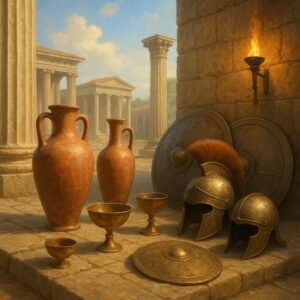
Carsulae is an ancient abandoned Roman city, located along the Via Flaminia a few kilometers from Terni. Discover the remains of the forum, the twin temples, the theater, and the amphitheater, perfectly preserved thanks to the lack of later building overlays. An immersive experience in history, enriched by a visitor center with unique artifacts.
– Forum and Twin Temples: the political and religious heart of the city, with travertine paving and two temples dedicated to the Dioscuri.
– Theater and Amphitheater: 1st-century AD buildings, still used for summer performances.
– Arch of San Damiano: imposing monumental entrance with three arches, from the Augustan age.
– “U. Ciotti” Visitor Center: displays statues, mosaics, and artifacts from the excavations, including the lead sarcophagus of a young girl.
Evocative Introduction
Imagine walking on the same limestone paving where wagons once passed along the Via Flaminia two thousand years ago. This is Carsulae: an abandoned ancient Roman city, never rebuilt over. No medieval villages or modern houses superimposed. Only silence, grass growing between the flagstones, and the silhouette of the Arco di San Damiano welcoming you. It is one of the most authentic archaeological sites in Umbria, little visited, where you can truly feel time stand still.
Evocative Introduction
Imagine walking on the same limestone paving where wagons once passed along the Via Flaminia two thousand years ago. This is Carsulae: an abandoned ancient Roman city, never rebuilt over. No medieval villages or modern houses superimposed. Only silence, grass growing between the flagstones, and the silhouette of the Arco di San Damiano welcoming you. It is one of the most authentic archaeological sites in Umbria, little visited, where you can truly feel time stand still.
Historical Notes
Carsulae was founded after the Battle of Sentinum (295 BC) and grew along the Via Flaminia (220-219 BC), which became its main artery. It experienced its greatest splendor under Augustus and the Julio-Claudian dynasty, as attested by inscriptions. However, the crisis of the late Empire, the rerouting of the Via Flaminia towards Spoleto, and barbarian invasions sealed its fate. Lacking walls, it was abandoned by the 5th century AD and buried by alluvial deposits. Scientific excavations only began after World War II, led by Umberto Ciotti.
Historical Notes
Carsulae was founded after the Battle of Sentinum (295 BC) and grew along the Via Flaminia (220-219 BC), which became its main artery. It experienced its greatest splendor under Augustus and the Julio-Claudian dynasty, as attested by inscriptions. However, the crisis of the late Empire, the rerouting of the Via Flaminia towards Spoleto, and barbarian invasions sealed its fate. Lacking walls, it was abandoned by the 5th century AD and buried by alluvial deposits. Scientific excavations only began after World War II, led by Umberto Ciotti.
Strolling through the Forum
The heart of the city is the forum, a square paved in travertine. Here stand the Templi Gemini (perhaps dedicated to the Dioscuri), the basilica with its pillar plinths, and the curia. On the southern side, tabernae with stone counters reveal the commercial soul of the municipality. Stop to observe the remains of the noble domus with mosaics, and the Capitolium – the temple of the Capitoline triad – brought to light by recent excavations. It is an open-air museum where every stone tells stories from two thousand years ago.
Strolling through the Forum
The heart of the city is the forum, a square paved in travertine. Here stand the Templi Gemini (perhaps dedicated to the Dioscuri), the basilica with its pillar plinths, and the curia. On the southern side, tabernae with stone counters reveal the commercial soul of the municipality. Stop to observe the remains of the noble domus with mosaics, and the Capitolium – the temple of the Capitoline triad – brought to light by recent excavations. It is an open-air museum where every stone tells stories from two thousand years ago.
Theater and Amphitheater: The Show Goes On
Built in the 1st century AD, the theater and amphitheater are aligned and perfectly integrated into the landscape. The theater, nestled against the hill, is still used today for summer events like the Terni Summer Fest – a unique chance to sit where Romans once applauded. The smaller amphitheater was used for games. A little further on, the Antiquarium, housed in a former cistern, displays architectural fragments, painted plaster, and the lead sarcophagus of a young girl. A dive into daily life of the era.
Theater and Amphitheater: The Show Goes On
Built in the 1st century AD, the theater and amphitheater are aligned and perfectly integrated into the landscape. The theater, nestled against the hill, is still used today for summer events like the Terni Summer Fest – a unique chance to sit where Romans once applauded. The smaller amphitheater was used for games. A little further on, the Antiquarium, housed in a former cistern, displays architectural fragments, painted plaster, and the lead sarcophagus of a young girl. A dive into daily life of the era.
Why Visit It
First: authenticity. Unlike many sites, Carsulae has no medieval layers: what you see is the Roman city as it was, with the original pavement and intact urban layout. Second: the absence of crowds even in high season allows a relaxed, almost private visit. Third: technology aids understanding – a free app reconstructs the city in 3D for the year 69 AD, with audio and video. Download it before entering; it reveals details that the naked eye might miss.
Why Visit It
First: authenticity. Unlike many sites, Carsulae has no medieval layers: what you see is the Roman city as it was, with the original pavement and intact urban layout. Second: the absence of crowds even in high season allows a relaxed, almost private visit. Third: technology aids understanding – a free app reconstructs the city in 3D for the year 69 AD, with audio and video. Download it before entering; it reveals details that the naked eye might miss.
When to Go
The best time? Spring, when the weather is mild and the grass among the ruins is still bright green. In autumn, the low light enhances the colors of the stone. If you want to experience theater, go in summer: the program of the Terni Summer Fest (July-August) offers evenings of theater, music, and comedy under the stars. Avoid the midday hours on the hottest days: there is no shade in the forum, but the cistern and visitor center offer refreshment.
When to Go
The best time? Spring, when the weather is mild and the grass among the ruins is still bright green. In autumn, the low light enhances the colors of the stone. If you want to experience theater, go in summer: the program of the Terni Summer Fest (July-August) offers evenings of theater, music, and comedy under the stars. Avoid the midday hours on the hottest days: there is no shade in the forum, but the cistern and visitor center offer refreshment.
Nearby
A few kilometers away, San Gemini is worth a detour: a medieval village with its mineral waters known since ancient times and a beautiful historic center. Still on the Flaminia road towards Terni, you can also visit the Marmore Falls (even if not mentioned in our documents, they are a classic). Or, if you’re in the mood for street food and shops, head straight to the center of Terni, 8 km away: covered market, underground Narni? No, let’s play it safe: Terni offers squares and good Umbrian cuisine.
Nearby
A few kilometers away, San Gemini is worth a detour: a medieval village with its mineral waters known since ancient times and a beautiful historic center. Still on the Flaminia road towards Terni, you can also visit the Marmore Falls (even if not mentioned in our documents, they are a classic). Or, if you’re in the mood for street food and shops, head straight to the center of Terni, 8 km away: covered market, underground Narni? No, let’s play it safe: Terni offers squares and good Umbrian cuisine.