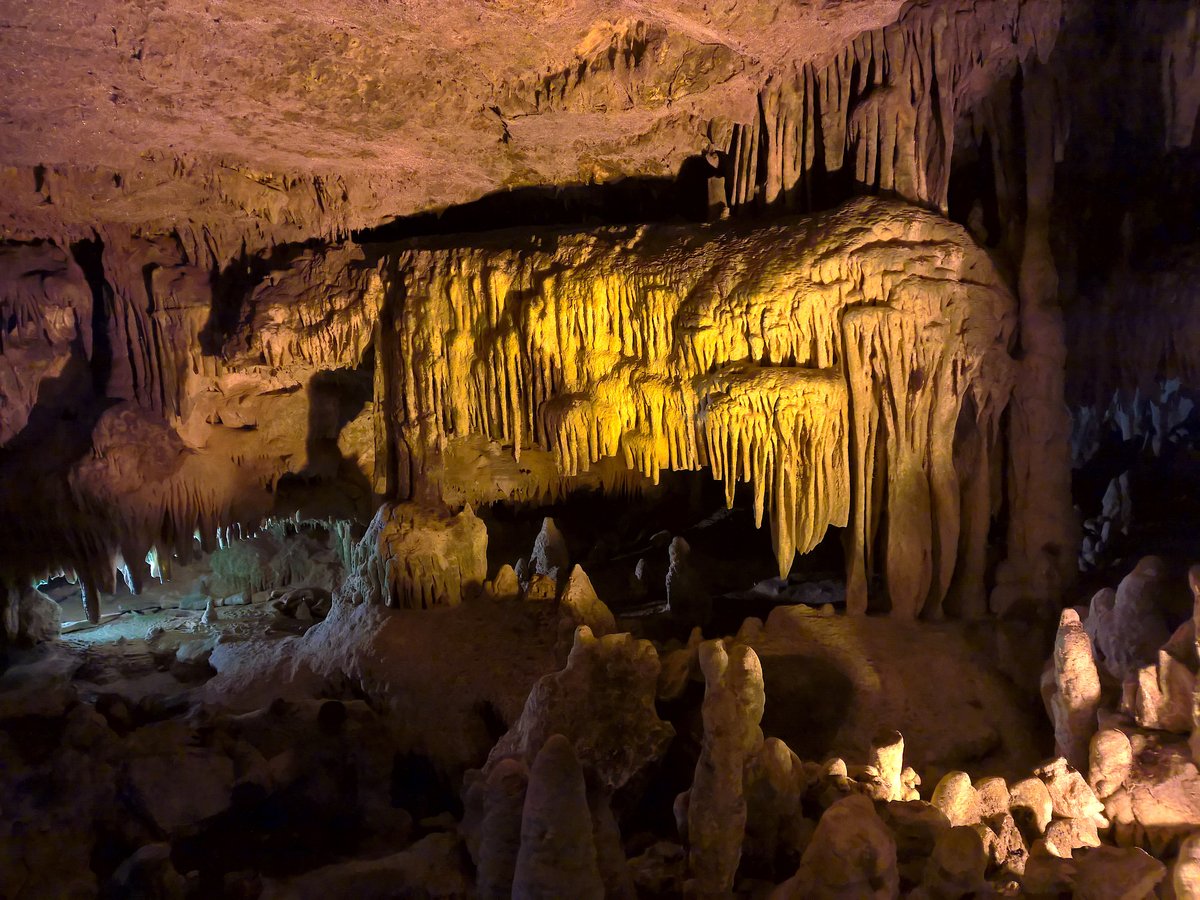
The Castellana Caves offer a spectacular journey into the heart of the earth, among stalactites, stalagmites and underground canyons. Discover the 3 km long route leading to the White Cave, admiring unique formations such as the Calza and the Tower of Pisa. Ideal for families and nature lovers, with cool temperatures all year round.
– Short route 1 km (50 min) or long route 3 km (2 hours)
– Constant temperature 18°C, humidity over 90%
– Speleological Museum and Sirio Astronomical Observatory
– Guided tours in Italian, English, French and German
Welcome to the Underground World of the Castellana Caves
Take the first steps down into the Grave, the humidity envelops you, and you immediately realize you’re in another world. The Castellana Caves are a labyrinth of caverns, canyons, and formations stretching for 3 km at a depth of 70 meters. The first chamber, the Grave, is a natural pantheon 50 meters wide and 60 meters deep—an opening that has existed forever. But it’s at the end of the route that the surprise comes: the White Cave, with its walls of pure alabaster sparkling like snow. Here, time seems to stand still. The temperature stays constant around 16°C, humidity hovers near 90%. A place that leaves you breathless, even if you’re not a cave enthusiast.
Welcome to the Underground World of the Castellana Caves
Take the first steps down into the Grave, the humidity envelops you, and you immediately realize you’re in another world. The Castellana Caves are a labyrinth of caverns, canyons, and formations stretching for 3 km at a depth of 70 meters. The first chamber, the Grave, is a natural pantheon 50 meters wide and 60 meters deep—an opening that has existed forever. But it’s at the end of the route that the surprise comes: the White Cave, with its walls of pure alabaster sparkling like snow. Here, time seems to stand still. The temperature stays constant around 16°C, humidity hovers near 90%. A place that leaves you breathless, even if you’re not a cave enthusiast.
Discovery and History
Until 1938, no one knew what lay hidden beneath Castellana. It was Franco Anelli, a speleologist, who explored the system on January 23 of that year. Two years later, he discovered the White Cave, which President Luigi Einaudi called “the most beautiful in the world” in 1952. Since then, the caves have been open to the public and have attracted millions of visitors. In 2000, the Speleological Museum named after him was inaugurated. Here are the key moments:
Discovery and History
Until 1938, no one knew what lay hidden beneath Castellana. It was Franco Anelli, a speleologist, who explored the system on January 23 of that year. Two years later, he discovered the White Cave, which President Luigi Einaudi called “the most beautiful in the world” in 1952. Since then, the caves have been open to the public and have attracted millions of visitors. In 2000, the Speleological Museum named after him was inaugurated. Here are the key moments:
A journey among stalactites and canyons
The route starts from the Grave and winds through caves with fantastical names: the Grotta Nera (with the strange black fungus Scolecobasidium anellii), the Cavernone dei Monumenti, the Caverna della Civetta. Then you pass into the Corridoio del Deserto, a true underground canyon with reddish colors. You reach the Torre di Pisa, a lopsided stalagmite, and finally the Grotta Bianca, with eccentric stalactites and “bacon strips” of alabaster. You can choose the short route (1 km, 50 min) or the long route (3 km, 2 hours). Both are guided and suitable for everyone, but wear comfortable shoes as the floor is slippery.
A journey among stalactites and canyons
The route starts from the Grave and winds through caves with fantastical names: the Grotta Nera (with the strange black fungus Scolecobasidium anellii), the Cavernone dei Monumenti, the Caverna della Civetta. Then you pass into the Corridoio del Deserto, a true underground canyon with reddish colors. You reach the Torre di Pisa, a lopsided stalagmite, and finally the Grotta Bianca, with eccentric stalactites and “bacon strips” of alabaster. You can choose the short route (1 km, 50 min) or the long route (3 km, 2 hours). Both are guided and suitable for everyone, but wear comfortable shoes as the floor is slippery.
The Hidden Life in the Caves
Not just rocks: the Castellana Caves host a surprising fauna. There are 5 species of bats (like Miniopterus schreibersii and Rhinolophus ferrumequinum) and extremely rare insects such as the blind beetle Italodytes stammeri or the pseudoscorpion Hadoblothrus gigas. The Grotta Nera owes its color to a microscopic fungus. Even if you won’t see animals during the tourist visit (they’re shy), knowing they exist adds to the allure. The environment is extreme: total darkness, very high humidity, stable temperature. A unique ecosystem that has survived for millennia.
The Hidden Life in the Caves
Not just rocks: the Castellana Caves host a surprising fauna. There are 5 species of bats (like Miniopterus schreibersii and Rhinolophus ferrumequinum) and extremely rare insects such as the blind beetle Italodytes stammeri or the pseudoscorpion Hadoblothrus gigas. The Grotta Nera owes its color to a microscopic fungus. Even if you won’t see animals during the tourist visit (they’re shy), knowing they exist adds to the allure. The environment is extreme: total darkness, very high humidity, stable temperature. A unique ecosystem that has survived for millennia.
Three Reasons Not to Miss Them
1. The White Cave: considered the most beautiful in the world for its pure alabaster, it’s an experience you won’t forget. 2. A route for everyone: no need to be a speleologist; expert guides accompany you along equipped paths, with elevators to climb back up. Children are welcome (free under 6, reduced for ages 6-14). 3. Cool in summer: with an internal temperature of 16°C (61°F), it’s the perfect refuge when the sun is beating down outside. I recommend booking online to avoid queues.
Three Reasons Not to Miss Them
1. The White Cave: considered the most beautiful in the world for its pure alabaster, it’s an experience you won’t forget. 2. A route for everyone: no need to be a speleologist; expert guides accompany you along equipped paths, with elevators to climb back up. Children are welcome (free under 6, reduced for ages 6-14). 3. Cool in summer: with an internal temperature of 16°C (61°F), it’s the perfect refuge when the sun is beating down outside. I recommend booking online to avoid queues.
The Best Time to Visit
The caves are open all year round (Tuesday to Sunday, closed on Mondays, Christmas Day, and New Year’s Day). The most magical time? Early morning, when the crowds are still thin and you can enjoy the almost sacred silence of the caverns. If you can, choose spring or autumn: the weather outside is mild, and you can combine the visit with a walk in the surrounding area. In summer, the coolness of the caves is a blessing, but expect more people. Keep an eye on the hours: the last entry is usually at 4:00 PM, but check the website.
The Best Time to Visit
The caves are open all year round (Tuesday to Sunday, closed on Mondays, Christmas Day, and New Year’s Day). The most magical time? Early morning, when the crowds are still thin and you can enjoy the almost sacred silence of the caverns. If you can, choose spring or autumn: the weather outside is mild, and you can combine the visit with a walk in the surrounding area. In summer, the coolness of the caves is a blessing, but expect more people. Keep an eye on the hours: the last entry is usually at 4:00 PM, but check the website.
What to do after the visit
Just steps from the entrance is the Franco Anelli Speleological Museum, with educational workshops and an astronomical observatory (Osservatorio Sirio) that organizes summer evening visits: a way to gaze at the stars after being underground. If you have time, visit the center of Castellana Grotte, with its trulli and Apulian cuisine: try orecchiette or focaccia barese. Another idea? The Parco delle Grotte offers nature trails to complete the day.
What to do after the visit
Just steps from the entrance is the Franco Anelli Speleological Museum, with educational workshops and an astronomical observatory (Osservatorio Sirio) that organizes summer evening visits: a way to gaze at the stars after being underground. If you have time, visit the center of Castellana Grotte, with its trulli and Apulian cuisine: try orecchiette or focaccia barese. Another idea? The Parco delle Grotte offers nature trails to complete the day.