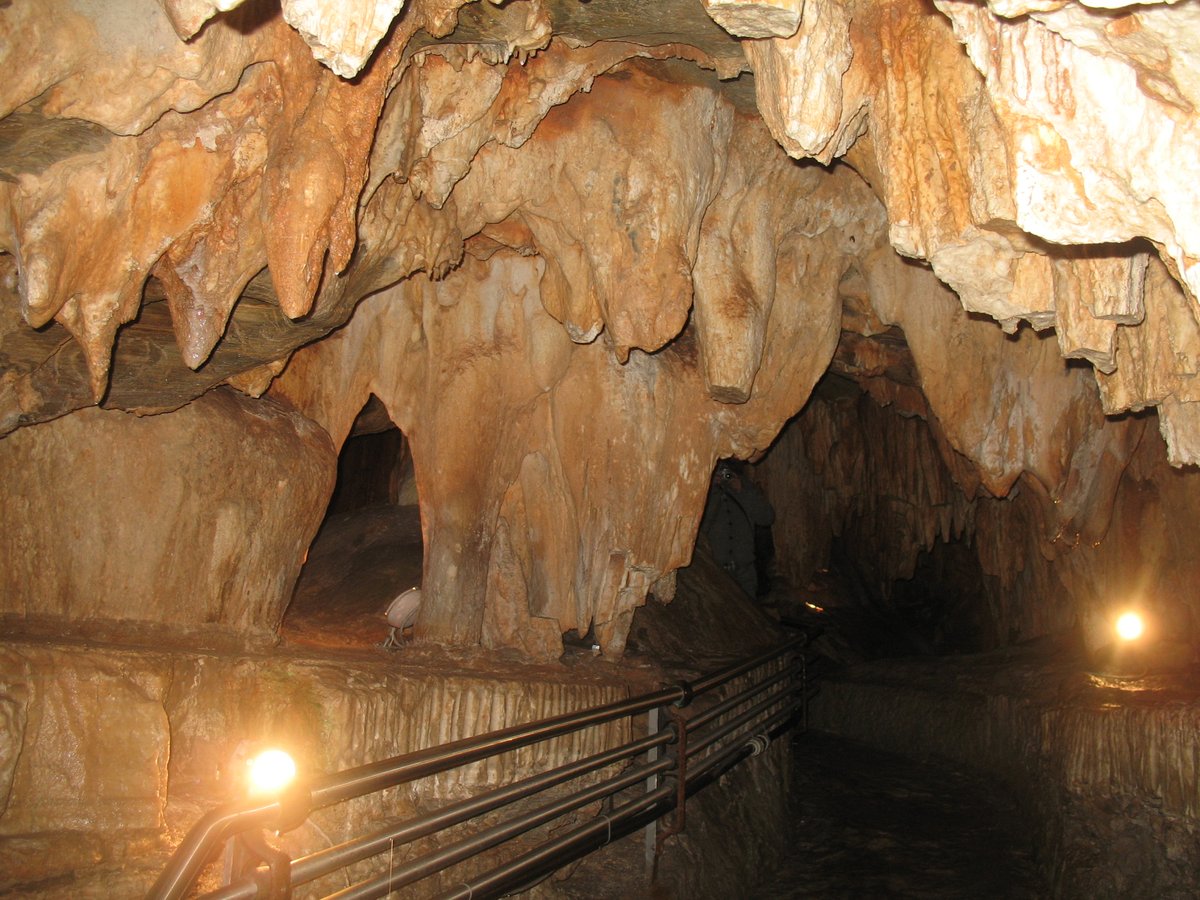
The Toirano Caves, in the province of Savona, offer a 70-minute journey through geological wonders and prehistoric evidence. Here you can walk in the footsteps of cave bears and Paleolithic Homo sapiens, admiring stalactites and unique crystals. The complex includes the Bàsura Cave and the Lower Santa Lucia Cave, connected by a tunnel.
4 key points:
– Guided tour of 1.3 km with helmet and speleological guide.
– Constant temperature of 16°C, appropriate clothing.
– Prehistoric Museum of Val Varatella included in the ticket.
– Suitable for families (children from 8 years old).
Introduction
Entering the Toirano Caves is like taking a 12,000-year leap back in time. Here, beneath 150 meters of rock, a route of over 1,300 meters winds through two connected caves: the Grotta della Bàsura and Santa Lucia Inferiore. The name says it all: it’s the largest cave bear cemetery in Europe, but that’s not all. Human footprints, stalactites, and aragonite crystals await you on an underground journey that will leave you speechless.
Introduction
Entering the Toirano Caves is like taking a 12,000-year leap back in time. Here, beneath 150 meters of rock, a route of over 1,300 meters winds through two connected caves: the Grotta della Bàsura and Santa Lucia Inferiore. The name says it all: it’s the largest cave bear cemetery in Europe, but that’s not all. Human footprints, stalactites, and aragonite crystals await you on an underground journey that will leave you speechless.
Historical Background
The Grotta della Bàsura was discovered in
May 1950 by a group of local boys. Since then, archaeological research has revealed a treasure: bones of
Ursus spelaeus and human footprints from the Upper Paleolithic. In 1960, Santa Lucia Inferiore was discovered, and since
1967 an artificial tunnel connects the two cavities. The complex has been open to the public since 1953. Here are the key moments:
- 1950: discovery of Grotta della Bàsura
- 1953: opening to the public
- 1960: discovery of Santa Lucia Inferiore
- 1967: connection between the two caves
- 2014: opening of the Prehistoric Museum
Historical Background
The Grotta della Bàsura was discovered in
May 1950 by a group of local boys. Since then, archaeological research has revealed a treasure: bones of
Ursus spelaeus and human footprints from the Upper Paleolithic. In 1960, Santa Lucia Inferiore was discovered, and since
1967 an artificial tunnel connects the two cavities. The complex has been open to the public since 1953. Here are the key moments:
- 1950: discovery of Grotta della Bàsura
- 1953: opening to the public
- 1960: discovery of Santa Lucia Inferiore
- 1967: connection between the two caves
- 2014: opening of the Prehistoric Museum
The Bear Cemetery and Human Traces
The Bàsura Cave is a history book written in stone. Here lies the Bear Cemetery, a pile of Ursus spelaeus bones dating back 27,000–24,000 years. But the real thrill is the Corridor of Footprints: footprints, handprints, and knee prints left by prehistoric humans about 12,000 years ago. In the Hall of Mysteries, clay balls thrown against the walls tell of ancient rituals. Evidence of bears is not lacking: scratch marks and paw prints.
The Bear Cemetery and Human Traces
The Bàsura Cave is a history book written in stone. Here lies the Bear Cemetery, a pile of Ursus spelaeus bones dating back 27,000–24,000 years. But the real thrill is the Corridor of Footprints: footprints, handprints, and knee prints left by prehistoric humans about 12,000 years ago. In the Hall of Mysteries, clay balls thrown against the walls tell of ancient rituals. Evidence of bears is not lacking: scratch marks and paw prints.
The Aragonite Crystals and the Cave of Cybele
After passing through the artificial tunnel, you enter Santa Lucia Inferiore, a world of aragonite crystals that look like ice flowers. The walls are covered in white coralloids, and in the Hall of the Pantheon, an eight-meter column enchants visitors. But the masterpiece is the Cave of Cybele, in the Grotta della Bàsura, with mammillary formations unique in the world. If you like, at the end there is also a sparkling wine cellar, an original touch.
The Aragonite Crystals and the Cave of Cybele
After passing through the artificial tunnel, you enter Santa Lucia Inferiore, a world of aragonite crystals that look like ice flowers. The walls are covered in white coralloids, and in the Hall of the Pantheon, an eight-meter column enchants visitors. But the masterpiece is the Cave of Cybele, in the Grotta della Bàsura, with mammillary formations unique in the world. If you like, at the end there is also a sparkling wine cellar, an original touch.
Why Visit
Three reasons: first, it is Europe’s largest cave bear cemetery, a paleontology hotspot. Second, the 12,000-year-old human footprints are among the best preserved in the world – you’ll feel like you’re walking alongside our ancestors. Third, the trail is suitable for everyone (ages 5 and up) and features unique geological formations like aragonite and alabaster flows. Plus, the ticket includes the Val Varatella Prehistoric Museum.
Why Visit
Three reasons: first, it is Europe’s largest cave bear cemetery, a paleontology hotspot. Second, the 12,000-year-old human footprints are among the best preserved in the world – you’ll feel like you’re walking alongside our ancestors. Third, the trail is suitable for everyone (ages 5 and up) and features unique geological formations like aragonite and alabaster flows. Plus, the ticket includes the Val Varatella Prehistoric Museum.
When to Go
The cave has a constant temperature of 16°C, so it’s open year-round. If you want to avoid the queue, choose a weekday in spring or autumn. In summer, there’s the possibility of night tours by reservation – a completely different experience, with the stalactites fully lit. Always bring a sweatshirt, even if it’s hot outside.
When to Go
The cave has a constant temperature of 16°C, so it’s open year-round. If you want to avoid the queue, choose a weekday in spring or autumn. In summer, there’s the possibility of night tours by reservation – a completely different experience, with the stalactites fully lit. Always bring a sweatshirt, even if it’s hot outside.
In the Vicinity
After your visit, don’t miss the medieval village of Toirano, with its narrow alleyways and Romanesque bell tower. Drop by the Ethnographic Museum of Val Varatella, housed in the palace of the Marchesi del Carretto. If you feel like walking, Monte San Pietro offers over 300 climbing routes and trails with sea views. For lunch, the municipal park (Parco del Marchese) has picnic tables in the shade.
In the Vicinity
After your visit, don’t miss the medieval village of Toirano, with its narrow alleyways and Romanesque bell tower. Drop by the Ethnographic Museum of Val Varatella, housed in the palace of the Marchesi del Carretto. If you feel like walking, Monte San Pietro offers over 300 climbing routes and trails with sea views. For lunch, the municipal park (Parco del Marchese) has picnic tables in the shade.