Introduction
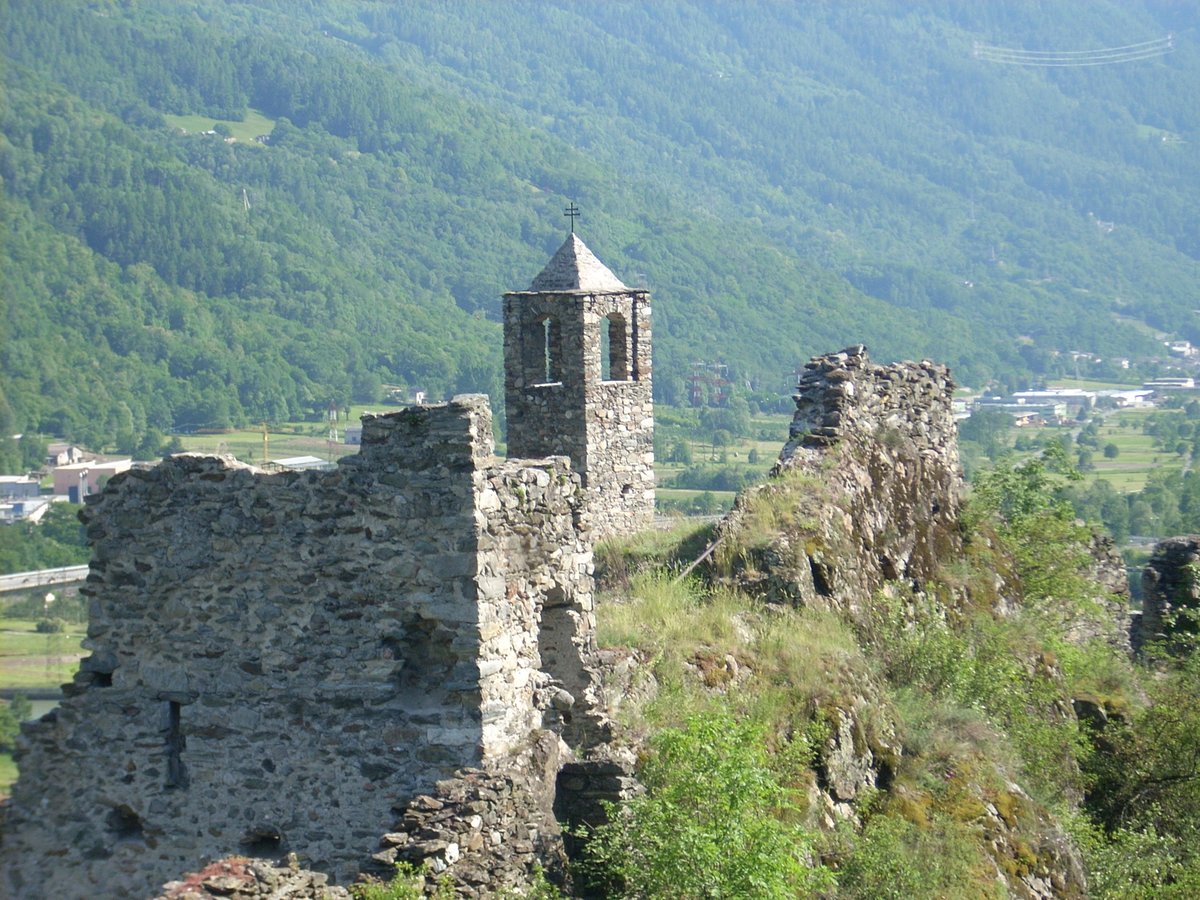
Have you ever paused to look at Valtellina from above, feeling suspended between sky and earth? At the Castello Vecchio di S. Faustino, perched on a rocky spur overlooking the valley, that’s exactly what happens. The view is breathtaking: vineyards, woods, and the Adda River flowing down there, far away. A place that grabs you right away, perhaps for its slightly decadent atmosphere, with moss-covered crumbling walls and the wind whistling through the stones. It’s not a restored, polished castle: it’s authentic, raw, alive. And it smells of ancient history.
Historical Notes
Built perhaps as early as the 10th century as a refuge for local populations, the Old Castle of S. Faustino was involved in the struggles between Guelphs and Ghibellines. Here, in 1376, the bishop of Como
Giovanni di S. Faustino – from whom it takes its name – took shelter during a feud with the Visconti. In the 17th century, after various battles, it was gradually abandoned. Today it remains a suggestive ruin, but the walls and the crenellated tower still tell its medieval past. A timeline to help you find your way:
- 10th-11th century: construction of the castle
- 13th century: expansion and fortification
- 1376: refuge of the bishop of Como
- 17th century: gradual abandonment
The Chestnut Grove Trail
To reach the castle, you follow a trail that winds through the century-old chestnut groves on the slopes of Mount Masuccio. The path is well-marked, with gentle inclines and some steeper stretches among the tree roots. It’s a sensory experience: the scent of damp earth, the rustle of dry leaves underfoot, and the occasional flight of a kestrel. In winter, the woods are bare and light filters through the branches, creating plays of shadow. It’s truly a shame not to bring a snack to stop halfway.
The View from the Tower
Once you arrive, the first thing that strikes you is the 360-degree view from the top of the castle. If you climb the tower (watch out, the steps are unstable), a panorama unfolds that spans the entire Valtellina valley, from Bormio to Lake Como. In summer, the green meadows contrast incredibly with the gray rocks of the alpine pastures. In autumn, the vineyards turn yellow and red. Tip: go on a clear day and bring binoculars – you might spot deer in the distant woods.
Why Visit
Three good reasons to come up here: first, it’s free and always open, no tickets or fixed hours. Second, it’s away from the crowds: almost no one goes there, so you can enjoy the silence and the sounds of nature. Third, it’s a perfect spot for a romantic picnic or a sunset photo, when the sun tints the mountains pink. And if you’re into photography, this is the place for breathtaking shots, with the ruins in the foreground and the valley in the background.
When to Go
The best moment? The sunset, without a doubt. Around 5-6 PM in summer (but check the time), the light becomes warm and enveloping, and the castle seems to glow. In winter, if the snow is light, you can hike up with snowshoes and it’s a magical, almost mystical experience, with the snow-covered landscape and absolute silence. In spring, crocuses and primroses bloom among the stones, but the weather is changeable: always bring an extra layer.
Around Here
Just a stone’s throw from the castle (still in Grosotto), the Church of St. Faustino is worth a visit, featuring 16th-century frescoes from the Tyrolean school. Another gem is the Ecomuseum of Val Grosina, which tells the story of rural life and woodworking. If you still have energy, the Path of the Wayfarer continues towards Stelvio National Park, with larch forests and alpine meadows. In short, the castle is just the beginning of a day full of discoveries.