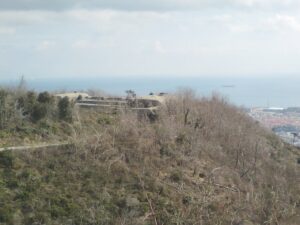
Perched on a hill at 330 meters, the Castle of Cairo Montenotte is a remarkably well-preserved medieval fortress. Built in the 12th century by the Del Carretto marquises, it dominates the entire Bormida Valley with a breathtaking view that stretches to the Ligurian Sea on clear days.
Perfectly preserved towers and walls that transport you directly to the Middle Ages
Strategic location along the ancient Via Aemilia Scauri, an important Roman communication route
360-degree panoramic view of the Bormida Valley and, on clear days, all the way to the sea
Medieval military architecture with an intact moat, drawbridge, and defensive system
Introduction
Upon arriving in Cairo Montenotte, the medieval castle stands out against the sky, dominating the Val Bormida with an air of ancient authority. It’s not just a monument, but a privileged vantage point that immediately makes you understand why this location was so strategic. Its massive towers and stone walls seem to tell stories of knights and merchants, while the gaze sweeps over the Ligurian hills fading into the horizon. Personally, I’m always struck by how certain places retain a particular energy, almost palpable. Here, you breathe history, but also a certain tranquility, far from the more beaten tourist routes. Perhaps that’s exactly what makes it special: an authentic corner where time seems to have stood still. As you climb towards the entrance, you already sense that the visit will be more than just a cultural stop.
Historical Background
The origins of Cairo Montenotte Castle date back to the
12th century, when it was built as a fortification by the Del Carretto marquises, a powerful family that controlled much of the territory. Its location along the ancient Via Aemilia Scauri, a Roman road connecting the Ligurian coast with Piedmont, made it a crucial commercial and military crossroads. Over the centuries, it passed through various hands, undergoing modifications and expansions, particularly during Savoy rule. One detail that has always intrigued me is how, despite battles and changes in ownership, the structure has maintained its essential medieval character. Perhaps because here, more than elsewhere, there was a need for a solid stronghold guarding the valley.
- 12th century: initial construction by the Del Carretto family
- Middle Ages: key role as an outpost on the Via Aemilia Scauri
- Modern era: transition under Savoy rule and architectural modifications
- Today: preservation as a historical site and tourist attraction
The Towers and the Panoramic View
One of the things that makes this castle memorable is the view from the top of the towers. Climbing the time-worn stone steps—be careful, some are a bit steep—you reach a point where the Bormida Valley unfolds like a living postcard. To the left, you can glimpse the rooftops of Cairo Montenotte, with its pastel-colored houses; to the right, the hills roll on until they blend with the sky. In winter, when fog envelops the valley, the atmosphere becomes almost mysterious, while in summer the colors are vivid and full of light. I like to think that, centuries ago, sentinels watched the same panorama, scanning the horizon for signs of danger. Today, however, it’s a moment of pure contemplation. Bring a camera, because from here you can take photos that capture the essence of inland Liguria, far from the sea but equally captivating.
The interior rooms and hidden details
Inside, the castle surprises with its austere simplicity, far from the opulence of other noble residences. The rooms are spacious yet essential, with stone floors and thick walls that maintain a natural coolness even on the hottest days. Walking through these rooms, you’ll notice small details that tell of daily life in the past: niches in the walls that might have served as storage spaces, or traces of fireplaces now out of use. In one of the main halls, I noticed a splayed window that perfectly frames the external landscape, as if it was designed to enjoy the view even while indoors. There are no period furniture or lavish collections, and perhaps that’s for the best: attention remains on the architecture and history of the place. Some might find it a bit bare, but I appreciate this honesty, which leaves room for imagination to reconstruct what it must have been like to live here.
Why Visit It
Visiting the Castle of Cairo Montenotte is worthwhile for at least three concrete reasons. First, the panoramic view of the Val Bormida is simply unique, offering a perspective on Liguria that few know. Second, it is a well-preserved example of medieval military architecture, with towers and walls that show how these territories were defended. Third, the atmosphere is authentic and not overly touristy, perfect for those seeking a tranquil experience away from the crowds. Personally, I also appreciate that it can easily be combined with a day of exploration in the area without having to rush. Perhaps it’s not the most famous castle in Italy, but precisely for this reason, it has a special character that makes you feel a bit like a discoverer.
When to Go
The best time to visit the castle, in my experience, is in the late afternoon of autumn. The changing leaf colors paint the Val Bormida with warm hues, and the low-angle sunlight highlights the stone textures of the walls. In summer, however, days can be muggy, so it’s better to opt for the early morning hours when the air is still fresh and the sun isn’t too intense. In winter, if you catch a clear day after snowfall, the view becomes magical, but be mindful of the cold and possible closures due to adverse conditions. In short, there’s no wrong season, but autumn offers that melancholic atmosphere that suits such an ancient place.
In the Surroundings
To enrich your day, I recommend pairing your castle visit with a stop at the Cairo Montenotte Railway Museum, which tells the story of local railways with vintage locomotives and interesting memorabilia. It’s a curious contrast between medieval and modern, but it works. Alternatively, if you enjoy walking, nearby trails lead into the hills of Val Bormida, ideal for a nature walk. These aren’t challenging paths, but they allow you to see the area from a different perspective. Some people have also mentioned small local wineries where you can taste regional wines, but I haven’t explored them yet—perhaps next time.