Church of the Eremitani: Mantegna and the UNESCO Frescoes

The Church of the Eremitani stands on Piazza Eremitani in Padua, near the Scrovegni Chapel. Built between 1276 and 1306, it preserves a single nave with a wooden keel-shaped ceiling and cycles of 14th-century frescoes by Guariento and Giusto de’ Menabuoi, as well as fragments from Mantegna’s Ovetari Chapel. Admission is free, and the building is part of the UNESCO site “Padua’s 14th-Century Fresco Cycles”.
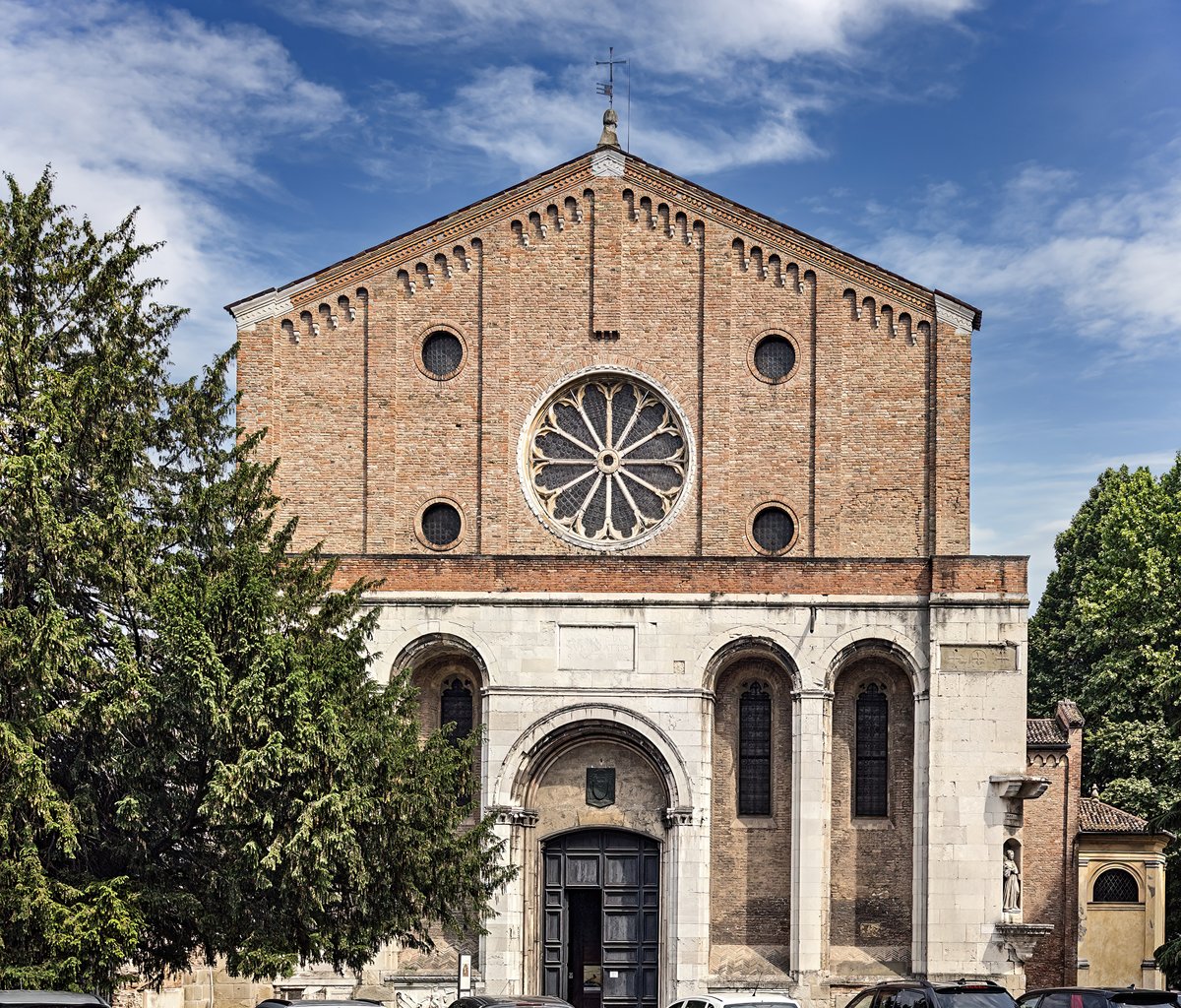
– Façade in brick and stone, with a rose window and a five-arch loggia.
– Interior: a single nave with a keel-shaped ceiling rebuilt after the 1944 bombing.
– Ovetari Chapel: Mantegna fragments repositioned and put back on display since 2006.
– Practical information: weekdays 7:30–12:30 and 15:30–19:00; Saturdays and Sundays 9:00–12:30 and 16:00–19:00.


Events nearby

Copertina itinerario Church of the Eremitani: Mantegna and the UNESCO Frescoes
The Gothic church on Piazza Eremitani in Padua: a brick façade, a single nave with a keel-shaped ceiling, frescoes by Guariento and Giusto de’ Menabuoi, Mantegna’s Ovetari Chapel, and free admission.

Good to know


Introduction: Church of the Eremitani, Mantegna and the UNESCO Frescoes

The Church of the Eremitani draws you in from afar, with its terracotta façade that seems to glow even under a grey sky. We are in Piazza Eremitani, in Padua, facing a Gothic building dedicated to Saints Philip and James: inside, the surprise is the single nave with a wooden ship’s-keel ceiling, rebuilt after the war. Here time is measured in frescoes: Guariento and Giusto de’ Menabuoi tell the story of fourteenth-century Padua, while the Ovetari Chapel preserves fragments of Mantegna’s cycle, part of the UNESCO site “Padua’s fourteenth-century fresco cycles” since 2021. Admission is free, and this is one of the reasons people wander in almost by chance, perhaps on their way from the Scrovegni Chapel. Don’t expect a silent museum: it is a living church, with its religious services and a heritage that coexists with everyday life. What struck me was precisely this contrast, between the simplicity of the hall and the density of the painted stories.

Historical background

A wooden church dedicated to Saints Philip and James already stood here in 1218. Construction in masonry began in 1276 and was completed around 1306 under Fra’ Giovanni degli Eremitani, who in 1306 replaced the thatched roof with a ship’s-keel roof. The Augustinian order held it until 1806; the façade dates to 1360. In the fourteenth century came the fresco cycles by Guariento and Giusto de’ Menabuoi, while between 1448 and 1457 Andrea Mantegna worked on the Ovetari Chapel. On 11 March 1944, an Anglo-American bombing raid destroyed the façade, ceiling, part of the apse and the Dotto and Ovetari chapels: it was one of the war’s most serious artistic losses. After the war the church was rebuilt using anastylosis under Ferdinando Forlati. Since 2021 it has been part of the UNESCO site “Padua’s Fourteenth-Century Fresco Cycles”.

  • 1218: wooden temple
  • 1276-1306: construction
  • 1360: façade
  • 1448-1457: Mantegna
  • 1944: bombing
  • 2021: UNESCO

The brick façade and the keel-shaped nave

The façade is not entirely brick: the lower part is stone, with four blind arches and a central portal; the upper part, dating from 1360, is in brick, with pilasters, small arches and a rose window. The Renaissance southern portal has twelve high-reliefs of the months by Niccolò Baroncelli (1422). On entering, the single nave is striking: the wooden ceiling shaped like an inverted ship’s keel is the work of Fra’ Giovanni degli Eremitani, faithfully rebuilt after 1944. The walls alternate red and ochre brick, with a striped pattern imitating courses of brick. Flanking the entrance are the funerary monuments of Ubertino and Jacopo II da Carrara, carved by Andriolo de Santi and others around 1345 and 1351. On the right wall is the Glory of Saint Augustine with Virtues and Liberal Arts by Giusto de’ Menabuoi; on the left, an ancient clock. It is a simple interior, almost bare in places, but precisely for this reason the frescoes stand out powerfully.

Ovetari Chapel: Mantegna and the Surviving Fragments

The Ovetari Chapel is the reason many people step inside: here Andrea Mantegna, barely seventeen, worked between 1448 and 1457 with Giovanni d’Alemagna, Antonio Vivarini, Niccolò Pizzolo and Ansuino da Forlì. The cycle recounted the Stories of Saint Christopher and Saint James across three registers, with the south wall dedicated to Saint James and the north wall to Saint Christopher. In the bombing of 11 March 1944 the chapel collapsed and much of the fresco cycle was lost. The surviving fragments were reassembled and put back on display from 2006; two works had already been detached in 1880 and were saved, including the Martyrdom of Saint Christopher. Today visitors walk before a mosaic of gaps and original pieces: it is not the same as seeing the cycle intact, but it is still moving. The photographic trace helps visitors imagine the overall composition. It made me think about how little it can take to lose a masterpiece.

Guariento, Giusto de’ Menabuoi and the UNESCO Fourteenth Century

Before Mantegna, the church was already a painting site. In the main chapel Guariento di Arpo painted between 1361 and 1365 the Stories of Saint Philip, Saint Augustine and Saint James, with a lower register dedicated to the Planets and the Ages of Man. Today mainly the left wall of the cycle survives, because the presbytery was badly hit in 1944. Also linked to Guariento are the chapel of Saint Anthony Abbot (1338) and fragments with six half-length female figures. Giusto de’ Menabuoi worked in the Sanguinacci Chapel, dedicated to Saints Cosmas and Damian, and in the Cortellieri Chapel: here remain the Virtues and Liberal Arts, commissioned in the Carrarese context, with female patronage linked to Traversina Cortellieri. The crucifix on the high altar is by Nicoletto Semitecolo (1367). These are cycles that dialogue with Giotto and with the Scrovegni Chapel, but they have their own precise Paduan identity. This is why the church is part of the UNESCO site “Fourteenth-Century Fresco Cycles of Padua”.

Why it’s worth a visit

Three concrete reasons. First: entry is free and the church is in Piazza Eremitani, so you can walk in without arranging a complicated visit. Second: the Ovetari Chapel lets you see, even if only in fragments, a cycle by Mantegna from 1448–1457; it is one of the key sites of the Paduan Renaissance. Third: the keel-shaped ceiling and single nave give a very physical sense of what the halls of the mendicant preachers were like. There are also the Carraresi monuments, the mausoleum of Marco Mantova Benavides by Bartolomeo Ammannati (1544), and the altar of St Nicholas by Giuliano d’Ognibene (1495). This is not a quick tick-box stop: even non-specialists pause in front of the missing sections of the Ovetari Chapel. And there is the added advantage of being next to the Civic Museum and the Arena Gardens, so the visit fits neatly into a day in Padua.

When to go

There is no magic moment that works for everyone. I would choose a weekday morning, when the church is quieter and you can hear your footsteps echoing under the ceiling. The light coming through the rose window and the side windows warms the terracotta of the façade and makes the colours of the frescoes clearer. If you can, avoid the times of religious services: the church is alive, and it would be disrespectful to wander around with a tourist’s curiosity during Mass. Even in the late afternoon the atmosphere changes, with the brick walls becoming warmer. In summer Padua can be muggy, but the interior is a simple, shaded refuge; in winter the half-light makes certain details more evocative, even though some areas are less well lit. Be patient if you find groups: the Ovetari Chapel is small and deserves to be looked at without rushing.

In the Surrounding Area

Just outside, the Cappella degli Scrovegni is the natural completion of the story: Giotto’s frescoes help you understand the influence that can also be felt in the Eremitani. Next door is the Museo Civico agli Eremitani, housed in the former convent, with archaeological and civic collections; the adjoining convent once housed the pilgrims’ guest quarters. If the Carrarese thread interests you, you can continue toward the historic center and the Palazzo della Ragione, remembering that Fra’ Giovanni degli Eremitani also worked on the great roof of that palace. There’s no need for a rigid itinerary: the piazza itself, with its coming and going of students and visitors, is part of the experience. I’d go back toward evening, not so much for a specific time as to see the façade change color.

Itineraries nearby


💡 Did You Know…?

The keel-shaped ceiling was made with timber left over from the vault of the Palazzo della Ragione: a detail that links two Paduan building sites. In the Ovetari Chapel, the Martyrdom of Saint Christopher and the Transport of the Beheaded Body were detached in 1880, and this is precisely how they survived the bombing of 11 March 1944; the fragments have been on display again since 2006. On Jacopo da Carrara’s tomb runs an inscription in Latin distichs by Petrarch.