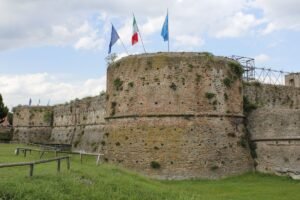
The Estense Castle dominates Ferrara with its four towers and still water-filled moat. Built in 1385 as a fortress, it became the residence of the Este family. Today, you can explore frescoed halls, prisons, ancient kitchens, and climb the towers for a spectacular view of the UNESCO historic center.
- Four majestic towers and water-filled moat
- Frescoed halls and apartments of Lucrezia Borgia
- Rampart walkways with panoramic views of Ferrara
- Historic prisons and perfectly preserved ancient kitchens
Introduction
As soon as you arrive in Piazza Castello, the Castello Estense strikes you with its grandeur: four corner towers, a moat still filled with water, and red bricks that gleam under the sun. It’s not just a monument, but the symbol of Ferrara, a medieval fortress that dominates the UNESCO historic center. Walking along its Renaissance ramparts, you breathe in the history of the Este dukes, who ruled here for centuries. The castle is perfectly integrated into the urban fabric, with its arches overlooking the city center streets, creating a unique contrast between its military appearance and the elegance of the court. Entering means immersing yourself in an atmosphere where every room tells stories of power, art, and daily life, from Don Giulio’s prisons to the frescoed halls. It’s an unforgettable place, ideal for those seeking authentic emotions in a city full of charm.
Historical Overview
The Estense Castle was built in 1385 by order of
Niccolò II d’Este as a defensive fortress following a popular uprising. Originally a basic structure, it was transformed under subsequent dukes like Ercole I and Alfonso I into a noble residence, with the addition of loggias, gardens, and reception halls. During the Renaissance, it hosted figures such as Lucrezia Borgia, who lived here as duchess. After the end of the Este dynasty in 1598, the castle passed to the Papal State and was used as a prison and barracks before being restored in the 20th century to become a museum. Today, its rooms preserve frescoes, furnishings, and artifacts that bear witness to centuries of Ferrara’s history, from court conspiracies to architectural evolutions.
- 1385: Construction as a fortress
- 15th century: Transformation into a ducal residence
- 1598: End of Este rule
- Subsequent centuries: Use as a prison and barracks
- Modern restorations: Opening to the public as a museum
The Ramparts Walkway
One of the highlights of the visit are the ramparts walkway, elevated paths that wind between the towers, offering breathtaking views over Ferrara. Built in the fifteenth century, these passages allowed guards to monitor the city and surrounding countryside, but today they provide unique panoramas: on one side, the historic center with its Renaissance palaces, on the other, the green expanses of Emilia-Romagna. Climbing up here means walking through history, touching the original walls and imagining court life. Particularly evocative is the section connecting the Tower of the Lions to the Marchesana Tower, where the arrow slits for archers can still be seen. It’s an experience that combines adventure and culture, perfect for unforgettable photos and for understanding how the castle was a strategic control point.
The Frescoed Halls and Gardens
Inside, the frescoed halls recount the splendour of the Este court, with pictorial cycles celebrating family myths and achievements. The Hall of Coats of Arms stands out, where heraldic symbols recall the dukes’ alliances, and the apartments of Lucrezia Borgia, furnished with period furniture. The hanging gardens are not to be missed, once a leisure spot for the nobility, now reconstructed with typical local plants such as roses and aromatic herbs. These green spaces, suspended between the walls, offer a corner of tranquility away from the crowds and show how the castle combined military functionality with residential elegance. Visiting these rooms means discovering unique details, like the monumental fireplaces or the windows framing the Ferrara landscape, making the experience immersive and memorable.
Why Visit It
The Estense Castle is worth visiting for at least three practical reasons: first, the rampart walkways offer panoramic views of Ferrara that you won’t find elsewhere, perfect for photos and getting your bearings in the city; second, the historic prisons, such as that of Don Giulio, tell dramatic stories of court intrigues, adding a touch of mystery; third, its location in the heart of the UNESCO center allows you to combine your visit with other nearby monuments, such as the Duomo or Palazzo dei Diamanti, without wasting time on travel. It’s a place that combines history, architecture, and emotion, suitable for everyone, from art enthusiasts to those seeking an authentic experience in Emilia-Romagna.
When to Visit
For a truly enchanting experience, explore the castle during the early morning hours or in the late afternoon, when the soft, slanting light beautifully highlights the red bricks and the shadows create magical atmospheres. Avoid peak hours to enjoy the walkways without the crowds. In terms of seasons, the milder periods like spring or autumn are ideal for pleasant temperatures and stunning landscape colors, but winter also holds a special charm, with the typical mists of the Po Valley enveloping the towers.
In the Surroundings
After the castle, explore the Ferrara Cathedral, just a short walk away, with its Romanesque-Gothic facade and the attached museum housing sacred art. For a thematic experience, visit the Diamond Palace, home to international exhibitions, in the Renaissance district designed by Biagio Rossetti. Both sites enhance your understanding of Ferrara’s heritage and are easily accessible on foot.