Introduction
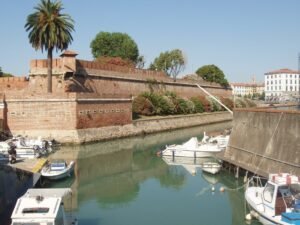
As you approach Porto Ercole, the Rocca aldobrandesca greets you from afar, a stern silhouette etched against the blue Tyrrhenian sky. It’s not just a fortress, but a visual landmark that accompanies you as you explore the village. The feeling is one of being watched by centuries of history, with that blend of majesty and mystery that only medieval fortresses can convey. Its position is strategic: perched on the promontory, it dominates the entire gulf with an air of silent challenge. I first saw it at sunset, and the contrast between the dark stones and the fiery sky left a lasting impression. This is not a monument to be visited casually: it demands attention, almost respect.
Historical Notes
Its history is a tapestry of power and defense. Built by the Aldobrandeschi in the 13th century,
it was not a noble residence but a military fortress, designed to control the sea and protect the territory. It later came under the control of the Republic of Siena, which further strengthened it, eventually ending up with the Medici of Florence in the 16th century. Each change of hands left its mark, altering walls and bastions. It is said that figures such as Caravaggio passed through here, fleeing northward. The sensation is of walking on layers of different, sometimes contrasting, stories.
- 13th century: construction by the Aldobrandeschi
- 15th century: transition under the Republic of Siena and expansions
- 16th century: annexation to the Spanish State of the Presidi and then to the Medici
- Today: a visitable monumental site, with restorations preserving its original appearance
Exploring the Walls
The true charm lies in walking along the patrol walkway. It’s not just a tourist tour, but a tactile experience. The stones are rough to the touch, warmed by the sun, and from up there the perspective completely changes. You see Porto Ercole from above, with its colorful houses that look like toys, and the Tyrrhenian Sea fading into the horizon in shades of blue. The angular bastions allow you to peer in different directions, imagining the lookouts of times past. I noticed curious details, like the narrow loopholes for arquebuses and the spots where artillery was likely positioned. There aren’t explanatory panels everywhere, and perhaps that’s for the best: it forces you to observe with your own eyes, to seek out the details. The sea air mingles with the scent of ancient stone, creating a unique atmosphere.
The Silence of the Fortress
Contrary to what one might think, it is not always a crowded place. During the middle of the day, there might be some people, but early in the morning or late in the afternoon, you often find a surprising quietness. This silence allows you to appreciate the sounds of the place: the wind whistling through the walls, the call of seagulls, the distant noise of boats. It’s the perfect time to sit on one of the stone steps and let the vastness of the panorama envelop you. Personally, I found that sense of suspension magical, far from the frenzy of the village below. Even the interior, with its bare rooms and narrow passages, speaks of an essential life, made of vigilance and waiting. There are no furnishings or fake reconstructions, and perhaps it’s precisely this authenticity that makes it special.
Why Visit It
Three concrete reasons not to skip it. First: the view is simply unmatched, one of those that makes you say ‘it was worth the climb’. Second: it’s a rare example of well-preserved medieval military architecture in the Maremma, without too many modern alterations. Third: it offers an immediate understanding of the area’s history, from the struggles between communes to foreign dominations, all contained in a compact space. You don’t need to be a history expert to grasp its importance: you feel it while walking through it. Plus, it’s a privileged observation point to understand the geography of the Argentario, with its coves and landing spots.
When to go
Avoid the hottest hours of summer, as the sun beats down hard on the pale stones and shade is scarce. The best time? Early afternoon, when the light starts to become warmer and longer, or early morning, when the air is still cool and the village below is waking up. In spring and autumn, you can enjoy mild temperatures and more intense colors. In winter, if you catch a clear day, the view stretches all the way to the islands of the Tuscan Archipelago. I visited in late September, and the low afternoon sun cast dramatic shadows on the walls, making everything more photogenic.
In the Surroundings
A visit to the Rocca pairs perfectly with a stroll through the historic center of Porto Ercole, a labyrinth of cobblestone alleys and pastel-colored houses that smell of sea salt. Not far away, the Spanish Fortress is worth a stop, another testament to the area’s military past, with a museum dedicated to the fortresses of the State of the Presidi. If you’re looking for a natural contrast, head to Cala dei Santi, a hidden cove beach reachable with a short walk, where the water is crystal clear and the setting is wild. These are all places that complete the picture of a territory rich in layers.