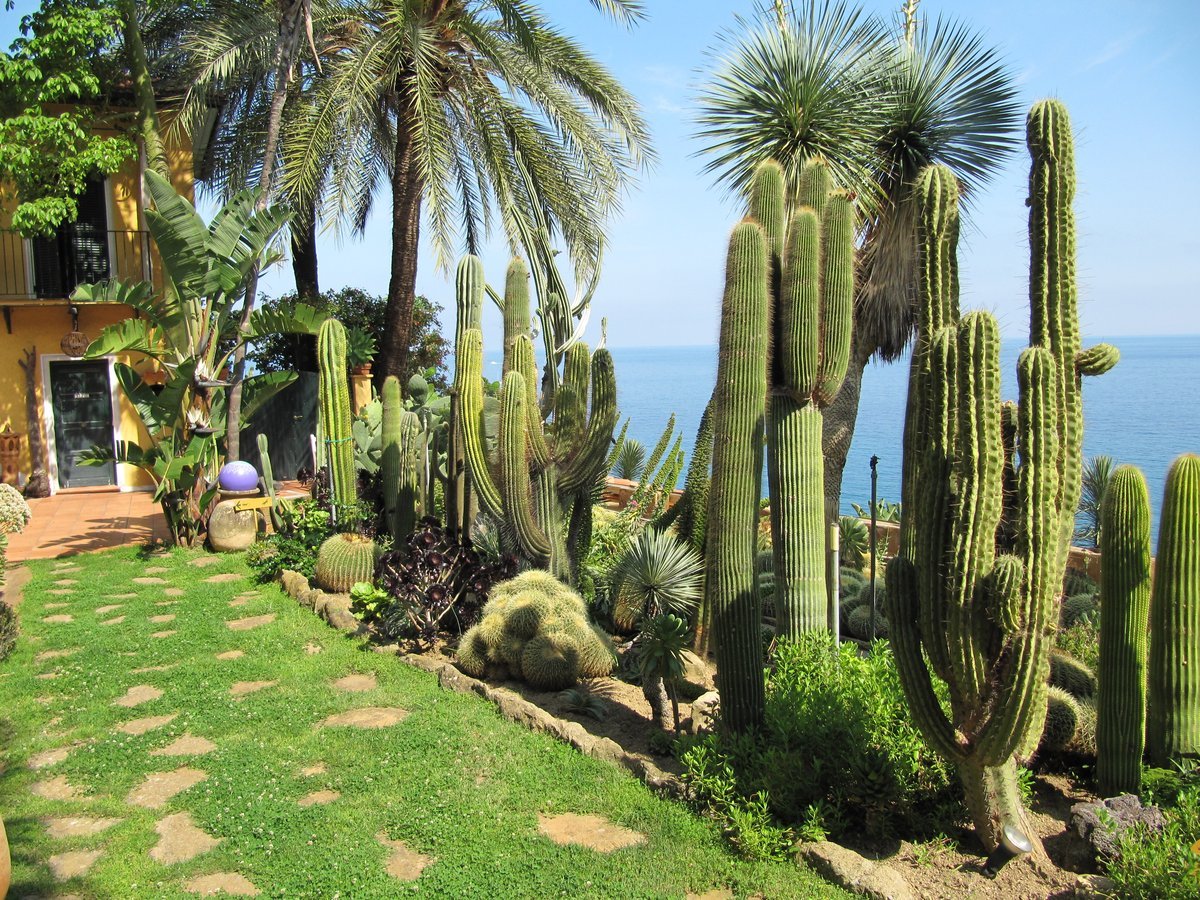
The Pallanca Exotic Garden in Bordighera is an open-air botanical museum with over 3,000 species of cacti and succulents. Founded in 1910 by the Pallanca family, it is laid out on terraces overlooking the sea, offering spectacular views. Among the specimens, a 300-year-old Chilean Copiapoa stands out.
Key points:
• Over 3,000 varieties of succulents
• Terraced garden with sea views
• Oldest plant: 300-year-old Copiapoa
• Open all year, great for families
Evocative Introduction
Imagine a garden clinging to a cliff, with the blue sea as a backdrop to thousands of cacti. The Pallanca Exotic Garden in Bordighera is exactly that: a steep terraced slope where over 3,200 species of succulent plants create a surreal landscape. Walking along paths carved into the ocher rock, among plants from Chile, Peru, and Madagascar, is an experience that blends botany and wonder. It’s not just a garden: it’s a living collection, one of the most important in Europe. And then, suddenly, your gaze falls on the sea: a spectacle that alone is worth the trip.
Evocative Introduction
Imagine a garden clinging to a cliff, with the blue sea as a backdrop to thousands of cacti. The Pallanca Exotic Garden in Bordighera is exactly that: a steep terraced slope where over 3,200 species of succulent plants create a surreal landscape. Walking along paths carved into the ocher rock, among plants from Chile, Peru, and Madagascar, is an experience that blends botany and wonder. It’s not just a garden: it’s a living collection, one of the most important in Europe. And then, suddenly, your gaze falls on the sea: a spectacle that alone is worth the trip.
Historical Notes
It all began in 1861, when
Giacomo Pallanca left the family business to work with the famous landscape designer Ludwig Winter. His passion for exotic plants spread to his son Bartolomeo, who in
1910 founded his own garden in Bordighera. After the Great War, Bartolomeo specialized in succulent plants with the help of his son Giacomo. The collection grew until
1989, when Barth (Giacomo’s son) opened the garden to the public. Today it is managed by the Associazione Culturale Botanica. Here is the timeline:
- 1861 – Giacomo Pallanca begins working with Ludwig Winter
- 1910 – Bartolomeo founds the garden
- 1989 – Opens to the public as a museum
Historical Notes
It all began in 1861, when
Giacomo Pallanca left the family business to work with the famous landscape designer Ludwig Winter. His passion for exotic plants spread to his son Bartolomeo, who in
1910 founded his own garden in Bordighera. After the Great War, Bartolomeo specialized in succulent plants with the help of his son Giacomo. The collection grew until
1989, when Barth (Giacomo’s son) opened the garden to the public. Today it is managed by the Associazione Culturale Botanica. Here is the timeline:
- 1861 – Giacomo Pallanca begins working with Ludwig Winter
- 1910 – Bartolomeo founds the garden
- 1989 – Opens to the public as a museum
The Cactus Collection
The garden is a riot of bizarre shapes. There are candle-shaped cacti up to 6 meters tall, like Neobuxbaumia polylopha, and round plants covered in golden spines. Standing out among them is the 300-year-old Copiapoa, brought directly from the Chilean Andes: a true living monument. The plants are grouped by origin, so you can move from the Madagascar desert to the Mexican one in just a few steps. Flowering is plentiful, adding splashes of color among the green and gray of the rocks. Enthusiasts can also purchase small plants at the adjoining nursery.
The Cactus Collection
The garden is a riot of bizarre shapes. There are candle-shaped cacti up to 6 meters tall, like Neobuxbaumia polylopha, and round plants covered in golden spines. Standing out among them is the 300-year-old Copiapoa, brought directly from the Chilean Andes: a true living monument. The plants are grouped by origin, so you can move from the Madagascar desert to the Mexican one in just a few steps. Flowering is plentiful, adding splashes of color among the green and gray of the rocks. Enthusiasts can also purchase small plants at the adjoining nursery.
A Path Between Rock and Sea
The garden stretches across 10,000 square meters of terraces carved into sandstone rock, once a volcano. The paths are narrow and sometimes steep, but each bend reveals a new perspective. The contrast between the green succulents, the ochre stone, and the blue sea is pure poetry. At the top, you enjoy a panoramic view of the Bay of Bordighera and, on clear days, all the way to the French Riviera. It’s a place that invites calm: there are shady spots to stop and meditate, and a small play area for children. At the entrance, they give you a numbered map so you don’t get lost among over 3,000 species.
A Path Between Rock and Sea
The garden stretches across 10,000 square meters of terraces carved into sandstone rock, once a volcano. The paths are narrow and sometimes steep, but each bend reveals a new perspective. The contrast between the green succulents, the ochre stone, and the blue sea is pure poetry. At the top, you enjoy a panoramic view of the Bay of Bordighera and, on clear days, all the way to the French Riviera. It’s a place that invites calm: there are shady spots to stop and meditate, and a small play area for children. At the entrance, they give you a numbered map so you don’t get lost among over 3,000 species.
Why Visit It
First: it’s one of the five most important succulent gardens in the world, an absolute rarity. Second: it’s perfect for a family outing – kids have fun among strange shapes and colors, and there’s even a play area. Third: you can take home a piece of the desert: the nursery sells plants at affordable prices, a unique souvenir. Plus, its cliffside location makes it unique – you won’t find another garden like this in Italy.
Why Visit It
First: it’s one of the five most important succulent gardens in the world, an absolute rarity. Second: it’s perfect for a family outing – kids have fun among strange shapes and colors, and there’s even a play area. Third: you can take home a piece of the desert: the nursery sells plants at affordable prices, a unique souvenir. Plus, its cliffside location makes it unique – you won’t find another garden like this in Italy.
When to Go
The garden is open all year round (with a break in November/December for maintenance). The best time? Early morning in spring, when the sun lights up the terraces and the plants are still wet with dew. Or in the late afternoon, when the low sun casts long shadows among the cacti and the sea turns golden. Avoid the midday hours in summer: the heat among the rocks is intense.
When to Go
The garden is open all year round (with a break in November/December for maintenance). The best time? Early morning in spring, when the sun lights up the terraces and the plants are still wet with dew. Or in the late afternoon, when the low sun casts long shadows among the cacti and the sea turns golden. Avoid the midday hours in summer: the heat among the rocks is intense.
In the Surroundings
Bordighera is worth a stroll: its historic center with palm trees and the seaside promenade. A few kilometers away, don’t miss Villa Hanbury in Ventimiglia, a historic botanical garden designed by Ludwig Winter (the same master behind Pallanca). Another idea: head down to Bordighera beach for a dip after your visit. The contrast between the garden’s green and the sea’s blue is the theme of the day.
In the Surroundings
Bordighera is worth a stroll: its historic center with palm trees and the seaside promenade. A few kilometers away, don’t miss Villa Hanbury in Ventimiglia, a historic botanical garden designed by Ludwig Winter (the same master behind Pallanca). Another idea: head down to Bordighera beach for a dip after your visit. The contrast between the garden’s green and the sea’s blue is the theme of the day.