The Cathedral of Sant’Eusebio is the main place of worship in Vercelli, a Baroque building that preserves an artistic heritage of inestimable value. Inside you will find the famous Ottonian crucifix in silver sheet from the 10th century and the tombs of some dukes of Savoy. Don’t miss the Museo del Tesoro del Duomo, with a rich collection of reliquaries and sacred objects.
– Ottonian Crucifix: a masterpiece of goldsmithing over 3 meters high, dating back to the year 1000.
– Cappella del Beato Amedeo IX: Baroque, houses the tombs of the House of Savoy.
– Museo del Tesoro del Duomo: houses reliquaries, the Evangelary of Saint Eusebius, and the silver pastoral staff.
– Madonna dello Schiaffo: a 13th-century marble statue with a curious legend.
Evocative Introduction
Entering the Cathedral of Saint Eusebius is like diving into the heart of Vercelli’s history. The Ottonian crucifix dominates the nave, a work in silver foil over three meters high that shines with its own light. Around it, Baroque chapels, precious relics, and the tombs of the House of Savoy tell centuries of faith and power. A place that unites spirituality and art, to be experienced calmly.
Evocative Introduction
Entering the Cathedral of Saint Eusebius is like diving into the heart of Vercelli’s history. The Ottonian crucifix dominates the nave, a work in silver foil over three meters high that shines with its own light. Around it, Baroque chapels, precious relics, and the tombs of the House of Savoy tell centuries of faith and power. A place that unites spirituality and art, to be experienced calmly.
Historical Notes
The cathedral stands on a Roman necropolis where Saint Eusebius was buried in 371. An early Christian basilica arose between the 5th and 6th centuries, but the fire of 997 destroyed it. Reconstruction began in 1570 under the design of Pellegrino Tibaldi, continuing for centuries. In 1860 the dome was added, while the 18th-century façade is by Benedetto Alfieri. Here are the key moments:
Historical Notes
The cathedral stands on a Roman necropolis where Saint Eusebius was buried in 371. An early Christian basilica arose between the 5th and 6th centuries, but the fire of 997 destroyed it. Reconstruction began in 1570 under the design of Pellegrino Tibaldi, continuing for centuries. In 1860 the dome was added, while the 18th-century façade is by Benedetto Alfieri. Here are the key moments:
The Ottonian Crucifix: Masterpiece of the Year 1000
Hanging at the center of the nave, the Ottonian Crucifix is the jewel of the Cathedral. Created between 998 and 1026, it is 3.27 meters high and 2.36 meters wide, made of wood covered with embossed and gilded silver sheet. It depicts the Christus Triumphans, with Christ alive and regal. After a vandal attack in 1983, it was restored and today shines again, with details such as the sun, the moon, and the Descent into Limbo. A unique piece of Ottonian goldsmithing.
The Ottonian Crucifix: Masterpiece of the Year 1000
Hanging at the center of the nave, the Ottonian Crucifix is the jewel of the Cathedral. Created between 998 and 1026, it is 3.27 meters high and 2.36 meters wide, made of wood covered with embossed and gilded silver sheet. It depicts the Christus Triumphans, with Christ alive and regal. After a vandal attack in 1983, it was restored and today shines again, with details such as the sun, the moon, and the Descent into Limbo. A unique piece of Ottonian goldsmithing.
Chapels and Tombs of the Savoy
In the right nave, the Chapel of Blessed Amedeo IX is a Baroque gem designed by Guarino Guarini. Here rest Amedeo IX, Charles I, Charles III, and other Savoy rulers. The blessed one’s urn is topped by an altarpiece by Daniel Seiter. Opposite, the Chapel of St. Eusebius houses the patron’s relics in a silver urn, with 19th-century frescoes. Each chapel has a story: the Madonna of the Slap, a 13th-century statue with a mysterious mark on its cheek.
Chapels and Tombs of the Savoy
In the right nave, the Chapel of Blessed Amedeo IX is a Baroque gem designed by Guarino Guarini. Here rest Amedeo IX, Charles I, Charles III, and other Savoy rulers. The blessed one’s urn is topped by an altarpiece by Daniel Seiter. Opposite, the Chapel of St. Eusebius houses the patron’s relics in a silver urn, with 19th-century frescoes. Each chapel has a story: the Madonna of the Slap, a 13th-century statue with a mysterious mark on its cheek.
Why Visit It
Three concrete reasons: first, admire the Ottonian crucifix, one of the oldest and most precious in Italy. Second, explore the Savoy chapels, with burials of dukes and blesseds. Third, visit the adjacent Museum of the Treasure of the Cathedral, which houses reliquaries, the silver pastoral staff, and a copy of the crucifix. A journey that combines art, history, and faith in a single experience.
Why Visit It
Three concrete reasons: first, admire the Ottonian crucifix, one of the oldest and most precious in Italy. Second, explore the Savoy chapels, with burials of dukes and blesseds. Third, visit the adjacent Museum of the Treasure of the Cathedral, which houses reliquaries, the silver pastoral staff, and a copy of the crucifix. A journey that combines art, history, and faith in a single experience.
When to Go
The best time? Early in the morning, when the slanting light from the dome illuminates the crucifix and the side chapels, creating an intimate atmosphere. Or in the late afternoon, to enjoy the silence before closing. Avoid peak mass times (7:30 PM on weekdays, 11:30 AM on Sundays) if you seek tranquility. Spring offers a soft light, but the interior is impressive all year round.
When to Go
The best time? Early in the morning, when the slanting light from the dome illuminates the crucifix and the side chapels, creating an intimate atmosphere. Or in the late afternoon, to enjoy the silence before closing. Avoid peak mass times (7:30 PM on weekdays, 11:30 AM on Sundays) if you seek tranquility. Spring offers a soft light, but the interior is impressive all year round.
Nearby
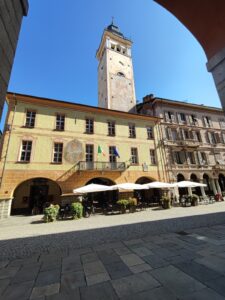
A stone’s throw away, the Museo del Tesoro del Duomo (Palazzo Arcivescovile) displays the chapter treasure: reliquaries, the Evangeliary of Saint Eusebius, and the famous Mappamondo di Vercelli from the 13th century (by reservation). For a break, the historic center of Vercelli with its arcades and the nearby Basilica of Sant’Andrea (Romanesque-Gothic) completes the day. An itinerary rich in art and history.
Nearby
A stone’s throw away, the Museo del Tesoro del Duomo (Palazzo Arcivescovile) displays the chapter treasure: reliquaries, the Evangeliary of Saint Eusebius, and the famous Mappamondo di Vercelli from the 13th century (by reservation). For a break, the historic center of Vercelli with its arcades and the nearby Basilica of Sant’Andrea (Romanesque-Gothic) completes the day. An itinerary rich in art and history.