
Villa d’Este is a Renaissance gem in Tivoli, 30 km from Rome, famous for its terraced gardens and impressive system of fountains. Visiting means immersing yourself in a masterpiece of architecture, nature, and hydraulic engineering, where every corner tells the power and taste of Cardinal Ippolito II d’Este. Here’s what not to miss:
– Over 50 fountains, including the Organ Fountain playing every two hours and Bernini’s Bicchierone Fountain.
– The Hundred Fountains Avenue, a 100-meter path with jets and Este symbols.
– The Fountain of Neptune, the most imposing, with waterfalls and a bust of the god.
– The frescoed interiors of the piano nobile, with works of Roman Mannerism.
Events nearby


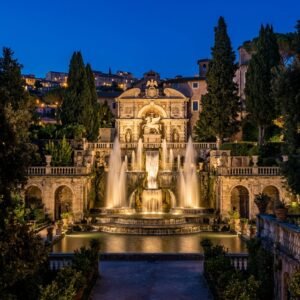

In Tivoli, Villa d’Este amazes with over 50 fountains, water features, and a hydraulic organ. A UNESCO World Heritage site, the Italian garden is a Renaissance masterpiece to visit in any season.
- http://www.villadestetivoli.info/index.htm
- info@villadestetivoli.info
- Via Boselli, Roma (RM)
- +39 0774 332920
- Open in Google Maps
- View on Google Images Villa d’Este a Roma
Good to know
A Dive into the Renaissance Amidst Water and Wonder
History and Splendor: From Cardinal Ippolito to Today
- 1550: Ippolito II d’Este appointed governor of Tivoli
- 1560-1572: construction overseen by Pirro Ligorio
- 1572: grand inauguration
- 19th century: restoration by von Hohenlohe and Liszt’s stay
- 1918: purchase by the Italian state
- 2001: declared a UNESCO World Heritage site
The Fountains: A Water Theatre
Hydraulic Genius: Art and Engineering
Why visit? Three good reasons
The Perfect Time to Visit
In the Surroundings: A Dive into Ancient History
Itineraries nearby


💡 Did You Know…?
A curious anecdote: during his stays at Villa d’Este, composer Franz Liszt was so fascinated by the water features that he wrote the piano piece ‘Les jeux d’eau à la Villa d’Este’. Moreover, the Owl Fountain, with its hydraulic mechanisms, made metal birds sing that were silenced by an owl – an effect that captivated the cardinal’s guests.