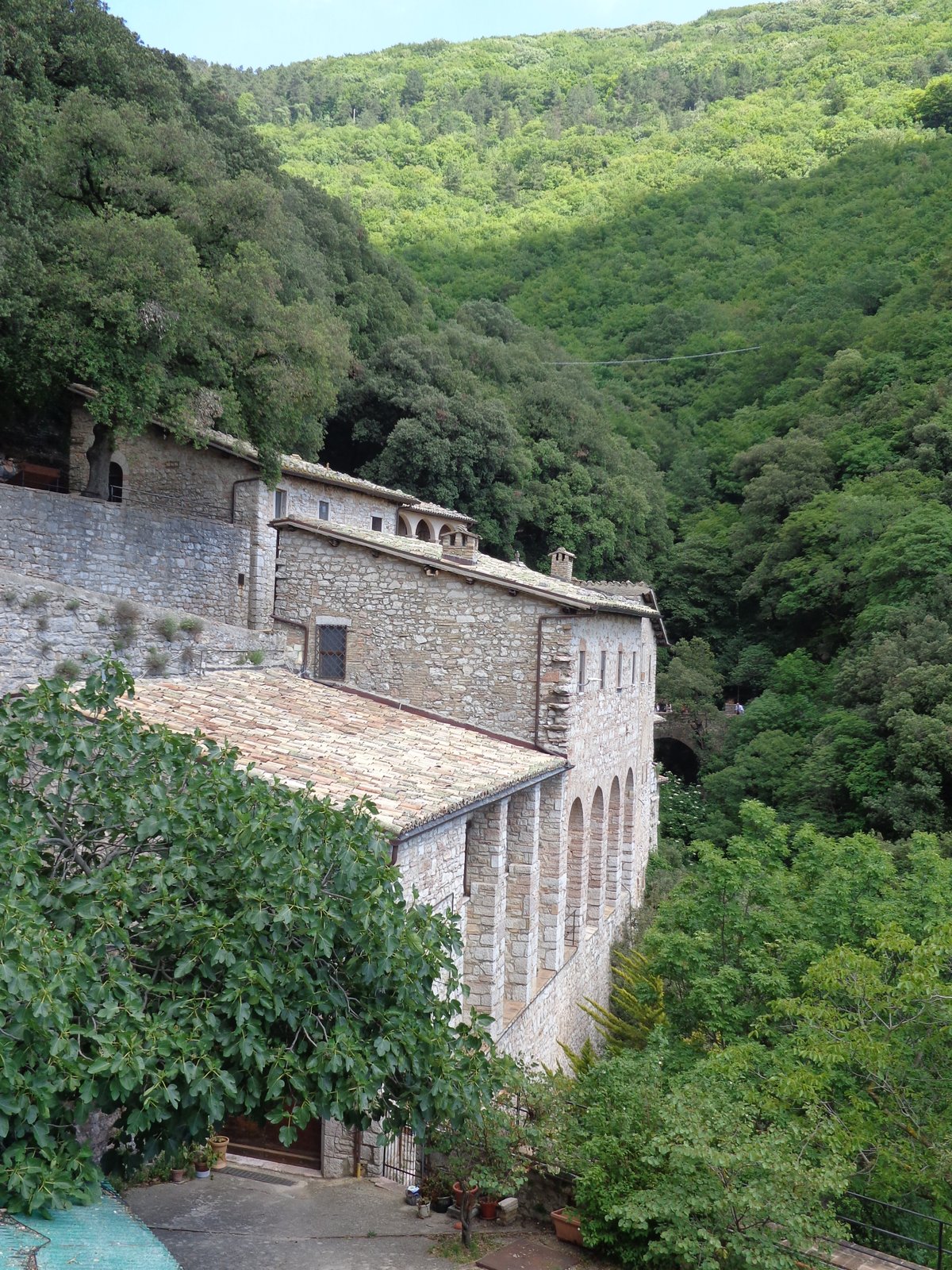
The Hermitage of the Carceri is a peaceful place 4 km from Assisi, reachable via a 30–40 minute walk through the woods of Mount Subasio. Here, St. Francis and his early followers retreated into natural caves, which can be visited today along with the chapel and the ‘small cloister’.
- Natural caves carved into the rock, including St. Francis’s cell
- Scenic trail through the holm oak forest with views of the Umbrian Valley
- Santa Maria delle Carceri chapel and the evocative small cloister
- Free entry and an atmosphere of silence and contemplation
Introduction
The Hermitage of the Prisons is not just a place of worship; it’s an experience that takes your breath away. As you approach from the center of Assisi, the path grows steeper, the city noise fades, and you find yourself immersed in an ancient holm oak forest. The silence here is almost palpable, broken only by the rustle of leaves and the chirping of birds. The hermitage suddenly appears, nestled into the rock of Mount Subasio, and you immediately understand why Saint Francis chose this spot for prayer and retreat. It’s not a monument to photograph and move on, but a sanctuary that invites you to pause, breathe, and let yourself be enveloped by peace. Personally, I was struck by how the atmosphere completely changes compared to the crowded basilica: here you truly feel the spirit of the saint, away from pomp and close to nature.
Historical Notes
This hermitage existed even before Francis, likely as a refuge for hermits, but it was he who transformed it into his preferred retreat starting in 1205-1206.
Here the saint would withdraw with his first companions to pray and meditate, living in natural caves and small cells. It was not an organized monastery, but a true spiritual ‘prison,’ a place of voluntary isolation. After Francis’s death, the site was expanded with a small church and a convent, but it always maintained its austere character. The history is still visible: in the cave of Saint Francis, where he slept, or in the holm oak under which, according to legend, he preached to the birds.
- 1205-1206: Francis begins frequenting the place
- 13th century: construction of the small church of Santa Maria delle Carceri
- 15th century: expansion with the convent of the Friars Minor
- Today: a place of pilgrimage and meditation open to all
The Sacred Wood and the Path
The true magic of the Hermitage of the Prisons lies in the journey to reach it. The path starting from Assisi is an experience in itself: about 4 km of uphill walking through the Subasio woods, with sudden glimpses of the Umbrian valley. It’s not overly strenuous, but requires comfortable shoes and a bit of patience. Along the way, you’ll come across small chapels, wooden crosses, and stone points where, it is said, Francis stopped to pray. The wood itself seems to partake in the sacredness of the place: gnarled trees, moss everywhere, and that silence that makes you feel light-years away from modern frenzy. I encountered a group of pilgrims walking in silence, and even without speaking, an atmosphere of sharing was created. I recommend taking it easy, stopping on the boulders to look at the panorama, and perhaps bringing a water bottle.
The Caves and the Miraculous Water
Inside the hermitage, beyond the simple and evocative chapel, are the caves that served as the first cells for the monks. Saint Francis’s cave is the most moving: a cramped, dark space with only a stone as a bed. Entering it prompts reflection on the saint’s choice of radical poverty. Not far away, there’s a water spring flowing from the rock, considered miraculous. Legend has it that Francis made it gush forth by striking the stone, and even today many pilgrims take a sip or carry it away in small bottles. I tasted it: it’s very fresh, with a slightly mineral flavor. I don’t know if it has healing properties, but in that context, it truly seems special. However, note that the caves are small and sometimes crowded; it’s best to visit during off-peak hours to enjoy their solitude.
Why Visit
First, to experience authentic peace, away from the mass tourism of Assisi. Here, there are no souvenir shops or queues, only nature and spirituality. Second, to hike through Umbrian nature that combines physical activity and inner reflection: the trail is accessible to those accustomed to walking and offers breathtaking views. Third, to truly understand who Francis was: not the saint of gilded basilicas, but the man who sought God in extreme simplicity, among rocks and trees. Visiting the hermitage completes the vision of Assisi, revealing its most intimate and wild side. I have returned twice, and each time I discovered a new detail, like the carvings on the cave walls left by pilgrims over the centuries.
When to Go
Avoid the midday hours on summer days: the trail can become very hot and crowded. The best time is early morning, when light filters through the trees and the air is fresh, or in the late afternoon, as the sun sets and casts a golden hue on the hermitage stones. In spring and autumn, it’s perfect: the forest is lush or colorful, and the temperature is ideal for walking. In winter, if there’s no ice, it can be atmospheric with fog enveloping the mountain, but check the weather conditions as the trail may be slippery. I visited in October, with leaves falling and an almost surreal silence, and it felt like the most magical moment. If possible, choose a weekday to avoid organized groups.
In the Surroundings
If the hermitage has captivated you, don’t miss the Franciscan Path of Peace, a longer trail connecting Assisi to Gubbio, passing through other sites linked to the saint, such as the Sanctuary of San Damiano. It’s a total immersion into the Umbrian landscape and Franciscan spirituality. For a different yet complementary experience, visit the Forest of Saint Francis, a natural area just below Assisi with easy trails, a beautiful Tibetan bridge, and a visitor center explaining the local ecology. It’s perfect for families or for a relaxing walk after the climb to the hermitage. Both places are easily accessible from Assisi and enrich the understanding of how Francis lived in symbiosis with nature.