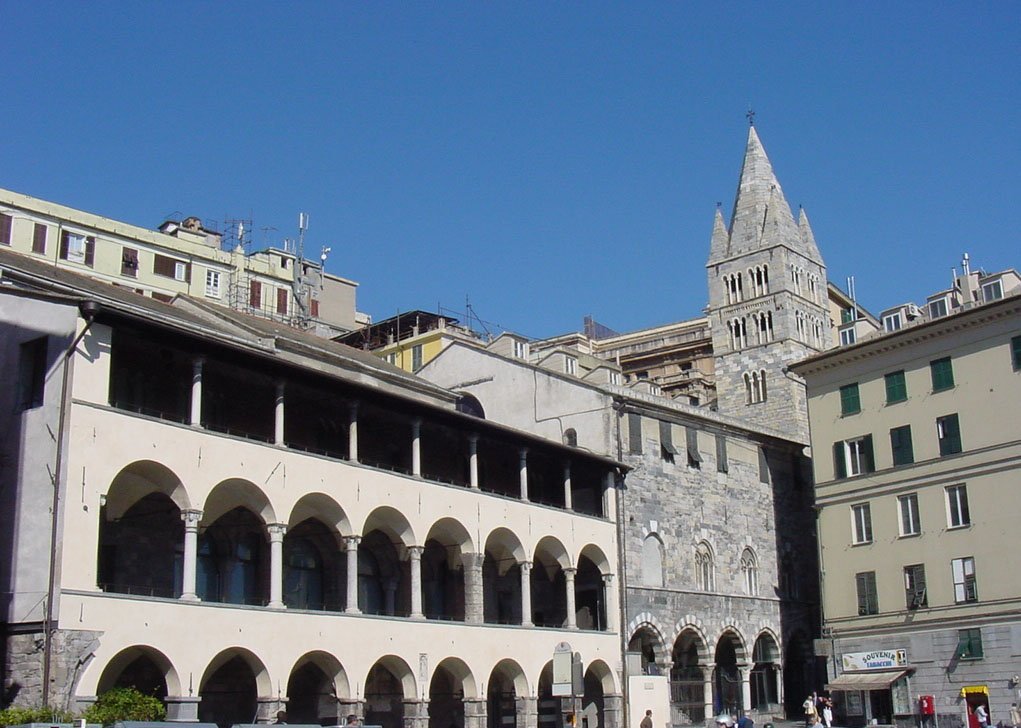
Founded in 1180, the Commenda di San Giovanni di Prè is an ancient pilgrims’ hospital managed by the Knights of Malta, perfectly preserved in Genoa’s historic center. Its Genoese-Romanesque architecture in Promontorio black stone and its location just steps from the ancient harbor make it an authentic and easily accessible historical experience.
- 1180 medieval hospital for pilgrims heading to the Holy Land
- Two-level overlapping church: lower level for the sick, upper level for services
- Evocative Romanesque crypt with sturdy columns and intimate atmosphere
- Architecture in Promontorio black stone typical of medieval Genoa
A Medieval Corner in the Harbor
You might be strolling through the ancient port of Genoa, among restaurants and nightlife, when suddenly you come across this dark stone building that seems to have emerged from another era. The Commenda di San Giovanni di Prè is exactly that: an intact piece of medieval history set in the heart of the modern city. It’s not just a church or a museum, but an ancient hospital of the Knights of Malta that has preserved its authentic atmosphere. Upon entering, you breathe a different air, more silent, almost sacred. The walls tell stories of pilgrims, crusaders, and sailors who found refuge here. For me, it’s one of those places that makes you feel truly in Genoa, not just visiting.
Living History Among the Knights
The Commenda was founded in
1180 as a hospital for pilgrims traveling to the Holy Land, managed by the Knights Hospitaller (later the Knights of Malta). It was not just a place of healing: it served as a crucial hub for those departing or returning from the Crusades by sea. Over time, it has withstood urban transformations that reshaped the Prè district. Today, following restorations, it preserves original structures such as the
Romanesque crypt and spaces from the ancient hospital. It is a rare example of medieval architecture dedicated to assistance, still discernible in its essential forms. Timeline summary:
- 1180: Foundation as a hospital of the Knights Hospitaller
- Middle Ages: A welcoming point for pilgrims and crusaders
- Subsequent centuries: Various transformations, but structure preserved
- Modern restorations: Reopened as a visitable historical site
The Crypt That Speaks of Pilgrims
Descending into the Romanesque crypt is the most evocative experience. It’s a low, almost intimate space with stout columns and little light filtering through the small windows. According to sources, pilgrims rested here while waiting to embark. You can sense an atmosphere of anticipation, of imminent journeys. The stone walls have a particular dampness, typical of Genoa’s semi-underground spaces, which adds authenticity. There are no lavish decorations, but it’s precisely this simplicity that strikes you: it makes you imagine the stories of those who passed through here centuries ago, with their belongings and hopes. For me, it’s more moving than many Baroque churches because you feel the weight of time.
Architecture That Stands the Test of Time
Looking at the exterior, you immediately notice the Promontory stone, dark and sturdy, typical of medieval Genoese constructions. The facade is simple, almost severe, with narrow windows that recall the building’s defensive function. Inside, the spaces are organized functionally: the main nave, side areas for welcoming visitors, service rooms. There are no frescoes or stuccoes, but this bareness is its strength. You understand how it was designed to withstand, to endure. In an era where everything seems ephemeral, finding a place so consistent with its origins is rare. Perhaps it’s not as photogenic as other monuments, but it has a genuine character.
Why It’s Worth Visiting
First: it’s an authentic journey into the Middle Ages, without reconstructions or special effects. You breathe history in the walls. Second: its location in the ancient port makes it easy to combine with a day exploring the city, without complicated detours. Third: it’s a smart alternative to crowded museums; there are often few people here, so you can enjoy it at your own pace. Plus, it’s free or very low-cost, ideal for those traveling on a tight budget. For me, it’s perfect for those looking for something different from the usual attractions, something that leaves a deeper memory.
The Right Time for Magic
I visited on an autumn morning, with that low light streaming through the crypt and creating shadow plays on the stones. It was perfect: silence, few visitors, an intimate atmosphere. In summer, the port can be hot and chaotic, so it might be best to avoid peak hours. Instead, on winter afternoons, when the sun sets early, the interior lighting makes everything more evocative. There’s no wrong season, but in my opinion, the moments of tranquility are when the Commenda shows its best. Avoid crowded weekends if you want to savor its medieval essence without distractions.
What to Pair in the Surroundings
Step outside and take a short walk to the Galata Sea Museum, just a few minutes away. It offers an interesting contrast: from medieval Genoa to the era of great navigations. Alternatively, explore the Prè neighborhood, with its narrow alleys and typical spots to enjoy focaccia or pesto. If you’re interested in religious themes, nearby you’ll find the Church of San Donato, another lesser-known medieval gem. You don’t need to go far: the old port already has everything for a full day. Personally, after visiting the Commenda, I always stop for a coffee at one of the historic bistros in the area to soak in the atmosphere.