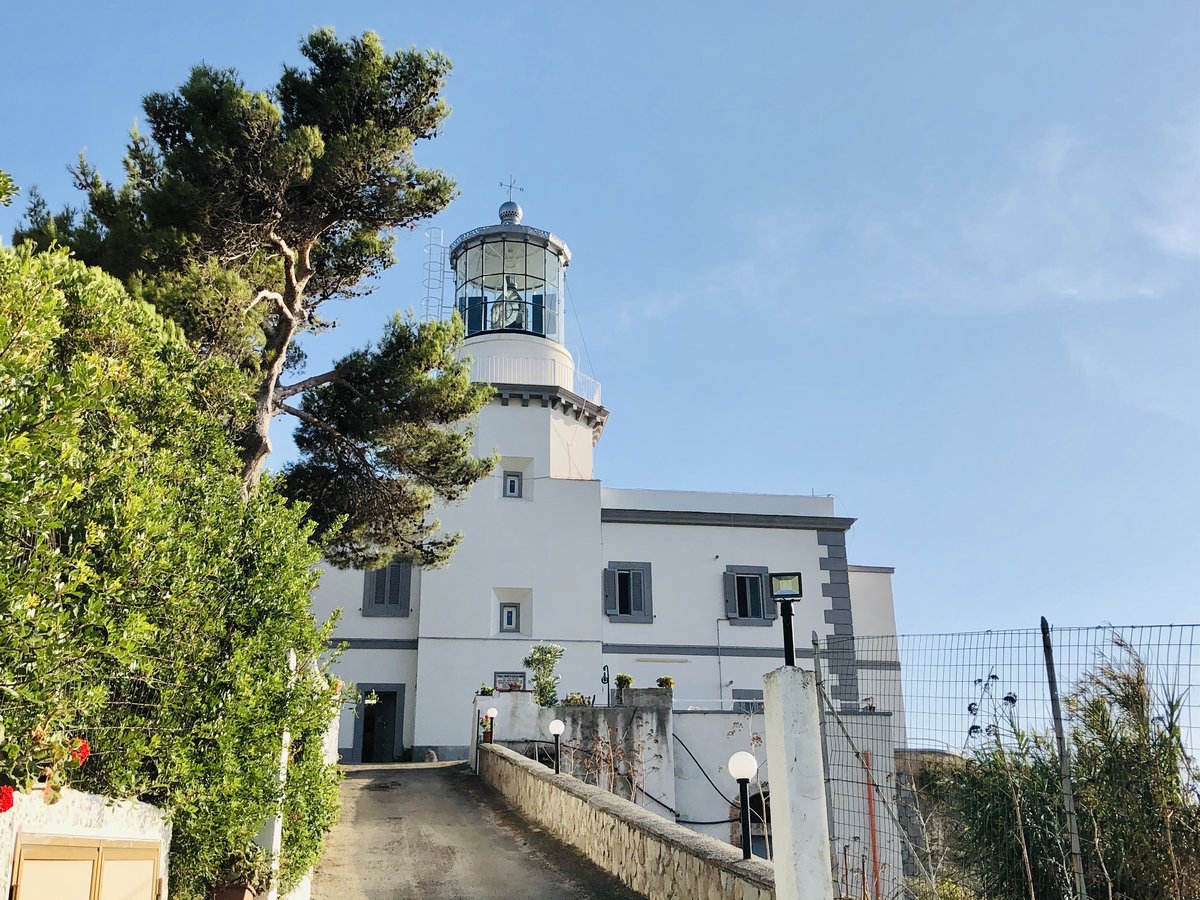
Cape Palinuro Lighthouse is one of Italy’s tallest lighthouses, with a height of 70 meters. Located on Punta del Telegrafo in Palinuro, within the Cilento National Park, it was first lit in 1870. From its summit, the view stretches all the way to Sicily. The interior is a military zone, but the surrounding area is accessible and offers stunning panoramas, perfect for watching the sunset. Nearby trails include the Sentiero dei Fortini e delle Torri.
– Italy’s second tallest lighthouse at 70 meters
– Light visible up to 25 nautical miles and as far as Sicily
– Built in 1870 on the foundations of the Torre di Spartivento
– Interior not open, but panoramic area accessible
Introduction
Perched on Punta del Telegrafo, the Capo Palinuro Lighthouse is a 70-meter giant dominating the Cilento coast. Italy’s second tallest lighthouse, its light reaches Sicily, giving a sense of infinity. Getting up there means driving along a scenic road that offers breathtaking views of the Tyrrhenian Sea. When you finally see it, you feel small in the face of such grandeur. The atmosphere is quiet, suspended between sky and sea. A place you won’t forget.
Introduction
Perched on Punta del Telegrafo, the Capo Palinuro Lighthouse is a 70-meter giant dominating the Cilento coast. Italy’s second tallest lighthouse, its light reaches Sicily, giving a sense of infinity. Getting up there means driving along a scenic road that offers breathtaking views of the Tyrrhenian Sea. When you finally see it, you feel small in the face of such grandeur. The atmosphere is quiet, suspended between sky and sea. A place you won’t forget.
Historical Notes
The lighthouse was officially lit on March 19, 1870, built on the foundations of the ancient Torre di Spartivento. Initially oil-powered, then coal, and today electric. For 155 years it remained off-limits, but in 2025 it opened to the public for the first time, thanks to collaboration between the Municipality of Centola and the Navy. It has been repeatedly nominated for the FAI ‘Places of the Heart’ census. Here are the key moments:
Historical Notes
The lighthouse was officially lit on March 19, 1870, built on the foundations of the ancient Torre di Spartivento. Initially oil-powered, then coal, and today electric. For 155 years it remained off-limits, but in 2025 it opened to the public for the first time, thanks to collaboration between the Municipality of Centola and the Navy. It has been repeatedly nominated for the FAI ‘Places of the Heart’ census. Here are the key moments:
Historical Timeline
- 1870 – Lighthouse lit on Torre Spartivento foundations
- 1873 – Ministry document confirms its operation
- 2025 – First public opening after 155 years
- 2025 – Agreement with Federico II University for scientific enhancement
Historical Timeline
- 1870 – Lighthouse lit on Torre Spartivento foundations
- 1873 – Ministry document confirms its operation
- 2025 – First public opening after 155 years
- 2025 – Agreement with Federico II University for scientific enhancement
Architecture and Technology
The white tower stands 14 meters tall, resting on a two-story building. Inside, a rotating optic emits a white light visible for 25 miles. It is among the tallest lighthouses in Italy, second in luminous range. Today it is powered by electricity with backup batteries; once it burned coal. Access is prohibited (military zone), but from the outside you can admire the elegant structure emerging from the Mediterranean scrub.
Architecture and Technology
The white tower stands 14 meters tall, resting on a two-story building. Inside, a rotating optic emits a white light visible for 25 miles. It is among the tallest lighthouses in Italy, second in luminous range. Today it is powered by electricity with backup batteries; once it burned coal. Access is prohibited (military zone), but from the outside you can admire the elegant structure emerging from the Mediterranean scrub.
A Dive into Nature
Around the lighthouse, the Mediterranean scrub smells of helichrysum and mastic. Here grows the rare Primula Palinuri, endemic to Cilento. The Path of Forts and Towers runs right here, offering walks with sea views. From the top, the view stretches to Capri and Ischia on clear days. The sunsets are spectacular: the sun sinks into the Tyrrhenian Sea, painting everything orange. A paradise for nature lovers.
A Dive into Nature
Around the lighthouse, the Mediterranean scrub smells of helichrysum and mastic. Here grows the rare Primula Palinuri, endemic to Cilento. The Path of Forts and Towers runs right here, offering walks with sea views. From the top, the view stretches to Capri and Ischia on clear days. The sunsets are spectacular: the sun sinks into the Tyrrhenian Sea, painting everything orange. A paradise for nature lovers.
Why Visit
1. Unique Panorama: From the natural terrace you can see the Cilento coast, the sea, and with the right light, even Sicily. 2. Unforgettable Sunset: It’s the perfect place to watch the sun disappear over the horizon, with colors changing minute by minute. 3. Active Excursion: The well-marked trails allow you to combine the visit with a nice walk immersed in nature.
Why Visit
1. Unique Panorama: From the natural terrace you can see the Cilento coast, the sea, and with the right light, even Sicily. 2. Unforgettable Sunset: It’s the perfect place to watch the sun disappear over the horizon, with colors changing minute by minute. 3. Active Excursion: The well-marked trails allow you to combine the visit with a nice walk immersed in nature.
When to Go
The best time is at sunset, when the sun sets the sky ablaze and the lighthouse beam begins to shine. In spring and autumn, the days are clearer and less crowded. In summer, the heat is felt, but the air is clear. Avoid the midday hours: better to arrive in the late afternoon, enjoy the walk, and stay until evening. Bring binoculars: the view stretches far away.
When to Go
The best time is at sunset, when the sun sets the sky ablaze and the lighthouse beam begins to shine. In spring and autumn, the days are clearer and less crowded. In summer, the heat is felt, but the air is clear. Avoid the midday hours: better to arrive in the late afternoon, enjoy the walk, and stay until evening. Bring binoculars: the view stretches far away.
Nearby
Just a few steps away, the ruins of Punta del Fortino (Napoleonic era) and the Torre della Quaglia, below which opens the Grotta Azzurra, accessible only by sea. It’s worth organizing a boat trip to see the lighthouse from below and discover hidden coves. All within the Cilento National Park, a biodiversity treasure.
Nearby
Just a few steps away, the ruins of Punta del Fortino (Napoleonic era) and the Torre della Quaglia, below which opens the Grotta Azzurra, accessible only by sea. It’s worth organizing a boat trip to see the lighthouse from below and discover hidden coves. All within the Cilento National Park, a biodiversity treasure.